Rosaceae
Rosa agrestis (Small-leaved Sweet-briar)
Rosa agrestis
A tough, low-maintenance wild rose best suited to open, sunny garden spots, hedgerows, or wildlife borders. Once established it tolerates a wide range of soils and needs little more than occasional watering, an annual prune to remove dead or crossing wood, and space to arch and spread naturally.
Every 10 days
Direct sun
-20° - 35°C
% - %
Categories
What is Small-leaved Sweet-briar?
Small-leaved Sweet-briar (Rosa agrestis) is a easy-care plant from the Rosaceae family. Rosa agrestis, the small-leaved sweet-briar or field rose, is a deciduous wild shrub native to southern and central Europe, extending sporadically to the Caucasus. It forms an upright, bushy growth of arching stems armed with curved prickles, reaching 1.5-3 meters tall. Its pinnate leaves, made up o...
Small-leaved Sweet-briar grows up to 3.0m, spread of 250cm, watering every 10 days, -20°C – 35°C. It is not suitable for indoor environments and safe for pets.
Unlike many tropical plants, Small-leaved Sweet-briar tolerates watering mistakes. Best for beginners. Unlike many popular species, Small-leaved Sweet-briar is safe to keep around pets.
How to Care for Small-leaved Sweet-briar?
TLDR: Small-leaved Sweet-briar needs Direct sun, watering every 10 days, and temperatures between -20-35°C with 40-70% humidity.
How Often Should You Water Small-leaved Sweet-briar?
Water regularly during the first growing season to help the shrub establish; afterwards it is fairly drought-tolerant and only needs supplemental watering during prolonged dry spells.
How Much Light Does Small-leaved Sweet-briar Need?
Plant in full sun for the best flowering and hip production; it tolerates light shade but flowers more sparsely.
What Is the Best Soil for Small-leaved Sweet-briar?
Thrives in moist but well-drained loamy soil and tolerates chalk, clay, and sandy ground; avoid waterlogged sites.
What Pot Should You Use for Small-leaved Sweet-briar?
Best grown directly in the ground rather than in containers; if pot culture is necessary, use a large, deep, well-draining pot of at least 60cm diameter and repot every few years as the shrub outgrows it.
What Is Small-leaved Sweet-briar and Where Does It Come From?
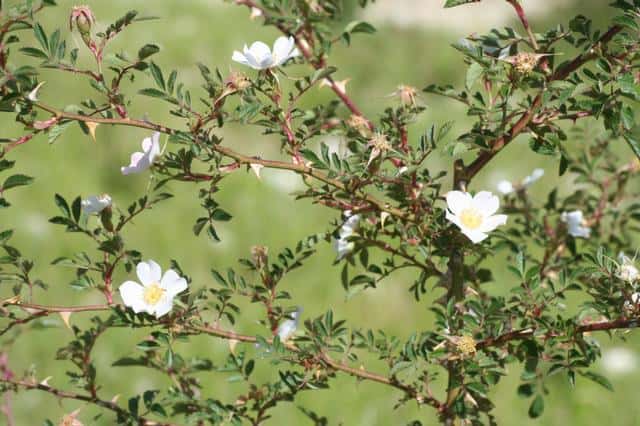
Rosa agrestis, the small-leaved sweet-briar or field rose, is a deciduous wild shrub native to southern and central Europe, extending sporadically to the Caucasus. It forms an upright, bushy growth of arching stems armed with curved prickles, reaching 1.5-3 meters tall. Its pinnate leaves, made up of 5-7 small, coarsely serrated leaflets, are noticeably smaller than those of its close relative Rosa rubiginosa (sweet briar) and carry very little of the apple-like scent typical of that species. In mid-summer it bears clusters of subtly fragrant, single white to blush-pink flowers up to 4cm across, followed in autumn by small oval red hips that persist on the plant and add ornamental interest into winter.
How to Propagate Small-leaved Sweet-briar?
Propagation from seed
Wild rose seed is notoriously slow and erratic to germinate; patience over one to two seasons is often needed.
- 1 Collect ripe hips in autumn and extract the seeds
- 2 Cold-stratify seeds in moist sand or peat in the fridge for 8-12 weeks
- 3 Sow stratified seeds in trays of well-draining compost in late winter
- 4 Keep moist in a cold frame until germination, which can take months
Materials needed:
Softwood/hardwood stem cuttings
Hardwood cuttings taken in autumn and left outdoors over winter often root reliably by spring.
- 1 Take softwood cuttings in spring or hardwood cuttings in late summer to autumn
- 2 Cut a 15-20cm section just below a leaf node and remove lower leaves
- 3 Dip the cut end in rooting hormone
- 4 Insert into a pot of moist, well-draining compost and keep in a sheltered, humid spot until rooted
Materials needed:
How Big Does Small-leaved Sweet-briar Grow?
TLDR: Small-leaved Sweet-briar can reach up to 3.0m tall with Medium growth rate.
Max height
3.0m
Spread
2.5m
Growth rate
Medium
Foliage
Deciduous
Plant Uses
Ornamental
Great for decoration
Is your plant showing symptoms?
Click on the symptom to discover possible causes:
What Diseases Commonly Affect Small-leaved Sweet-briar?
TLDR: Small-leaved Sweet-briar is susceptible to 4 known diseases. Monitor regularly for early detection.
Black Spot
Black spot is the most serious fungal disease affecting roses, caused by the fungus Diplocarpon rosae. It is characterized by dark circular spots on leaves that progress to yellowing and premature leaf drop. The disease thrives in humid and cool conditions, especially early in the growing season.
Powdery Mildew
Powdery mildew is a common fungal disease caused by various fungi species including Erysiphe, Podosphaera, Oïdium, and Leveillula. It affects over 10,000 plant species worldwide. The disease thrives in warm, dry climates with high humidity and appears as a distinctive white powdery coating on plant surfaces.
Rust
Rust is a common fungal disease caused by fungi in the order Pucciniales that affects a wide variety of plants. The disease gets its name from the characteristic orange, yellow, or reddish-brown pustules that appear on leaves, resembling metal rust. This obligate fungal parasite requires living plants to survive and can cause significant economic losses in agricultural crops.
Aphids
Aphids are small, soft-bodied, pear-shaped insects (1/16 to 1/8 inch long) that feed by sucking nutrient-rich sap from plants. They reproduce rapidly and can quickly weaken plants, causing distorted growth and transmitting plant viruses. Aphids come in various colors including green, black, red, yellow, brown, and gray. They secrete honeydew, a sticky substance that attracts ants and encourages sooty mold growth.
Meaning & Symbolism
A symbol of wild, untamed beauty and resilience - the humble countryside cousin of the cultivated garden rose.
Fun Facts
Its hips can remain decorative on the bare stems well into winter, providing food for birds.
Unlike its relative the sweet briar, its leaves release almost no scent when crushed.
Frequently asked questions
Is Rosa agrestis the same as sweet briar (Rosa rubiginosa)?
Does Rosa agrestis need regular fertilizing?
Is Rosa agrestis toxic to pets?
Compare with similar plants
| Attribute | Difficulty | Light | Watering | Pet Safe |
|---|---|---|---|---|
| Field Maple | Easy | Bright indirect | 14d | ✓ |
| Silver Birch | Easy | Direct sun | 14d | ✓ |
| Common Blanketflower | Easy | Direct sun | 10d | ✓ |
| Cushion Bush | Easy | Direct sun | 14d | ✓ |





