Asteraceae
Spanish Needles (Bidens alba): plant guide
Bidens alba
It needs almost nothing: sun, drained soil and little water once established. The real challenge is keeping it in check, since each plant makes thousands of seeds and can take over a garden, so cut flowers before the seeds ripen.
Every 7 days
Direct sun
° - °C
% - %
Categories
What is Spanish Needles?
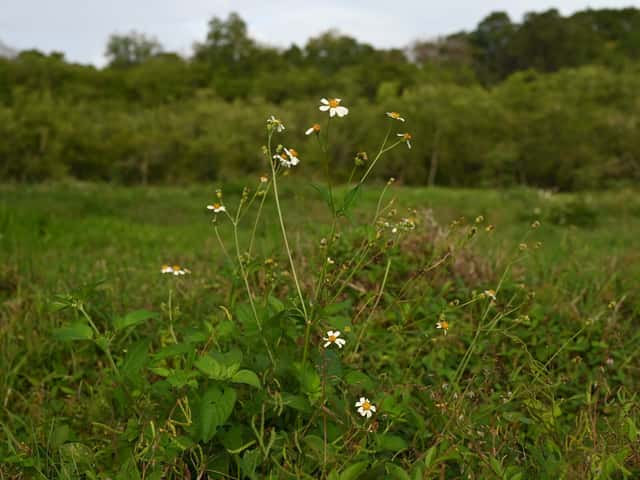
Spanish Needles (Bidens alba) is a easy-care plant from the Asteraceae family. Bidens alba is an annual or short-lived perennial herb in the sunflower family that grows up to 1.2 m tall. Its flower heads have white petals around a yellow center, draw bees and butterflies, and give way to barbed seeds that cling to clothes and fur. Native to the American tropics, it now turns u...
Spanish Needles grows up to 1.2m, watering every 7 days. It is not suitable for indoor environments and safe for pets.
Unlike many tropical plants, Spanish Needles tolerates watering mistakes. Best for beginners. Unlike many popular species, Spanish Needles is safe to keep around pets.
How to Care for Spanish Needles?
TLDR: Spanish Needles needs Direct sun, watering every 7 days, and temperatures between 15-30°C with 40-70% humidity.
How Often Should You Water Spanish Needles?
Water young plants about once a week. Once established it is drought-tolerant and only needs water in long dry spells.
How Much Light Does Spanish Needles Need?
Full sun. It also tolerates part shade.
What Is the Best Soil for Spanish Needles?
Grows in sandy, loamy or poor soil as long as it drains. It needs no fertilizer.
What Pot Should You Use for Spanish Needles?
A deep pot with drainage, since the taproot is long. Cut the flowers before they set seed.
What Is Spanish Needles and Where Does It Come From?
Bidens alba is an annual or short-lived perennial herb in the sunflower family that grows up to 1.2 m tall. Its flower heads have white petals around a yellow center, draw bees and butterflies, and give way to barbed seeds that cling to clothes and fur. Native to the American tropics, it now turns up along roadsides, in fields and on waste ground across warm regions of the world. It is very close to Bidens pilosa and the two can interbreed.
How to Propagate Spanish Needles?
Seed
After the first year it usually reseeds on its own, often too well.
- 1 Scatter seeds on the soil
- 2 Cover very lightly, as light helps
- 3 Keep moist until seedlings appear
- 4 Transplant young seedlings if needed
Materials needed:
How Big Does Spanish Needles Grow?
TLDR: Spanish Needles can reach up to 1.2m tall with Fast growth rate.
Max height
1.2m
Growth rate
Fast
Foliage
Evergreen
Plant Uses
Edible
Can be consumed
Medicinal
Medicinal properties
Medicinal Uses
- Folk use in traditional Cuban medicine for inflammation and as a wound healer
Culinary Uses
- Young leaves and flowers in salads, a few at a time
- Shoots and young leaves as a cooked green
- Tea from dried leaves
Is your plant showing symptoms?
Click on the symptom to discover possible causes:
What Diseases Commonly Affect Spanish Needles?
TLDR: Spanish Needles is susceptible to 3 known diseases. Monitor regularly for early detection.
Aphids
Aphids are small, soft-bodied, pear-shaped insects (1/16 to 1/8 inch long) that feed by sucking nutrient-rich sap from plants. They reproduce rapidly and can quickly weaken plants, causing distorted growth and transmitting plant viruses. Aphids come in various colors including green, black, red, yellow, brown, and gray. They secrete honeydew, a sticky substance that attracts ants and encourages sooty mold growth.
Leafminers
Leafminers are the larvae of various insects including flies, moths, sawflies, and beetles that tunnel between leaf surfaces, creating distinctive serpentine trails or blotchy patches. While primarily cosmetic, severe infestations can weaken plants by reducing photosynthesis capacity and making them susceptible to secondary infections.
Root-Knot Nematodes
Root-knot nematodes (Meloidogyne species) are microscopic roundworms that parasitize plant roots, causing characteristic galls or knots. These soil-borne pests are among the most economically damaging plant pathogens worldwide, affecting a wide range of ornamental and edible plants. The nematodes inject enzymes into root cells, causing abnormal swelling and disrupting water and nutrient uptake.
Fun Facts
Bidens means two-toothed, after the hooks on the seed, and alba refers to the white petals
A single plant can produce 3,000 to 6,000 seeds
In Florida it is a leading nectar source for honeybees and flowers year-round
Frequently asked questions
What is the difference between Bidens alba and Bidens pilosa?
Is Bidens alba edible?
How do I stop it taking over?
Compare with similar plants
| Attribute | Difficulty | Light | Watering | Pet Safe |
|---|---|---|---|---|
| Field Maple | Easy | Bright indirect | 14d | ✓ |
| Iberian Houseleek | Easy | Direct sun | 14d | ✓ |
| Silver Birch | Easy | Direct sun | 14d | ✓ |
| Common Blanketflower | Easy | Direct sun | 10d | ✓ |





