Orchidaceae
Spider Orchid: Pet-Safe Plant
Brassia
Brassia thrives best in bright indirect light, neither too intense nor in deep shade. Water when the substrate is nearly dry, avoiding waterlogging, and maintain relative humidity between 50% and 70%. It prefers warmer days and slightly cooler nights, with good air circulation to prevent fungal growth.
Every 7 days
Partial shade
14° - 27°C
50% - 70%
Categories
What is Spider Orchid?
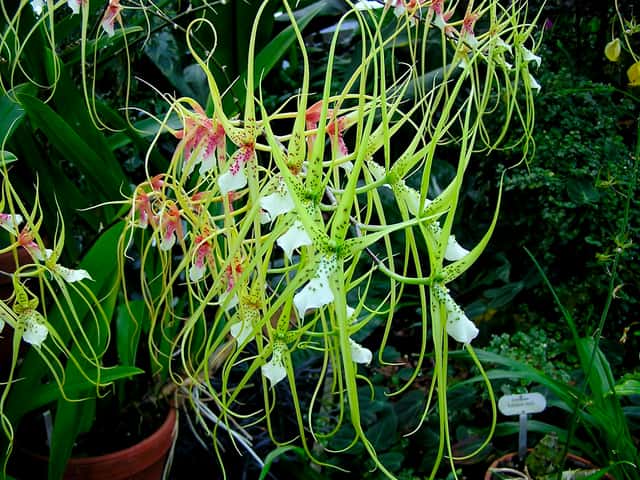
Spider Orchid (Brassia) is a medium-care plant from the Orchidaceae family. Brassia is a genus of epiphytic orchids native to the tropical and subtropical forests of Central and South America, popularly known as spider orchids due to their long, thin petals and sepals that resemble spider legs. Their flower spikes can display up to 20 blooms in shades of yellow, cream, gree...
Spider Orchid grows up to 60cm, spread of 50cm, watering every 7 days, 14°C – 27°C, 50–70% humidity. It is suitable for indoor environments and safe for pets.
Unlike many popular species, Spider Orchid is safe to keep around pets. Without adequate drainage, root rot can develop within 14 days.
How to Care for Spider Orchid?
TLDR: Spider Orchid needs Partial shade, watering every 7 days, and temperatures between 14-27°C with 50-70% humidity.
How Often Should You Water Spider Orchid?
Allow the substrate to dry almost completely between waterings—water in the morning and increase frequency during the formation of new shoots and flowering. Avoid letting the plant sit in standing water, as the roots rot easily.
How Much Light Does Spider Orchid Need?
Provide bright indirect light, such as near a window with a sheer curtain. Direct midday sun can burn the leaves, while environments that are too dark will hinder flowering.
What Is the Best Soil for Spider Orchid?
Use a well-draining substrate specifically for orchids, based on orchid bark, with perlite or sphagnum moss to retain some moisture without soaking the roots.
What Pot Should You Use for Spider Orchid?
Prefer clear plastic pots or specific orchid pots with multiple drainage holes, allowing you to observe the roots and avoid water accumulation.
Care Schedule
Fertilize
Every 14 days
Repot
Every 730 days
What Is Spider Orchid and Where Does It Come From?
Brassia is a genus of epiphytic orchids native to the tropical and subtropical forests of Central and South America, popularly known as spider orchids due to their long, thin petals and sepals that resemble spider legs. Their flower spikes can display up to 20 blooms in shades of yellow, cream, greenish, or reddish-brown, usually speckled with dark spots. It is a genus appreciated by both collectors and commercial hybridizers, valued for its exuberant flowering and exotic floral shape.
How to Propagate Spider Orchid?
Pseudobulb division
Each division needs enough pseudobulbs to sustain growth; very small divisions root with more difficulty and take longer to bloom again.
- 1 Wait until repotting time, preferably in spring, after the flowering period has ended
- 2 Carefully remove the plant from the pot, clearing the old substrate from the roots
- 3 Identify groups of at least 3 to 4 healthy pseudobulbs with roots
- 4 Cut with a sterilized tool, separating the divisions
- 5 Apply cinnamon powder to the cuts to prevent fungal infections
- 6 Plant each division in its own pot with orchid substrate
- 7 Keep in a location with indirect light and water moderately until rooted
Materials needed:
How Big Does Spider Orchid Grow?
TLDR: Spider Orchid can reach up to 60cm tall with Slow growth rate.
Max height
60cm
Spread
50cm
Growth rate
Slow
Foliage
Evergreen
Plant Uses
Ornamental
Great for decoration
Is your plant showing symptoms?
Click on the symptom to discover possible causes:
What Diseases Commonly Affect Spider Orchid?
TLDR: Spider Orchid is susceptible to 8 known diseases. Monitor regularly for early detection.
Root Rot
Root rot is a serious fungal disease that affects the root system of plants, causing them to decay and die. It is primarily caused by overwatering, poor drainage, or soil-borne fungi such as Pythium, Phytophthora, Rhizoctonia, and Fusarium. The disease thrives in waterlogged conditions where roots are deprived of oxygen, making them susceptible to fungal infection.
Crown Rot
Crown rot is a serious fungal disease that attacks the crown (base) of the plant where the stem meets the soil. It is caused by various fungal pathogens including Phytophthora, Fusarium, and Rhizoctonia. The disease thrives in waterlogged conditions and can quickly spread to kill the entire plant if not addressed promptly.
Grey Mould
Anthracnose
Anthracnose is a fungal disease caused by fungi in the genus Colletotrichum that affects many plants, including vegetables, fruits, and trees. The disease thrives in cool, wet conditions, causing dark, sunken lesions on leaves, stems, flowers, and fruits.
Meaning & Symbolism
The spider orchid symbolizes exoticism, sophistication, and the unusual beauty found in nature, being associated with originality and refinement.
Compare with similar plants
| Attribute | Difficulty | Light | Watering | Pet Safe |
|---|---|---|---|---|
| Dark Fieldcap | Medium | Low light | 2d | ⚠️ |
| Azalea | Medium | Partial shade | 3d | ⚠️ |
| Muriel's Bamboo | Medium | Partial shade | 3d | ✓ |
| Bougainvillea | Medium | Direct sun | 7d | ⚠️ |




