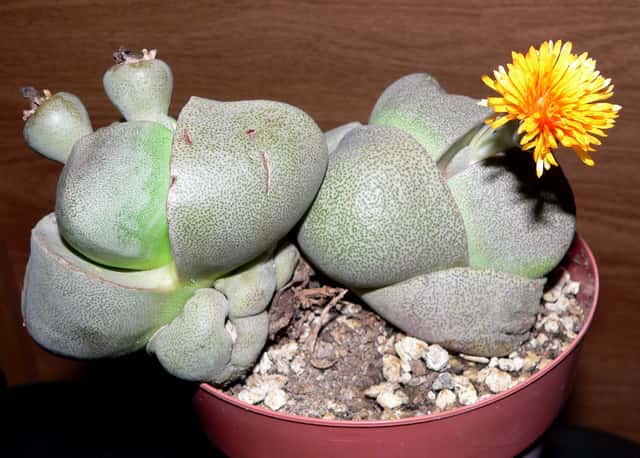
Aizoaceae
Split rock: Low Water Needs
Pleiospilos nelii
Pleiospilos nelii requires a bright location, very well-draining mineral substrate, and sparse watering—it is a succulent that is easier to overwater than to underwater. The key to success is mimicking its natural cycle: moderate growth and watering in spring and autumn, almost total drought in summer, and limited watering in winter when the plant blooms.
Every 21 days
Bright indirect
10° - 35°C
20% - 40%
Categories
What is Split rock?
Split rock (Pleiospilos nelii) is a medium-care plant from the Aizoaceae family. Pleiospilos nelii is a small, stemless succulent from the Aizoaceae family, native to the semi-arid Karoo regions on the border of the Western and Eastern Cape Provinces in South Africa. The plant produces only one or two pairs of thick, nearly spherical leaves in gray-green to reddish hues, covered...
Split rock grows up to 8cm, spread of 10cm, watering every 21 days, 10°C – 35°C, 20–40% humidity. It is suitable for indoor environments and safe for pets.
Unlike many popular species, Split rock is safe to keep around pets. Without adequate drainage, root rot can develop within 42 days.
How to Care for Split rock?
TLDR: Split rock needs Bright indirect, watering every 21 days, and temperatures between 10-35°C with 20-40% humidity.
How Often Should You Water Split rock?
Water only when the substrate has completely dried out and the leaves wrinkle slightly—then water thoroughly until water flows freely from the drainage holes. In summer, during the dormancy period, reduce watering almost to zero, and in winter, provide water rarely but regularly so the plant can bloom.
How Much Light Does Split rock Need?
Place the plant in the brightest spot in the house, preferably on a south or west-facing windowsill. It tolerates a few hours of morning sun, but harsh, midday rays in midsummer can burn the leaves—in such cases, it is worth lightly shading the position.
What Is the Best Soil for Split rock?
Plant in a heavily mineral, fast-drying substrate—ideally a ready-made cactus and succulent mix enriched with perlite, pumice, or grit, so that at least half of the volume consists of mineral fractions. Always use a pot with a drainage hole.
What Pot Should You Use for Split rock?
Choose a low, wide pot made of unglazed clay (terracotta) with a large drainage hole—the porous material helps moisture evaporate faster and mimics the rocky, permeable ground of the plant's natural habitat.
Care Schedule
Fertilize
Every 120 days
Rotate
Every 14 days
Repot
Every 730 days
What Is Split rock and Where Does It Come From?
Pleiospilos nelii is a small, stemless succulent from the Aizoaceae family, native to the semi-arid Karoo regions on the border of the Western and Eastern Cape Provinces in South Africa. The plant produces only one or two pairs of thick, nearly spherical leaves in gray-green to reddish hues, covered with tiny dots that perfectly imitate the surrounding stones and quartz gravel—hence the common name 'living stones.' In autumn, a new pair of leaves emerges between the old ones, while the old leaves wither and dry up, transferring their water to the new growth. From July to August, the plant produces large, fragrant, yellow-salmon daisy-like flowers that turn orange over time.
How to Propagate Split rock?
Sowing seeds
- Sow in summer, during the species' natural growing season.
- Seedlings grow very slowly—be patient.
- 1 Soak seeds
Soak the seeds in lukewarm water for 24 hours to soften the hard seed coat.
- 2 Sow
Scatter the seeds on a moist, sandy substrate and cover with a thin, 1 mm layer of fine sand.
- 3 Maintain humidity
Mist very gently and maintain constant humidity until germination, usually around 7 days.
- 4 Acclimatize seedlings
After germination, gradually reduce watering and increase light exposure, transplanting the seedlings once they reach about 10 mm.
Materials needed:
Clump division
- Do not water freshly planted divisions immediately—the risk of rot is high.
- 1 Select a clump
Find a mature plant that has produced several distinct rosettes with their own roots.
- 2 Separate
Gently separate or cut a section of the clump, ensuring it has roots.
- 3 Dry the wound
Leave the cut section in a dry, airy place for 2-3 days until the wound calluses over.
- 4 Plant
Plant in a dry, mineral substrate and only begin watering after 1-2 weeks.
Materials needed:
How Big Does Split rock Grow?
TLDR: Split rock can reach up to 8cm tall with Slow growth rate.
Max height
8cm
Spread
10cm
Growth rate
Slow
Foliage
Evergreen
Plant Uses
Ornamental
Great for decoration
Is your plant showing symptoms?
Click on the symptom to discover possible causes:
What Diseases Commonly Affect Split rock?
TLDR: Split rock is susceptible to 6 known diseases. Monitor regularly for early detection.
Root Rot
Root rot is a serious fungal disease that affects the root system of plants, causing them to decay and die. It is primarily caused by overwatering, poor drainage, or soil-borne fungi such as Pythium, Phytophthora, Rhizoctonia, and Fusarium. The disease thrives in waterlogged conditions where roots are deprived of oxygen, making them susceptible to fungal infection.
Mealybugs
Mealybugs are small, soft-bodied insects covered with a white, waxy, cottony material. They are common pests of houseplants and outdoor plants in mild climates. These sap-sucking insects feed on plant tissue, causing damage, stunted growth, and can lead to plant death if left untreated. They produce sticky honeydew which attracts sooty mold.
Spider Mites
Spider mites are tiny arachnids (less than 1/20 inch long) related to spiders and ticks that feed on plant sap. They thrive in hot, dry conditions and can cause significant damage to ornamental and vegetable plants. During severe infestations, crop losses can reach 14% or higher as these pests disrupt vital plant processes including photosynthesis, carbon dioxide absorption, and transpiration.
Aphids
Aphids are small, soft-bodied, pear-shaped insects (1/16 to 1/8 inch long) that feed by sucking nutrient-rich sap from plants. They reproduce rapidly and can quickly weaken plants, causing distorted growth and transmitting plant viruses. Aphids come in various colors including green, black, red, yellow, brown, and gray. They secrete honeydew, a sticky substance that attracts ants and encourages sooty mold growth.
Meaning & Symbolism
As a chameleon plant that evolved to disappear among the stones of the Karoo desert, Pleiospilos nelii symbolizes patience, camouflage, and the art of survival in a seemingly barren environment. In succulent culture, it is also interpreted as a sign of perseverance and hidden beauty.
Compare with similar plants
| Attribute | Difficulty | Light | Watering | Pet Safe |
|---|---|---|---|---|
| Dark Fieldcap | Medium | Low light | 2d | ⚠️ |
| Azalea | Medium | Partial shade | 3d | ⚠️ |
| Muriel's Bamboo | Medium | Partial shade | 3d | ✓ |
| Bougainvillea | Medium | Direct sun | 7d | ⚠️ |




