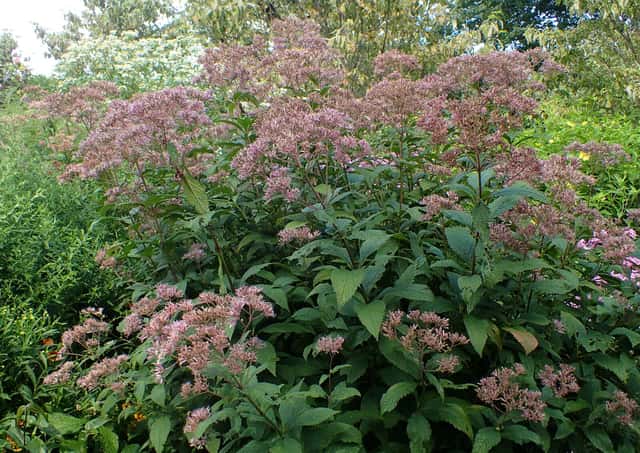
Asteraceae
Spotted Joe-Pye Weed: Full Sun Plant
Eutrochium maculatum
Relatively low-maintenance but requires consistently moist, nutrient-rich soil and a sunny to partially shaded location—dry soil causes leaf scorch. Cold hardy to zone 3a. Serious pests or diseases are not common, though powdery mildew may occur in shady spots.
Every 3 days
Direct sun
-37° - 35°C
50% - 90%
Categories
What is Spotted Joe-Pye Weed?
Spotted Joe-Pye Weed (Eutrochium maculatum) is a easy-care plant from the Asteraceae family. Spotted Joe-Pye weed (Eutrochium maculatum, synonym Eupatorium maculatum) is a perennial herbaceous plant native to North America in the Asteraceae family, growing naturally in moist meadows, stream banks, and marshy areas. The plant forms upright, sturdy, often purple-spotted stems up to 210 cm tal...
Spotted Joe-Pye Weed grows up to 2.1m, spread of 120cm, watering every 3 days, -37°C – 35°C, 50–90% humidity. It is not suitable for indoor environments and safe for pets.
Unlike many tropical plants, Spotted Joe-Pye Weed tolerates watering mistakes. Best for beginners. Unlike many popular species, Spotted Joe-Pye Weed is safe to keep around pets.
How to Care for Spotted Joe-Pye Weed?
TLDR: Spotted Joe-Pye Weed needs Direct sun, watering every 3 days, and temperatures between -37-35°C with 50-90% humidity.
How Often Should You Water Spotted Joe-Pye Weed?
Keep the soil consistently moist, especially during dry and hot weather—the plant does not tolerate drought, and leaf edges will scorch if the soil dries out. In naturally moist locations, additional watering is often unnecessary.
How Much Light Does Spotted Joe-Pye Weed Need?
Prefer full sun (at least 6 hours of direct light per day). In hot climates, light afternoon shade is suitable to help the soil retain moisture longer.
What Is the Best Soil for Spotted Joe-Pye Weed?
Best suited for soil rich in organic matter that retains moisture—clay, loamy, or silty soils that do not dry out completely. It also tolerates periodic flooding.
What Pot Should You Use for Spotted Joe-Pye Weed?
Better suited for open ground beds or rain gardens than pots, as it requires a large and constant supply of moisture. If grown in a large container, choose one at least 40–50 cm deep and wide with good drainage, and keep the soil consistently moist.
Care Schedule
Fertilize
Every 30 days
What Is Spotted Joe-Pye Weed and Where Does It Come From?
Spotted Joe-Pye weed (Eutrochium maculatum, synonym Eupatorium maculatum) is a perennial herbaceous plant native to North America in the Asteraceae family, growing naturally in moist meadows, stream banks, and marshy areas. The plant forms upright, sturdy, often purple-spotted stems up to 210 cm tall and bears large hemispherical pinkish-purple flower heads in late summer and autumn that attract butterflies and bees. In gardens, it is used as a background plant for moist borders, rain gardens, and naturalistic plantings.
How to Propagate Spotted Joe-Pye Weed?
Division
The easiest and most reliable propagation method. Divided plants root quickly if the soil is kept moist.
- 1 Dig up the entire plant clump in spring (when new growth appears) or autumn.
- 2 Divide the rhizome into several parts with a sharp knife or garden fork, each with at least one strong bud/shoot and some roots.
- 3 Replant the divisions immediately in the new location at the same depth as before.
- 4 Water thoroughly and keep the soil evenly moist until established.
Materials needed:
Growing from seed
Seeds germinate better after cold stratification; plants usually do not bloom until the second or third year.
- 1 Sow seeds in autumn or early spring in a cold frame in a moist growing medium, covering lightly.
- 2 Keep the growing medium moist and cool until the seeds germinate.
- 3 Prick out seedlings into individual pots once they have a few true leaves.
- 4 Harden off the plants outdoors before planting in their permanent location.
Materials needed:
How Big Does Spotted Joe-Pye Weed Grow?
TLDR: Spotted Joe-Pye Weed can reach up to 2.1m tall with Fast growth rate.
Max height
2.1m
Spread
1.2m
Growth rate
Fast
Foliage
Deciduous
Plant Uses
Ornamental
Great for decoration
Medicinal
Medicinal properties
Medicinal Uses
- Used in folk medicine as a diuretic
- Traditionally used to relieve fever
- Traditionally used for kidney and urinary tract ailments
- Traditionally used for rheumatic complaints (historical use, scientifically unproven)
Is your plant showing symptoms?
Click on the symptom to discover possible causes:
What Diseases Commonly Affect Spotted Joe-Pye Weed?
TLDR: Spotted Joe-Pye Weed is susceptible to 4 known diseases. Monitor regularly for early detection.
Powdery Mildew
Powdery mildew is a common fungal disease caused by various fungi species including Erysiphe, Podosphaera, Oïdium, and Leveillula. It affects over 10,000 plant species worldwide. The disease thrives in warm, dry climates with high humidity and appears as a distinctive white powdery coating on plant surfaces.
Rust
Rust is a common fungal disease caused by fungi in the order Pucciniales that affects a wide variety of plants. The disease gets its name from the characteristic orange, yellow, or reddish-brown pustules that appear on leaves, resembling metal rust. This obligate fungal parasite requires living plants to survive and can cause significant economic losses in agricultural crops.
Septoria Leaf Spot
Septoria leaf spot is a destructive fungal disease caused by Septoria lycopersici, particularly devastating during seasons of moderate temperature and abundant rainfall. The disease starts on lower leaves and progresses upward, causing small circular spots with tan to gray centers and dark brown margins. If left untreated, it can dramatically reduce plant yields and cause complete leaf blight.
Cercospora Leaf Spot
Cercospora leaf spot is a common fungal disease caused by Cercospora species that affects many plant types, particularly beets, roses, and leafy vegetables. The disease thrives in warm, humid conditions and can cause significant defoliation, reducing plant vigor and yield. It spreads rapidly through water splash, wind, and contaminated tools.
Compare with similar plants
| Attribute | Difficulty | Light | Watering | Pet Safe |
|---|---|---|---|---|
| Field Maple | Easy | Bright indirect | 14d | ✓ |
| Silver Birch | Easy | Direct sun | 14d | ✓ |
| Common Blanketflower | Easy | Direct sun | 10d | ✓ |
| Cushion Bush | Easy | Direct sun | 14d | ✓ |





