Campanulaceae
Star of Bethlehem: Medicinal Uses & Care Tips
Hippobroma longiflora
Cultivate only with protective gloves. Prefers full sun to partial shade and soil rich in organic matter, always moist but well-drained. Enjoys high air humidity and constant tropical temperatures; does not tolerate cold. Grows at a moderate pace and can flower throughout the year in warm climates.
Every 3 days
Partial shade
16° - 32°C
60% - 90%
Categories
What is Star of Bethlehem?
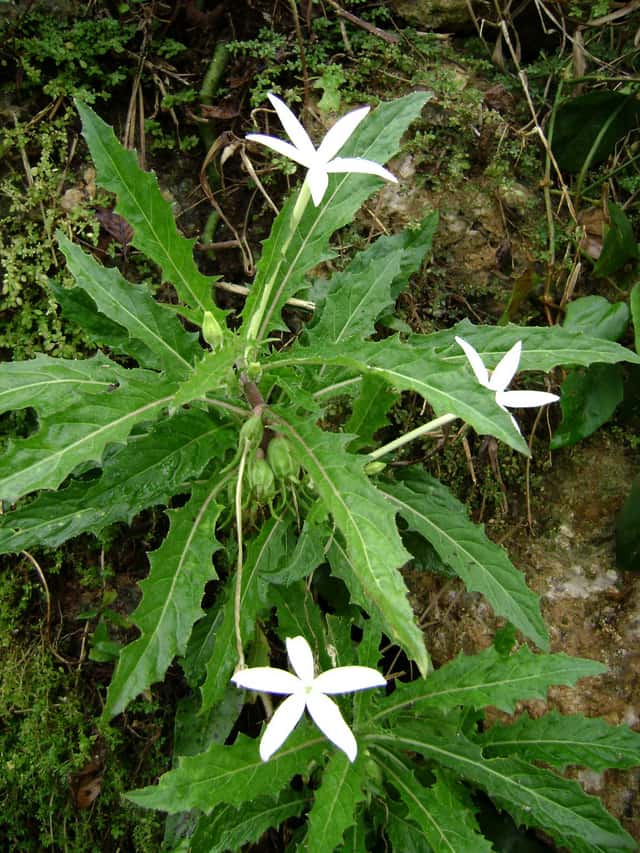
Star of Bethlehem (Hippobroma longiflora) is a medium-care plant from the Campanulaceae family. Hippobroma longiflora, commonly known as Star of Bethlehem, is a perennial herb with an erect or decumbent stem, native to Jamaica and now naturalized in humid tropical and subtropical regions, typically along stream banks and ditches. Its leaves are simple, alternate, elliptical to lanceolate in sh...
Star of Bethlehem grows up to 60cm, spread of 45cm, watering every 3 days, 16°C – 32°C, 60–90% humidity. It is suitable for indoor environments and not safe for pets.
Without precautions, ingestion can cause irritation in pets. Keep out of reach of cats and dogs. Without adequate drainage, root rot can develop within 7 days.
How to Care for Star of Bethlehem?
TLDR: Star of Bethlehem needs Partial shade, watering every 3 days, and temperatures between 16-32°C with 60-90% humidity.
How Often Should You Water Star of Bethlehem?
Keep the substrate consistently slightly moist—water as soon as the surface begins to dry to the touch; never allow it to dry out completely, as the plant wilts quickly.
How Much Light Does Star of Bethlehem Need?
Accepts full sun to partial shade; indoors, prefer strong indirect light near a bright window, avoiding intense, direct midday sun, which can scorch the tender leaves.
What Is the Best Soil for Star of Bethlehem?
Use a light, well-drained substrate rich in organic matter (humus), with a pH between 6.0 and 7.0; the plant tolerates poor soils but grows best in fertile, consistently moist soil.
What Pot Should You Use for Star of Bethlehem?
Ceramic or plastic pots with generous drainage holes, ideal placed on saucers with pebbles and water to maintain humidity around the plant without waterlogging the roots.
Care Schedule
Fertilize
Every 30 days
Misting
Every 2 days
Rotate
Every 15 days
Repot
Every 365 days
What Is Star of Bethlehem and Where Does It Come From?
Hippobroma longiflora, commonly known as Star of Bethlehem, is a perennial herb with an erect or decumbent stem, native to Jamaica and now naturalized in humid tropical and subtropical regions, typically along stream banks and ditches. Its leaves are simple, alternate, elliptical to lanceolate in shape with serrated edges, measuring 5 to 15 cm in length. The flowers are solitary, white, and fragrant, with a slender floral tube 6 to 12 cm long ending in five pointed lobes—an adaptation for pollination by long-tongued sphinx moths. It is considered one of the most dangerous plants to cultivate: the entire plant, especially the milky sap, contains pyridine alkaloids such as lobeline and nicotine. Contact with the sap causes intense burning on the skin and mucous membranes and can cause temporary blindness if it reaches the eyes; ingestion is dangerous for humans and animals (including cattle, dogs, and cats), potentially causing vomiting, tremors, muscle paralysis, and, in severe cases, death.
How to Propagate Star of Bethlehem?
Propagation by seeds
- Always wear gloves when handling capsules and seedlings—the sap is caustic even in young plants.
- 1 Seed collection
Harvest the ellipsoid capsules when they are dry and open on the plant, always using gloves.
- 2 Sowing
Distribute the seeds shallowly, about 0.5 cm deep, in a light substrate rich in organic matter.
- 3 Humidity and warmth
Keep the substrate moist and in a warm place (around 21°C) until germination, which occurs in 10 to 14 days.
Materials needed:
Propagation by cuttings
- Avoid direct contact of the sap with skin during cutting.
- 1 Cutting the stem
Cut a healthy stem segment 10 to 15 cm long, always using protective gloves.
- 2 Planting
Insert the cutting into a moist peat and perlite mixture, leaving at least one node buried.
- 3 Rooting
Keep in a shaded and humid location until rooting, in 2 to 3 weeks.
Materials needed:
How Big Does Star of Bethlehem Grow?
TLDR: Star of Bethlehem can reach up to 60cm tall with Medium growth rate.
Max height
60cm
Spread
45cm
Growth rate
Medium
Foliage
Evergreen
Warning: Toxic Plant
This plant can be toxic if ingested. Keep out of reach of:
Plant Uses
Ornamental
Great for decoration
Medicinal
Medicinal properties
Medicinal Uses
- Traditional use for asthma and bronchitis (ethnobotany, inhalation/external use)
- Macerated leaf drops for cataracts and conjunctivitis (Filipino folk use, without medical endorsement)
- Leaf poultice for wound healing
- Topical relief for toothache with macerated leaves
Is your plant showing symptoms?
Click on the symptom to discover possible causes:
What Diseases Commonly Affect Star of Bethlehem?
TLDR: Star of Bethlehem is susceptible to 6 known diseases. Monitor regularly for early detection.
Spider Mites
Spider mites are tiny arachnids (less than 1/20 inch long) related to spiders and ticks that feed on plant sap. They thrive in hot, dry conditions and can cause significant damage to ornamental and vegetable plants. During severe infestations, crop losses can reach 14% or higher as these pests disrupt vital plant processes including photosynthesis, carbon dioxide absorption, and transpiration.
Aphids
Aphids are small, soft-bodied, pear-shaped insects (1/16 to 1/8 inch long) that feed by sucking nutrient-rich sap from plants. They reproduce rapidly and can quickly weaken plants, causing distorted growth and transmitting plant viruses. Aphids come in various colors including green, black, red, yellow, brown, and gray. They secrete honeydew, a sticky substance that attracts ants and encourages sooty mold growth.
Whiteflies
Whiteflies are small, soft-bodied, winged insects closely related to aphids and mealybugs. They are moth-like in appearance, about 1/16 inch long, triangular in shape, and gray-white in color. These sap-sucking pests feed on plant tissue, causing yellowing, stunted growth, and wilting. They also excrete honeydew, which attracts ants and promotes sooty mold growth. Whiteflies can transmit serious plant viruses.
Powdery Mildew
Powdery mildew is a common fungal disease caused by various fungi species including Erysiphe, Podosphaera, Oïdium, and Leveillula. It affects over 10,000 plant species worldwide. The disease thrives in warm, dry climates with high humidity and appears as a distinctive white powdery coating on plant surfaces.
Meaning & Symbolism
Its star-shaped white flowers evoke purity and light, but the plant serves as a reminder that beauty can hide danger: it is one of the most toxic herbs in the garden.
Compare with similar plants
| Attribute | Difficulty | Light | Watering | Pet Safe |
|---|---|---|---|---|
| Dark Fieldcap | Medium | Low light | 2d | ⚠️ |
| Azalea | Medium | Partial shade | 3d | ⚠️ |
| Muriel's Bamboo | Medium | Partial shade | 3d | ✓ |
| Bougainvillea | Medium | Direct sun | 7d | ⚠️ |




