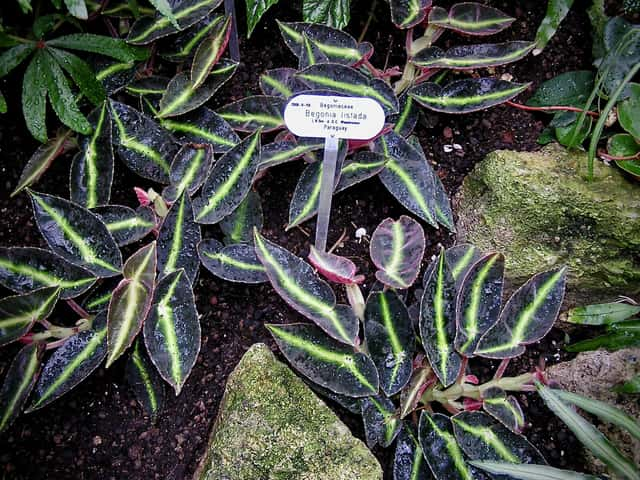
Begoniaceae
Striped begonia (Begonia listada)
Begonia listada
A good indoor plant for bright light without strong direct sun, humid air and light, fast-draining potting mix. Water when the top layer dries and never leave water standing in the saucer. It will not tolerate temperatures below 10 °C.
Every 5 days
Partial shade
10° - 32°C
65% - %
Categories
What is Striped begonia?
Striped begonia (Begonia listada) is a medium-care plant from the Begoniaceae family. Begonia listada is a begonia in the Begoniaceae family, native to Brazil (recorded in Rio Grande do Sul, though its exact origin is uncertain). It grows into a compact, bushy plant 30 to 50 cm tall with upright stems. The leaves are the main attraction: very dark green, almost chocolate, with a broa...
Striped begonia grows up to 50cm, spread of 50cm, watering every 5 days, 10°C – 32°C. It is suitable for indoor environments and not safe for pets.
Without precautions, ingestion can cause irritation in pets. Keep out of reach of cats and dogs. Without adequate drainage, root rot can develop within 10 days.
How to Care for Striped begonia?
TLDR: Striped begonia needs Partial shade, watering every 5 days, and temperatures between 10-32°C with 65-70% humidity.
How Often Should You Water Striped begonia?
Water when the top few centimetres of mix are dry, roughly every 5 days in warm weather. Water the soil, not the hairy leaves, and empty the saucer. Water less in winter.
How Much Light Does Striped begonia Need?
Bright, filtered light, such as near a window with a sheer curtain. Many hours of direct sun scorch and fade the leaves.
What Is the Best Soil for Striped begonia?
Light, open potting mix that drains well, such as houseplant mix with added bark or perlite. Soggy soil rots the stems.
What Pot Should You Use for Striped begonia?
A small to medium pot with drainage holes, plastic or ceramic; it also does well in an open terrarium, which holds humidity.
Care Schedule
Fertilize
Every 14 days
Repot
Every 365 days
What Is Striped begonia and Where Does It Come From?
Begonia listada is a begonia in the Begoniaceae family, native to Brazil (recorded in Rio Grande do Sul, though its exact origin is uncertain). It grows into a compact, bushy plant 30 to 50 cm tall with upright stems. The leaves are the main attraction: very dark green, almost chocolate, with a broad lime-green band along the central vein, fine hairs on top and a reddish underside. Listada means striped. The small flowers are white tinged pink and appear on and off through the year. In cool climates it is grown indoors, and it holds the RHS Award of Garden Merit.
How to Propagate Striped begonia?
Leaf cutting
Keep it moist but not wet: a leaf in soggy mix rots.
- 1 Cut a healthy leaf with 2-3 cm of stalk
- 2 Insert the stalk in light, moist mix with the leaf upright
- 3 Cover with a plastic bag or put it in a closed container to keep the air humid
- 4 Keep in bright light out of direct sun until plantlets form at the base
Materials needed:
Stem cutting
Use the stems you cut back in spring.
- 1 Cut a stem tip with 2 or 3 nodes
- 2 Remove the lower leaves
- 3 Plant in moist mix or stand it in a glass of water
- 4 Pot it up when the roots are 2-3 cm long
Materials needed:
How Big Does Striped begonia Grow?
TLDR: Striped begonia can reach up to 50cm tall with Medium growth rate.
Max height
50cm
Spread
50cm
Foliage
Evergreen
Warning: Toxic Plant
This plant can be toxic if ingested. Keep out of reach of:
Plant Uses
Ornamental
Great for decoration
Is your plant showing symptoms?
Click on the symptom to discover possible causes:
What Diseases Commonly Affect Striped begonia?
TLDR: Striped begonia is susceptible to 9 known diseases. Monitor regularly for early detection.
Caterpillars
Caterpillars are the larval stage of moths and butterflies that feed voraciously on plant foliage, stems, flowers, and fruits. Common species include cabbage loopers, tomato hornworms, armyworms, and cutworms. These pests can cause extensive damage by consuming large amounts of plant tissue in a short time. They vary in size from small (1/4 inch) to large (5 inches), with colors ranging from green to brown, often featuring stripes or spots. Caterpillars are highly mobile and can quickly spread throughout gardens, making them one of the most destructive common pests.
Mealybugs
Mealybugs are small, soft-bodied insects covered with a white, waxy, cottony material. They are common pests of houseplants and outdoor plants in mild climates. These sap-sucking insects feed on plant tissue, causing damage, stunted growth, and can lead to plant death if left untreated. They produce sticky honeydew which attracts sooty mold.
Spider Mites
Spider mites are tiny arachnids (less than 1/20 inch long) related to spiders and ticks that feed on plant sap. They thrive in hot, dry conditions and can cause significant damage to ornamental and vegetable plants. During severe infestations, crop losses can reach 14% or higher as these pests disrupt vital plant processes including photosynthesis, carbon dioxide absorption, and transpiration.
Thrips
Thrips are tiny cigar-shaped insects (1/25-inch long) that damage plants by sucking plant juices and scraping at fruits, flowers, and leaves. With over 6,000 species and rapid reproduction (lifecycle as short as 14 days), they can quickly infest plants and transmit viruses like tomato spotted wilt virus.
Fun Facts
Listada means striped, after the pale band down the middle of each leaf.
The species was described in 1981 by Lyman B. Smith and Dieter Wasshausen.
The undersides of the leaves are reddish.
Frequently asked questions
Can Begonia listada take direct sun?
Is Begonia listada toxic to cats and dogs?
Why are my striped begonia's stems rotting at the base?
Compare with similar plants
| Attribute | Difficulty | Light | Watering | Pet Safe |
|---|---|---|---|---|
| Dark Fieldcap | Medium | Low light | 2d | ⚠️ |
| Azalea | Medium | Partial shade | 3d | ⚠️ |
| Muriel's Bamboo | Medium | Partial shade | 3d | ✓ |
| Bougainvillea | Medium | Direct sun | 7d | ⚠️ |