Cactaceae
Aylostera heliosa - Sun Crown Cactus Care Guide
Aylostera heliosa
Give this miniature cactus maximum direct sunlight, a very gritty mineral substrate, and a strict soak-and-dry watering rhythm. It is highly sensitive to overwatering and root rot, so err on the side of underwatering, especially in winter when it should stay completely dry and cool.
Every 18 days
Direct sun
0° - 35°C
20% - 40%
Categories
What is Sun Crown Cactus?
Sun Crown Cactus (Aylostera heliosa) is a medium-care plant from the Cactaceae family. Aylostera heliosa (formerly Rebutia heliosa) is a small clustering cactus native to the high-altitude slopes near Tarija, Bolivia. Its compact, spherical to cylindrical stems are covered in dense white spines and rarely exceed 2.5 cm in diameter, but under bright sun they produce a spectacular abund...
Sun Crown Cactus grows up to 5cm, spread of 15cm, watering every 18 days, 0°C – 35°C, 20–40% humidity. It is suitable for indoor environments and safe for pets.
Unlike many popular species, Sun Crown Cactus is safe to keep around pets. Without adequate drainage, root rot can develop within 36 days.
How to Care for Sun Crown Cactus?
TLDR: Sun Crown Cactus needs Direct sun, watering every 18 days, and temperatures between 0-35°C with 20-40% humidity.
How Often Should You Water Sun Crown Cactus?
Water thoroughly only when the substrate is completely dry, roughly every 2-3 weeks during spring and summer. Stop watering entirely in winter to let the plant rest.
How Much Light Does Sun Crown Cactus Need?
Provide full, direct sun for at least 5-6 hours a day. Insufficient light causes the stems to stretch (etiolate) and lose their compact form.
What Is the Best Soil for Sun Crown Cactus?
Use a very well-draining mineral mix - about 70-80% coarse sand, pumice, or perlite mixed with a small amount of organic potting soil.
What Pot Should You Use for Sun Crown Cactus?
Shallow, unglazed terracotta pot with drainage holes to wick away excess moisture.
Care Schedule
Fertilize
Every 45 days
What Is Sun Crown Cactus and Where Does It Come From?
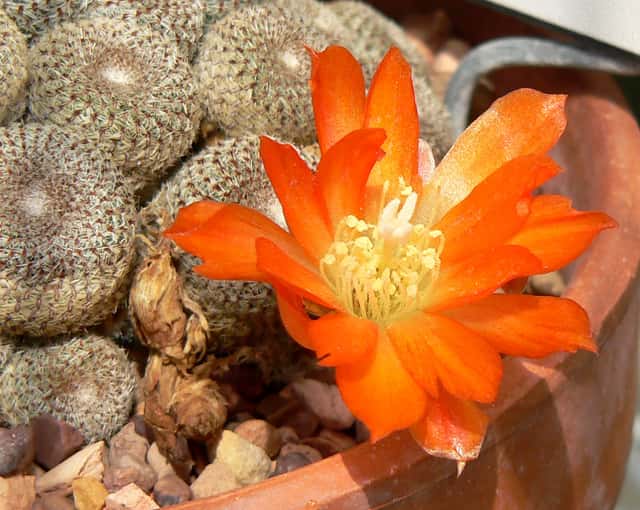
Aylostera heliosa (formerly Rebutia heliosa) is a small clustering cactus native to the high-altitude slopes near Tarija, Bolivia. Its compact, spherical to cylindrical stems are covered in dense white spines and rarely exceed 2.5 cm in diameter, but under bright sun they produce a spectacular abundance of orange to pinkish blooms in spring.
How to Propagate Sun Crown Cactus?
Offset division
Handle offsets with tongs or folded paper to avoid the spines, and keep the substrate bone-dry until roots form.
- 1 Locate a rooted offset (pup) at the base of the clump
- 2 Gently twist or cut it away from the mother plant with a clean, sharp tool
- 3 Let the cut surface callus for 3-5 days in a dry, shaded spot
- 4 Place the offset on top of dry, gritty cactus mix and do not water for 1-2 weeks
Materials needed:
Seed sowing
Seedlings are extremely slow-growing and vulnerable to fungus in the first months, so ensure good airflow.
- 1 Sow fresh seeds on the surface of a sterile, sandy mix
- 2 Cover the tray with plastic to keep humidity high
- 3 Keep at 20-25°C in bright, indirect light until germination
- 4 Gradually reduce humidity and increase light as seedlings grow
Materials needed:
How Big Does Sun Crown Cactus Grow?
TLDR: Sun Crown Cactus can reach up to 5cm tall with Slow growth rate.
Max height
5cm
Spread
15cm
Growth rate
Slow
Foliage
Evergreen
Plant Uses
Ornamental
Great for decoration
Is your plant showing symptoms?
Click on the symptom to discover possible causes:
What Diseases Commonly Affect Sun Crown Cactus?
TLDR: Sun Crown Cactus is susceptible to 6 known diseases. Monitor regularly for early detection.
Root Rot
Root rot is a serious fungal disease that affects the root system of plants, causing them to decay and die. It is primarily caused by overwatering, poor drainage, or soil-borne fungi such as Pythium, Phytophthora, Rhizoctonia, and Fusarium. The disease thrives in waterlogged conditions where roots are deprived of oxygen, making them susceptible to fungal infection.
Mealybugs
Mealybugs are small, soft-bodied insects covered with a white, waxy, cottony material. They are common pests of houseplants and outdoor plants in mild climates. These sap-sucking insects feed on plant tissue, causing damage, stunted growth, and can lead to plant death if left untreated. They produce sticky honeydew which attracts sooty mold.
Spider Mites
Spider mites are tiny arachnids (less than 1/20 inch long) related to spiders and ticks that feed on plant sap. They thrive in hot, dry conditions and can cause significant damage to ornamental and vegetable plants. During severe infestations, crop losses can reach 14% or higher as these pests disrupt vital plant processes including photosynthesis, carbon dioxide absorption, and transpiration.
Scale Insects
Scale insects are small sap-sucking pests that appear as brown, shell-like bumps on plant stems and leaves. There are over 25 species, divided into armored (hard) and unarmored (soft) scales. They feed by piercing plant tissue and extracting sap, which weakens the plant and can lead to yellowing, stunted growth, and even death if left untreated. They also excrete honeydew, which attracts ants and promotes sooty mold growth.
Meaning & Symbolism
Its species name, heliosa, references Helios, the Greek sun god, and the plant is often seen as a symbol of resilience and vitality drawn from intense sunlight.
Fun Facts
The species epithet 'heliosa' honors Helios, the Greek sun god, reflecting its love of intense light.
It was originally described as Rebutia heliosa in 1970 and reclassified into the genus Aylostera in 2011.
Despite its tiny size (stems under 2.5 cm), it produces flowers nearly as large as the plant itself.
Frequently asked questions
How often should I water Aylostera heliosa?
Is Aylostera heliosa toxic to pets?
Why is my plant losing its compact shape?
How do I propagate this cactus?
Compare with similar plants
| Attribute | Difficulty | Light | Watering | Pet Safe |
|---|---|---|---|---|
| Dark Fieldcap | Medium | Low light | 2d | ⚠️ |
| Azalea | Medium | Partial shade | 3d | ⚠️ |
| Muriel's Bamboo | Medium | Partial shade | 3d | ✓ |
| Bougainvillea | Medium | Direct sun | 7d | ⚠️ |




