Fabaceae
Surinam powderpuff: Medicinal Uses & Care Tips
Calliandra surinamensis
The Surinam powderpuff is a low-maintenance, fast-growing ornamental plant suitable for both gardens and large containers. It thrives best in a sunny to partially shaded location with at least 6 hours of light daily, in well-draining, slightly acidic soil with moderate, regular watering. While drought-tolerant once established, it is sensitive to waterlogged soil, which causes root rot. Regular pruning after flowering promotes a compact shape and more profuse blooming.
Every 5 days
Bright indirect
13° - 35°C
30% - 60%
Categories
What is Surinam powderpuff?
Surinam powderpuff (Calliandra surinamensis) is a easy-care plant from the Fabaceae family. The Surinam powderpuff (Calliandra surinamensis) is an evergreen tropical shrub or small tree from the legume family (Fabaceae), native to northern South America—Suriname, Brazil, Guyana, Venezuela, Colombia, Ecuador, Bolivia, French Guiana, and Peru. It features delicate, bipinnate leaves composed...
Surinam powderpuff grows up to 4.5m, spread of 400cm, watering every 5 days, 13°C – 35°C, 30–60% humidity. It is suitable for indoor environments and safe for pets.
Unlike many tropical plants, Surinam powderpuff tolerates watering mistakes. Best for beginners. Unlike many popular species, Surinam powderpuff is safe to keep around pets. Without adequate drainage, root rot can develop within 10 days.
How to Care for Surinam powderpuff?
TLDR: Surinam powderpuff needs Bright indirect, watering every 5 days, and temperatures between 13-35°C with 30-60% humidity.
How Often Should You Water Surinam powderpuff?
Water when the top layer of soil (about 1 inch) feels dry to the touch—typically every 4 to 6 days during the growing season, and less frequently in cooler months. The soil should be evenly moist but never waterlogged; discard excess water from the saucer to prevent root rot.
How Much Light Does Surinam powderpuff Need?
The plant requires full sun to partial shade, ideally at least 6 hours of direct or bright indirect light daily. The more sun it receives, the more abundant and striking its flowers will be.
What Is the Best Soil for Surinam powderpuff?
It prefers well-draining, nutrient-rich soil with a slightly acidic to neutral pH (6.0 – 7.5). A mixture of peat, perlite, and coarse sand, or garden soil enriched with compost, is suitable; heavy, clayey, and poorly draining substrates are not ideal.
What Pot Should You Use for Surinam powderpuff?
Due to its rapid growth and sensitivity to overwatering, choose a container with adequate drainage holes, preferably made of terracotta or another breathable material that helps wick away excess moisture. Adjust the container size as the plant grows, and plan to repot approximately once a year into a slightly larger pot.
Care Schedule
Fertilize
Every 60 days
Misting
Every 4 days
Rotate
Every 14 days
Repot
Every 365 days
What Is Surinam powderpuff and Where Does It Come From?
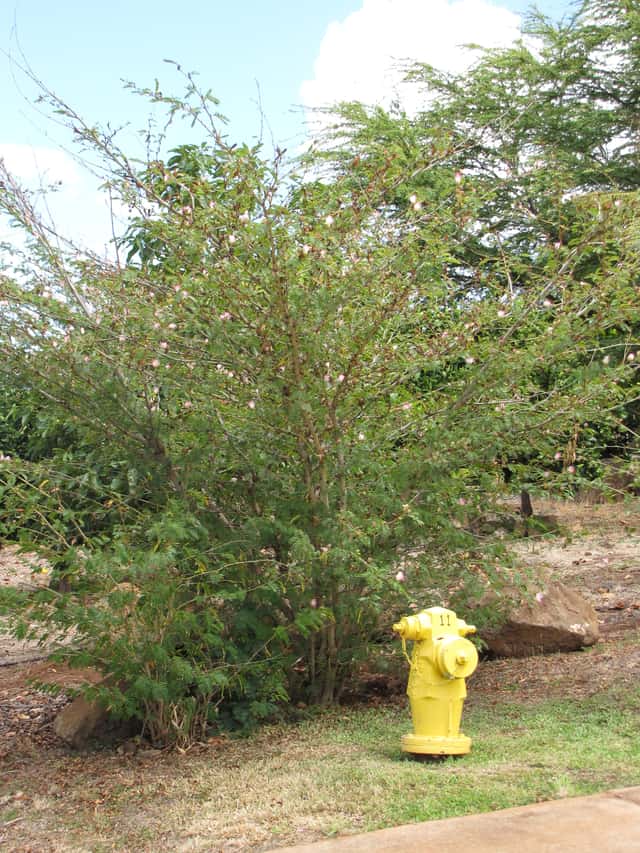
The Surinam powderpuff (Calliandra surinamensis) is an evergreen tropical shrub or small tree from the legume family (Fabaceae), native to northern South America—Suriname, Brazil, Guyana, Venezuela, Colombia, Ecuador, Bolivia, French Guiana, and Peru. It features delicate, bipinnate leaves composed of tiny leaflets that close and droop at night. It is characterized by striking flowers resembling pink-and-white powderpuffs, consisting of up to a hundred silky stamens—white at the base and pink at the tips. It grows rapidly, reaching a height of approximately 11 to 15 feet with a similar spread, and enriches the soil through its ability to fix atmospheric nitrogen, a trait typical of leguminous plants.
How to Propagate Surinam powderpuff?
Stem cuttings
Use clean, sharp tools to prevent infection. Rooting can be accelerated by bottom heat (e.g., a heating mat) and stable humidity.
- 1 Cut a 4-6 inch long healthy cutting below a node, preferably at a 45-degree angle.
- 2 Remove the lower leaves, leaving only 2-3 leaves at the top.
- 3 Dip the cut end into rooting hormone.
- 4 Plant in a moist, well-draining substrate (e.g., a mix of peat and perlite).
- 5 Cover with a transparent bag or plastic wrap to maintain humidity and place in a bright spot without direct sunlight.
- 6 Keep the substrate slightly moist until the cutting roots and develops new shoots.
Materials needed:
Seed sowing
Germination rates can vary, so sow multiple seeds at once. Gradually increase direct sunlight for seedlings after germination to acclimate them.
- 1 Soak mature seeds in lukewarm water for 24 hours to soften the hard seed coat.
- 2 Sow in a well-draining, slightly moist substrate at a depth of about 0.4 inches.
- 3 Place the container in a warm, bright location (ideally 75-82°F).
- 4 Keep the substrate evenly moist until the seeds germinate.
- 5 Once several true leaves have formed, transplant the seedlings into individual containers.
Materials needed:
Air layering
Check the moss periodically and re-moisten if necessary. This method is particularly suitable for obtaining a larger, faster-flowering plant.
- 1 Make a shallow circular cut on a healthy branch and remove a strip of bark.
- 2 Treat the wound with rooting hormone.
- 3 Wrap with moist sphagnum moss and cover with transparent plastic wrap.
- 4 Tie the plastic wrap tightly at both ends to prevent the moss from drying out.
- 5 When new roots are visible through the moss, cut the branch below them and transplant into substrate.
Materials needed:
How Big Does Surinam powderpuff Grow?
TLDR: Surinam powderpuff can reach up to 4.5m tall with Fast growth rate.
Max height
4.5m
Spread
4.0m
Growth rate
Fast
Foliage
Evergreen
Plant Uses
Ornamental
Great for decoration
Medicinal
Medicinal properties
Medicinal Uses
- In the traditional medicine of indigenous South American communities, infusions of the leaves and bark were used to treat fever, general weakness, and inflammation.
- It has traditionally been used for infections and coughs, although scientific evidence supporting these effects is limited.
Is your plant showing symptoms?
Click on the symptom to discover possible causes:
What Diseases Commonly Affect Surinam powderpuff?
TLDR: Surinam powderpuff is susceptible to 9 known diseases. Monitor regularly for early detection.
Aphids
Aphids are small, soft-bodied, pear-shaped insects (1/16 to 1/8 inch long) that feed by sucking nutrient-rich sap from plants. They reproduce rapidly and can quickly weaken plants, causing distorted growth and transmitting plant viruses. Aphids come in various colors including green, black, red, yellow, brown, and gray. They secrete honeydew, a sticky substance that attracts ants and encourages sooty mold growth.
Spider Mites
Spider mites are tiny arachnids (less than 1/20 inch long) related to spiders and ticks that feed on plant sap. They thrive in hot, dry conditions and can cause significant damage to ornamental and vegetable plants. During severe infestations, crop losses can reach 14% or higher as these pests disrupt vital plant processes including photosynthesis, carbon dioxide absorption, and transpiration.
Whiteflies
Whiteflies are small, soft-bodied, winged insects closely related to aphids and mealybugs. They are moth-like in appearance, about 1/16 inch long, triangular in shape, and gray-white in color. These sap-sucking pests feed on plant tissue, causing yellowing, stunted growth, and wilting. They also excrete honeydew, which attracts ants and promotes sooty mold growth. Whiteflies can transmit serious plant viruses.
Mealybugs
Mealybugs are small, soft-bodied insects covered with a white, waxy, cottony material. They are common pests of houseplants and outdoor plants in mild climates. These sap-sucking insects feed on plant tissue, causing damage, stunted growth, and can lead to plant death if left untreated. They produce sticky honeydew which attracts sooty mold.
Meaning & Symbolism
With its delicate, fluffy flowers resembling pink powderpuffs, the Calliandra symbolizes femininity, gentleness, and tropical joy. In garden symbolism, it is associated with hospitality and a festive mood, as its flowers appear in large numbers during warm months, attracting hummingbirds and butterflies.
Compare with similar plants
| Attribute | Difficulty | Light | Watering | Pet Safe |
|---|---|---|---|---|
| Field Maple | Easy | Bright indirect | 14d | ✓ |
| Silver Birch | Easy | Direct sun | 14d | ✓ |
| Common Blanketflower | Easy | Direct sun | 10d | ✓ |
| Cushion Bush | Easy | Direct sun | 14d | ✓ |
Choose & Compare
Sources & References
- ENH268/ST109: Calliandra surinamensis: Pink Powderpuff - UF/IFAS Extension
- Calliandra surinamensis - Wikipedia
- Surinamese Stickpea (Calliandra surinamensis) Care Guide - ForwardPlant
- Pink Powder Puff (Calliandra Surinamensis) Care Guide - Plantiary
- The Ultimate Guide to Growing and Caring for Calliandra surinamensis - Mahindra Nursery





