Campanulaceae
Tall Bellflower: Pet-Safe Plant
Campanulastrum americanum
Easy-going native woodland wildflower -- give it rich, consistently moist, well-drained soil and light-to-part shade (afternoon shade is best in hot climates) and it largely takes care of itself. It has no serious pest or disease problems, tolerates occasional wet soil and clay, and self-seeds freely so a planting can persist for years without replanting.
Every 4 days
Partial shade
-30° - 32°C
50% - 80%
Categories
What is Tall Bellflower?
Tall Bellflower (Campanulastrum americanum) is a easy-care plant from the Campanulaceae family. Campanulastrum americanum, commonly called tall bellflower or American bellflower, is an erect annual or biennial wildflower native to moist, partly shaded woodlands, meadows, streambanks, and ditches across eastern and central North America. It grows on a single unbranched, light-green stem that ca...
Tall Bellflower grows up to 1.8m, spread of 60cm, watering every 4 days, -30°C – 32°C, 50–80% humidity. It is not suitable for indoor environments and safe for pets.
Unlike many tropical plants, Tall Bellflower tolerates watering mistakes. Best for beginners. Unlike many popular species, Tall Bellflower is safe to keep around pets.
How to Care for Tall Bellflower?
TLDR: Tall Bellflower needs Partial shade, watering every 4 days, and temperatures between -30-32°C with 50-80% humidity.
How Often Should You Water Tall Bellflower?
Keep the soil evenly moist -- this woodland native does not tolerate prolonged drought and will drop its lower leaves if it dries out. Water deeply whenever the top inch of soil feels dry, more often during hot spells or for plants in full sun.
How Much Light Does Tall Bellflower Need?
Best in light shade to part sun with protection from hot afternoon sun. In regions with cool summers it tolerates more direct sun, but in hot climates give it afternoon shade to prevent stress and leaf scorch.
What Is the Best Soil for Tall Bellflower?
Plant in rich, humus-heavy soil that stays evenly moist but drains well; a neutral to slightly alkaline pH (about 6.0-8.0) suits it best, and it tolerates clay better than most bellflowers.
What Pot Should You Use for Tall Bellflower?
Best grown directly in garden beds or naturalized woodland borders rather than containers. If growing in a pot, choose a deep container with generous drainage holes and fill it with a rich, moisture-retentive, well-draining mix to mimic its native woodland-edge habitat, and keep it in light shade.
What Is Tall Bellflower and Where Does It Come From?
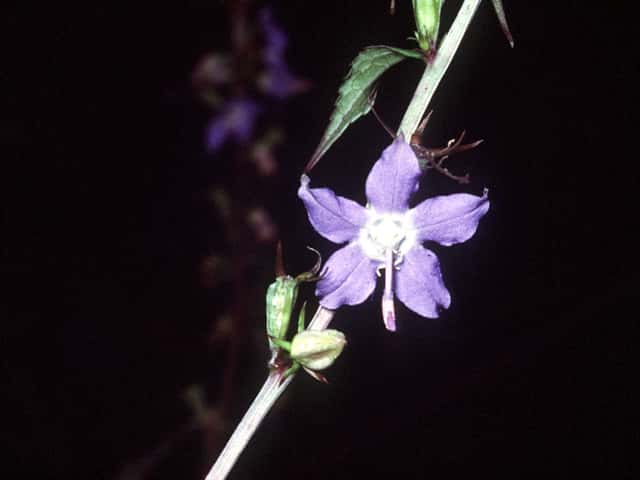
Campanulastrum americanum, commonly called tall bellflower or American bellflower, is an erect annual or biennial wildflower native to moist, partly shaded woodlands, meadows, streambanks, and ditches across eastern and central North America. It grows on a single unbranched, light-green stem that can reach 3-6 ft (90-180 cm), lined with rough-textured, toothed, lance-to-egg-shaped leaves. From June through August it produces open, star-shaped, five-lobed flowers about 1 in. across in light-to-dark violet-blue with a white throat ring, borne solitary or clustered in the leaf axils. The flowers have a distinctive curved style that helps ensure cross-pollination by long-tongued bees, bumblebees, and hummingbirds. It self-seeds readily, and depending on when seedlings germinate it behaves as an annual or as a biennial that overwinters as a basal rosette.
How to Propagate Tall Bellflower?
Seed sowing
Seed is tiny and needs light plus cold stratification to break dormancy; established plantings will self-seed reliably in woodland gardens.
- 1 Collect ripe seed capsules in late summer/fall or use fresh nursery seed.
- 2 Direct-sow outdoors in fall so seeds naturally cold-stratify over winter, or cold-moist stratify seed in the fridge for 30-60 days before spring sowing.
- 3 Sow seed very shallowly or press onto the soil surface -- the tiny seeds need light to germinate and should barely be covered.
- 4 Keep the seed bed or tray consistently moist; use a mister to avoid displacing the fine seed.
- 5 Provide bright light (grow lights recommended if starting indoors).
- 6 Once seedlings have a few sets of true leaves, harden off gradually and transplant outdoors 12-24 in. apart.
- 7 Leave a few spent flower heads in place each season to let the plant self-seed naturally.
Materials needed:
How Big Does Tall Bellflower Grow?
TLDR: Tall Bellflower can reach up to 1.8m tall with Medium growth rate.
Max height
1.8m
Spread
60cm
Growth rate
Medium
Foliage
Deciduous
Plant Uses
Ornamental
Great for decoration
Is your plant showing symptoms?
Click on the symptom to discover possible causes:
What Diseases Commonly Affect Tall Bellflower?
TLDR: Tall Bellflower is susceptible to 2 known diseases. Monitor regularly for early detection.
Aphids
Aphids are small, soft-bodied, pear-shaped insects (1/16 to 1/8 inch long) that feed by sucking nutrient-rich sap from plants. They reproduce rapidly and can quickly weaken plants, causing distorted growth and transmitting plant viruses. Aphids come in various colors including green, black, red, yellow, brown, and gray. They secrete honeydew, a sticky substance that attracts ants and encourages sooty mold growth.
Slugs and Snails
Slugs and snails are mollusks that feed on plant tissue, causing irregular holes in leaves and damage to young seedlings. They are most active at night and in moist conditions, leaving characteristic silvery slime trails. These pests can quickly devastate gardens, especially during wet seasons.
Meaning & Symbolism
Like other bellflowers, Campanulastrum americanum carries the Victorian-era meaning of gratitude -- a bouquet was a way of saying "I appreciate you" for kindness received. Its nodding, bell-shaped blossoms are also linked to humility and quiet devotion, while its habit of returning each year through self-seeding has made bellflowers a symbol of constancy and everlasting affection.
Compare with similar plants
| Attribute | Difficulty | Light | Watering | Pet Safe |
|---|---|---|---|---|
| Field Maple | Easy | Bright indirect | 14d | ✓ |
| Silver Birch | Easy | Direct sun | 14d | ✓ |
| Common Blanketflower | Easy | Direct sun | 10d | ✓ |
| Cushion Bush | Easy | Direct sun | 14d | ✓ |





