Cactaceae
Tephrocactus alexanderi
Tephrocactus alexanderi
Mountain cactus: full sun, well-drained cactus soil, sparse water in summer and none in winter, which should be cool for it to flower.
Every 14 days
Direct sun
-5° - 40°C
% - %
Categories
What is Tephrocactus alexanderi?
Tephrocactus alexanderi (Tephrocactus alexanderi) is a medium-care plant from the Cactaceae family. Tephrocactus alexanderi is a small cactus from the rocky slopes of the Argentine Andes and Bolivia. It grows as a stack of grey-green balls 2.5 to 5 cm across, one on top of the other, covered in white, dark-tipped spines that cross each other like a net. The balls break off easily, and each one can...
Tephrocactus alexanderi grows up to 15cm, spread of 30cm, watering every 14 days, -5°C – 40°C. It is suitable for indoor environments and safe for pets.
Unlike many popular species, Tephrocactus alexanderi is safe to keep around pets. Without adequate drainage, root rot can develop within 28 days.
How to Care for Tephrocactus alexanderi?
TLDR: Tephrocactus alexanderi needs Direct sun, watering every 14 days, and temperatures between -5-40°C with 40-70% humidity.
How Often Should You Water Tephrocactus alexanderi?
In summer, water only when the soil is dry all the way down, about every 2 weeks. In winter, stop watering. Too much water rots the root.
How Much Light Does Tephrocactus alexanderi Need?
Full sun all day. In very hot summers, light shade during the strongest hours prevents sunburn.
What Is the Best Soil for Tephrocactus alexanderi?
A well-drained mineral mix: cactus soil with plenty of coarse sand, grit or pumice.
What Pot Should You Use for Tephrocactus alexanderi?
A deep clay pot with a drainage hole, since the root is thick and long. Wide enough for the clump to spread.
Care Schedule
Fertilize
Every 60 days
What Is Tephrocactus alexanderi and Where Does It Come From?
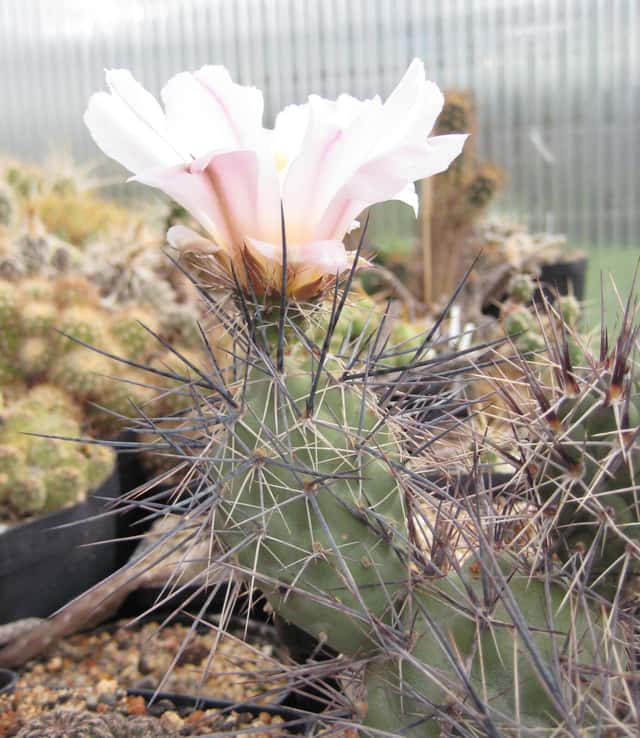
Tephrocactus alexanderi is a small cactus from the rocky slopes of the Argentine Andes and Bolivia. It grows as a stack of grey-green balls 2.5 to 5 cm across, one on top of the other, covered in white, dark-tipped spines that cross each other like a net. The balls break off easily, and each one can become a new plant. In summer it bears large white or pink flowers at the tips of the upper segments. It grows slowly and forms clumps up to 15 cm tall.
How to Propagate Tephrocactus alexanderi?
Detached segment
Segments drop off with a bump and each one roots easily. Wear thick gloves: the spines go through thin ones.
- 1 Carefully remove a segment with tongs or folded newspaper
- 2 Let it dry in the shade for 1 week
- 3 Set the segment on dry cactus soil without burying it
- 4 Start light watering after 2 weeks
Materials needed:
Seed
The seed coat is very hard and germination is slow and poor; segments are much easier.
- 1 Lightly sand the hard seed coat
- 2 Sow on the surface of moist sand
- 3 Keep in a bright, warm spot
Materials needed:
How Big Does Tephrocactus alexanderi Grow?
TLDR: Tephrocactus alexanderi can reach up to 15cm tall with Slow growth rate.
Max height
15cm
Spread
30cm
Growth rate
Slow
Foliage
Evergreen
Plant Uses
Ornamental
Great for decoration
Is your plant showing symptoms?
Click on the symptom to discover possible causes:
What Diseases Commonly Affect Tephrocactus alexanderi?
TLDR: Tephrocactus alexanderi is susceptible to 6 known diseases. Monitor regularly for early detection.
Root Rot
Root rot is a serious fungal disease that affects the root system of plants, causing them to decay and die. It is primarily caused by overwatering, poor drainage, or soil-borne fungi such as Pythium, Phytophthora, Rhizoctonia, and Fusarium. The disease thrives in waterlogged conditions where roots are deprived of oxygen, making them susceptible to fungal infection.
Overwatering
Overwatering occurs when plants receive too much water, depriving roots of oxygen and causing root rot. This environmental stress is one of the most common causes of houseplant death, as waterlogged soil prevents roots from breathing and functioning properly.
Mealybugs
Mealybugs are small, soft-bodied insects covered with a white, waxy, cottony material. They are common pests of houseplants and outdoor plants in mild climates. These sap-sucking insects feed on plant tissue, causing damage, stunted growth, and can lead to plant death if left untreated. They produce sticky honeydew which attracts sooty mold.
Scale Insects
Scale insects are small sap-sucking pests that appear as brown, shell-like bumps on plant stems and leaves. There are over 25 species, divided into armored (hard) and unarmored (soft) scales. They feed by piercing plant tissue and extracting sap, which weakens the plant and can lead to yellowing, stunted growth, and even death if left untreated. They also excrete honeydew, which attracts ants and promotes sooty mold growth.
Fun Facts
The spines on each segment cross to form a net-like pattern
Segments detach at a touch and hitch a ride on passing animals
It is related to prickly pear cactus and was once placed in Opuntia
Frequently asked questions
Why do the segments keep falling off?
Why won't it flower?
Can it take frost?
Is it dangerous to cats and dogs?
Compare with similar plants
| Attribute | Difficulty | Light | Watering | Pet Safe |
|---|---|---|---|---|
| Dark Fieldcap | Medium | Low light | 2d | ⚠️ |
| Azalea | Medium | Partial shade | 3d | ⚠️ |
| Muriel's Bamboo | Medium | Partial shade | 3d | ✓ |
| Bougainvillea | Medium | Direct sun | 7d | ⚠️ |




