Elaeagnaceae
Thorny Olive (Elaeagnus pungens): Complete Care Guide
Elaeagnus pungens
A very tough, low-maintenance shrub. Prefers full sun but tolerates partial shade. Once established, it is highly drought-tolerant and rarely needs watering. Fast-growing and responds well to pruning. Best suited for outdoor gardens, hedges, and wind barriers.
Every 14 days
Bright indirect
-15° - 38°C
40% - 70%
Categories
What is Thorny Olive?
Thorny Olive (Elaeagnus pungens) is a easy-care plant from the Elaeagnaceae family. Elaeagnus pungens, commonly known as Thorny Olive or Silverthorn, is an evergreen shrub native to East Asia, particularly Japan and China. It features leathery leaves with green uppersides and silvery-brown undersides, creating a striking bicolor effect. In autumn, it produces small, intensely fragr...
Thorny Olive grows up to 4.0m, spread of 400cm, watering every 14 days, -15°C – 38°C, 40–70% humidity. It is not suitable for indoor environments and safe for pets.
Unlike many tropical plants, Thorny Olive tolerates watering mistakes. Best for beginners. Unlike many popular species, Thorny Olive is safe to keep around pets.
How to Care for Thorny Olive?
TLDR: Thorny Olive needs Bright indirect, watering every 14 days, and temperatures between -15-38°C with 40-70% humidity.
How Often Should You Water Thorny Olive?
Once established, water every 14 days or only during prolonged droughts. The shrub is highly drought-tolerant and prefers to dry out between waterings. Avoid waterlogging.
How Much Light Does Thorny Olive Need?
Prefers full sun (6+ hours per day) but tolerates partial shade. More sunlight produces denser, more vigorous growth. In heavy shade, growth may become sparse and slow.
What Is the Best Soil for Thorny Olive?
Adapts to a wide range of soil types: sandy, clay, or loam. Good drainage is essential. Prefers a pH of 6.0–7.5. Tolerates poor and compacted soils.
What Pot Should You Use for Thorny Olive?
For container growing, use large pots (50+ cm diameter) with excellent drainage. Terracotta or wooden containers work well. Add a gravel layer at the bottom to aid drainage.
Care Schedule
Fertilize
Every 60 days
What Is Thorny Olive and Where Does It Come From?
Elaeagnus pungens, commonly known as Thorny Olive or Silverthorn, is an evergreen shrub native to East Asia, particularly Japan and China. It features leathery leaves with green uppersides and silvery-brown undersides, creating a striking bicolor effect. In autumn, it produces small, intensely fragrant tubular white flowers. Renowned for its toughness, it thrives in poor soils, withstands drought and strong winds, and is widely used as a hedge, windbreak, and ornamental specimen.
How to Propagate Thorny Olive?
Semi-hardwood cutting
Use sterilized tools. Cover with a plastic bag to maintain humidity and check for rooting after 4 weeks.
- 1 Take a semi-hardwood cutting of 7–10 cm in July or August
- 2 Remove lower leaves, leaving 2–3 leaves at the top
- 3 Apply rooting hormone to the base of the cutting
- 4 Plant in well-draining, moist propagation mix
- 5 Keep in indirect light with moderate humidity until rooted
Materials needed:
Ground layering
Ground layering offers high success without special equipment.
- 1 Select a long, flexible branch close to the ground
- 2 Make a small wound in the bark of the branch
- 3 Bury the wounded section in soil and secure with wire
- 4 Wait for rooting (September to following September)
- 5 Sever the rooted branch from the parent plant and transplant
Materials needed:
How Big Does Thorny Olive Grow?
TLDR: Thorny Olive can reach up to 4.0m tall with Fast growth rate.
Max height
4.0m
Spread
4.0m
Growth rate
Fast
Foliage
Evergreen
Plant Uses
Ornamental
Great for decoration
Edible
Can be consumed
Culinary Uses
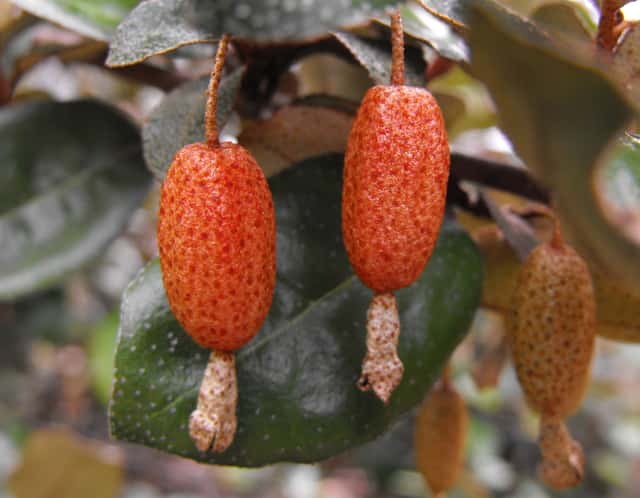
- Ripe fruits (April/May) are edible with a slightly tart-sweet flavor
Is your plant showing symptoms?
Click on the symptom to discover possible causes:
What Diseases Commonly Affect Thorny Olive?
TLDR: Thorny Olive is susceptible to 7 known diseases. Monitor regularly for early detection.
Leaf Spot
Leaf spot is a common fungal disease caused by various pathogens including Alternaria, Ascochyta, Colletotrichum, Septoria, and Venturia. It primarily affects leaves, causing discolored spots that can lead to premature leaf drop if left untreated.
Powdery Mildew
Powdery mildew is a common fungal disease caused by various fungi species including Erysiphe, Podosphaera, Oïdium, and Leveillula. It affects over 10,000 plant species worldwide. The disease thrives in warm, dry climates with high humidity and appears as a distinctive white powdery coating on plant surfaces.
Rust
Rust is a common fungal disease caused by fungi in the order Pucciniales that affects a wide variety of plants. The disease gets its name from the characteristic orange, yellow, or reddish-brown pustules that appear on leaves, resembling metal rust. This obligate fungal parasite requires living plants to survive and can cause significant economic losses in agricultural crops.
Root Rot
Root rot is a serious fungal disease that affects the root system of plants, causing them to decay and die. It is primarily caused by overwatering, poor drainage, or soil-borne fungi such as Pythium, Phytophthora, Rhizoctonia, and Fusarium. The disease thrives in waterlogged conditions where roots are deprived of oxygen, making them susceptible to fungal infection.
Meaning & Symbolism
In Japan and China, Elaeagnus pungens symbolizes resilience and protection. It is traditionally planted as a hedge around homes to ward off harsh winds and negative energy.
Fun Facts
Elaeagnus pungens is a nitrogen-fixing plant — its roots host bacteria that naturally enrich the surrounding soil.
Its autumn flowers are so intensely fragrant they can be detected from several meters away.
The ripe fruits (April/May) are edible and surprisingly high in lycopene, the same antioxidant found in tomatoes.
It is considered an invasive species in parts of the southeastern United States, spread by birds that consume its berries.
Frequently asked questions
How often should I water Thorny Olive?
Can Thorny Olive be grown in a pot?
Is Elaeagnus pungens toxic to pets?
When does Thorny Olive flower?
How do I prune Thorny Olive?
Compare with similar plants
| Attribute | Difficulty | Light | Watering | Pet Safe |
|---|---|---|---|---|
| Field Maple | Easy | Bright indirect | 14d | ✓ |
| Silver Birch | Easy | Direct sun | 14d | ✓ |
| Common Blanketflower | Easy | Direct sun | 10d | ✓ |
| Cushion Bush | Easy | Direct sun | 14d | ✓ |





