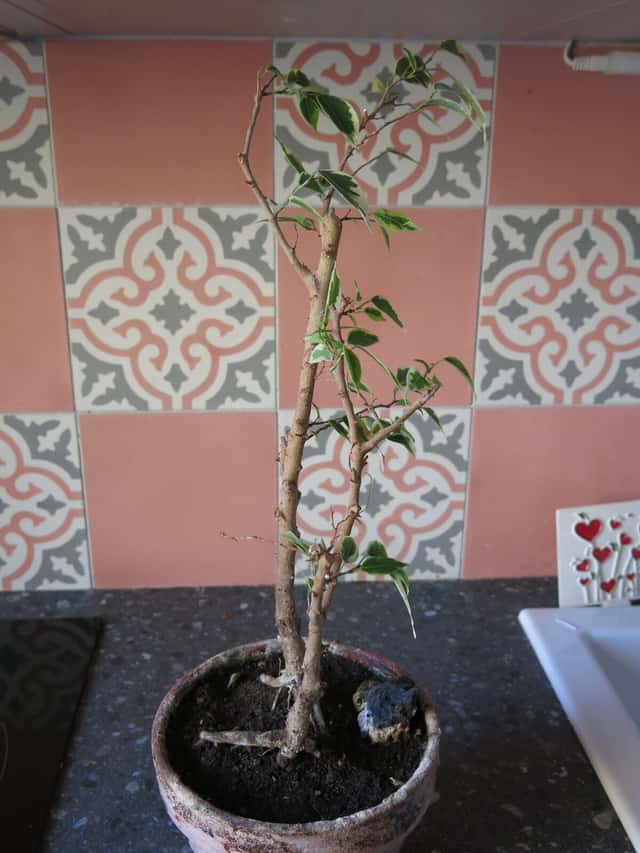
Moraceae
Variegated Weeping Fig (Ficus benjamina Variegata)
Ficus benjamina 'Variegata'
Prefers strong indirect light to keep its variegation, moderate watering that allows the topsoil to dry between waterings, and good humidity. Sensitive to drafts and to being relocated.
Every 7 days
Bright indirect
15° - 29°C
% - %
Categories
What is Variegated Weeping Fig?
Variegated Weeping Fig (Ficus benjamina 'Variegata') is a medium-care plant from the Moraceae family. The Variegated Weeping Fig is an ornamental cultivar of Ficus benjamina, prized for its green leaves splashed and edged with creamy white. Native to South and Southeast Asia and Australia, it is a medium-sized tree widely grown as a houseplant for its graceful shape and gently drooping branches.
Variegated Weeping Fig grows up to 2.0m, spread of 50cm, watering every 7 days, 15°C – 29°C. It is suitable for indoor environments and not safe for pets.
Without precautions, ingestion can cause irritation in pets. Keep out of reach of cats and dogs. Without adequate drainage, root rot can develop within 14 days.
How to Care for Variegated Weeping Fig?
TLDR: Variegated Weeping Fig needs Bright indirect, watering every 7 days, and temperatures between 15-29°C with 40-70% humidity.
How Often Should You Water Variegated Weeping Fig?
Let the top 5-7 cm of soil dry out before watering again; avoid soggy soil, as the plant does not tolerate excess moisture.
How Much Light Does Variegated Weeping Fig Need?
Unlike the plain green variety, the variegated form needs quite bright indirect light to hold its color pattern; low light can cause new leaves to grow back mostly green.
What Is the Best Soil for Variegated Weeping Fig?
Use a light, well-draining potting mix based on potting soil, coconut coir, and perlite or coarse sand.
What Pot Should You Use for Variegated Weeping Fig?
A pot with drainage holes, preferably ceramic or terracotta, to prevent moisture buildup around the roots.
Care Schedule
Fertilize
Every 30 days
Misting
Every 3 days
Repot
Every 730 days
What Is Variegated Weeping Fig and Where Does It Come From?
The Variegated Weeping Fig is an ornamental cultivar of Ficus benjamina, prized for its green leaves splashed and edged with creamy white. Native to South and Southeast Asia and Australia, it is a medium-sized tree widely grown as a houseplant for its graceful shape and gently drooping branches.
How to Propagate Variegated Weeping Fig?
Stem Cutting
Use clean, sharp tools; avoid touching the milky sap without gloves, as it can irritate skin.
- 1 Cut a young, flexible branch 10-15 cm long with at least 2-3 leaves
- 2 Let the cut end dry for a few hours to stop the milky latex sap
- 3 Apply rooting hormone to the base of the cutting
- 4 Plant in a light, well-draining substrate, keeping it lightly moist
- 5 Use bottom heat and strong indirect light until roots form
Materials needed:
Air Layering
Can be done year-round indoors where temperature stays stable.
- 1 Choose a healthy branch and make a ring cut removing the bark
- 2 Apply rooting hormone to the exposed area
- 3 Wrap with moist sphagnum moss and cover with clear plastic, tying the ends
- 4 Keep the moss moist until visible roots appear through the plastic
- 5 Cut the branch below the new roots and pot it separately
Materials needed:
How Big Does Variegated Weeping Fig Grow?
TLDR: Variegated Weeping Fig can reach up to 2.0m tall with Medium growth rate.
Max height
2.0m
Spread
50cm
Growth rate
Medium
Foliage
Evergreen
Warning: Toxic Plant
This plant can be toxic if ingested. Keep out of reach of:
Plant Uses
Ornamental
Great for decoration
Air Purifying
Improves air quality
Is your plant showing symptoms?
Click on the symptom to discover possible causes:
What Diseases Commonly Affect Variegated Weeping Fig?
TLDR: Variegated Weeping Fig is susceptible to 9 known diseases. Monitor regularly for early detection.
Anthracnose
Anthracnose is a fungal disease caused by fungi in the genus Colletotrichum that affects many plants, including vegetables, fruits, and trees. The disease thrives in cool, wet conditions, causing dark, sunken lesions on leaves, stems, flowers, and fruits.
Grey Mould
Verticillium Wilt
Verticillium wilt is a soil-borne fungal disease caused primarily by the fungi Verticillium dahliae and V. albo-atrum. These pathogens infect plant roots and grow within the vascular tissues, blocking water and nutrient transport, resulting in wilting and eventual plant death. The disease affects over 350 plant species including vegetables, fruits, ornamental flowers, and trees. The fungi can survive in soil for more than 10 years as resistant structures called microsclerotia.
Bacterial Leaf Spot
Xanthomonas is a group of bacteria that causes leaf spots and blights on many garden and indoor plants. It spreads through splashing water, wet tools, hands, and infected seed or cuttings. Early signs are small, water‑soaked spots that turn yellow, brown, or black; spots often have a yellow halo and can look angular because veins limit their shape. Leaves may yellow, tear, or drop; stems and fruit can develop dark, sunken lesions. Commonly affected plants include tomato and pepper, brassicas (such as cabbage), beans, citrus, orchid, philodendron, coleus, and many other ornamentals.
Meaning & Symbolism
Associated with luck, prosperity, and harmony in Feng Shui, and with peace and enlightenment in Buddhist tradition.
Fun Facts
It is a variegated cultivar of Ficus benjamina, also known as the weeping fig
It was included in NASA's Clean Air Study for helping filter formaldehyde, xylene, and toluene from indoor air
Its milky sap is traditionally used in producing natural latex in parts of Asia
In Buddhist tradition, fig trees of the Ficus genus are linked to the tree under which the Buddha attained enlightenment
Frequently asked questions
Is the Variegated Weeping Fig toxic to cats and dogs?
Why is my plant losing its variegation?
Why is my plant dropping leaves?
How often should I water a Variegated Weeping Fig?
Compare with similar plants
| Attribute | Difficulty | Light | Watering | Pet Safe |
|---|---|---|---|---|
| Dark Fieldcap | Medium | Low light | 2d | ⚠️ |
| Azalea | Medium | Partial shade | 3d | ⚠️ |
| Muriel's Bamboo | Medium | Partial shade | 3d | ✓ |
| Bougainvillea | Medium | Direct sun | 7d | ⚠️ |




