Rubiaceae
Virginia buttonweed: Ground Cover Plant
Diodia virginiana
An extremely tough, adaptable plant that thrives in consistently moist to wet, poorly-drained soil and tolerates everything from full sun to deep shade. It needs little intervention to survive and, left unchecked, spreads aggressively by rhizomes, rooting stem fragments, and seed — which is exactly why it is treated as an invasive lawn weed rather than a garden ornamental.
Every 2 days
Bright indirect
10° - 35°C
50% - 90%
Categories
What is Virginia buttonweed?
Virginia buttonweed (Diodia virginiana) is a easy-care plant from the Rubiaceae family. Virginia buttonweed is a low-growing, mat-forming perennial in the coffee family (Rubiaceae), native to wetlands and disturbed wet ground across the southeastern and south-central United States, Mexico, Cuba, and Nicaragua. Square, sprawling stems creep along the ground and root at the nodes, bearin...
Virginia buttonweed grows up to 15cm, spread of 90cm, watering every 2 days, 10°C – 35°C, 50–90% humidity. It is not suitable for indoor environments and safe for pets.
Unlike many tropical plants, Virginia buttonweed tolerates watering mistakes. Best for beginners. Unlike many popular species, Virginia buttonweed is safe to keep around pets.
How to Care for Virginia buttonweed?
TLDR: Virginia buttonweed needs Bright indirect, watering every 2 days, and temperatures between 10-35°C with 50-90% humidity.
How Often Should You Water Virginia buttonweed?
Keep the soil consistently moist to wet; this plant is adapted to boggy, poorly-drained ground and does not tolerate prolonged dryness. It is not drought-tolerant, so avoid letting the root zone dry out between waterings.
How Much Light Does Virginia buttonweed Need?
Grows best in full sun to partial shade but tolerates deep shade as well — one of the most light-adaptable weeds in southern lawns.
What Is the Best Soil for Virginia buttonweed?
Prefers loamy, organically rich, poorly-drained to occasionally waterlogged soil, though it tolerates sandy and clay soils too. Slightly acidic to neutral pH (roughly 5.5-7.5) is ideal.
What Pot Should You Use for Virginia buttonweed?
Rarely cultivated intentionally. If grown in a container for observation, choose a wide, shallow, drainage-holed pot kept standing in a saucer of water to mimic its natural boggy habitat, rather than a fast-draining houseplant mix.
Care Schedule
Fertilize
Every 30 days
What Is Virginia buttonweed and Where Does It Come From?
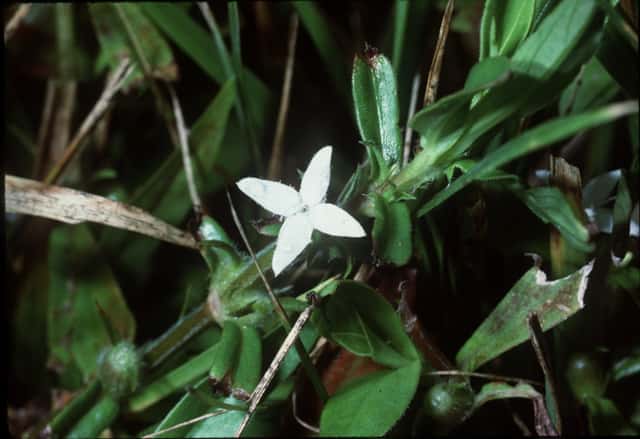
Virginia buttonweed is a low-growing, mat-forming perennial in the coffee family (Rubiaceae), native to wetlands and disturbed wet ground across the southeastern and south-central United States, Mexico, Cuba, and Nicaragua. Square, sprawling stems creep along the ground and root at the nodes, bearing opposite, lance-shaped leaves and small, four-petaled white (occasionally pink-streaked) star-shaped flowers from early summer through fall. It naturally colonizes swamps, ditches, marsh edges, and pond margins, and is notorious in the southern U.S. as one of the most persistent, hard-to-eradicate broadleaf weeds of lawns and turfgrass, since even small root or stem fragments can re-sprout into new plants.
How Big Does Virginia buttonweed Grow?
TLDR: Virginia buttonweed can reach up to 15cm tall with Fast growth rate.
Max height
15cm
Spread
90cm
Growth rate
Fast
Foliage
Semi-evergreen
Plant Uses
Ground Cover
Soil coverage
Is your plant showing symptoms?
Click on the symptom to discover possible causes:
Meaning & Symbolism
Virginia buttonweed carries no traditional ornamental or cultural symbolism — it is known almost exclusively as a stubborn southern lawn weed. Informally, its ability to regenerate from the smallest root or stem fragment has made it something of a folk emblem of resilience and tenacity in adverse, waterlogged conditions.
Compare with similar plants
| Attribute | Difficulty | Light | Watering | Pet Safe |
|---|---|---|---|---|
| Field Maple | Easy | Bright indirect | 14d | ✓ |
| Silver Birch | Easy | Direct sun | 14d | ✓ |
| Common Blanketflower | Easy | Direct sun | 10d | ✓ |
| Cushion Bush | Easy | Direct sun | 14d | ✓ |





