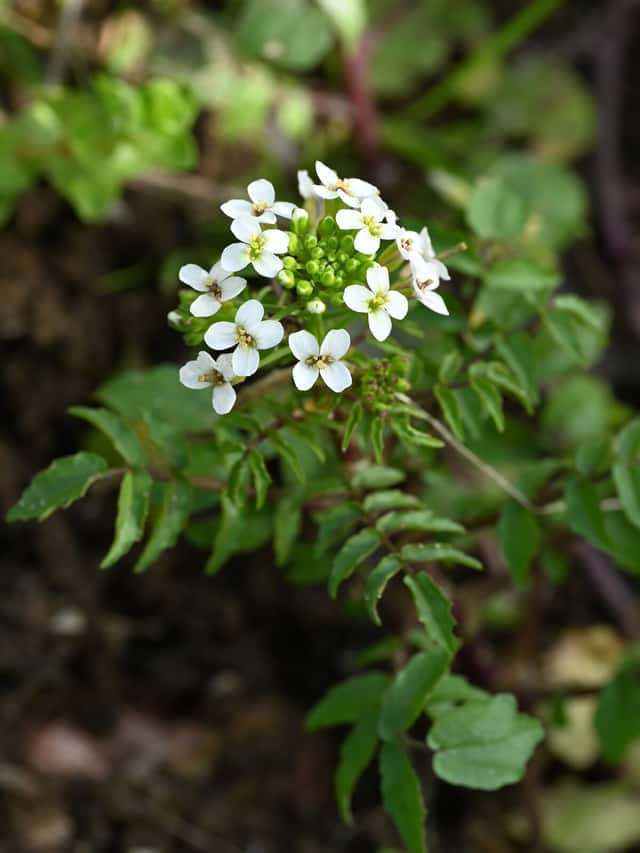
Brassicaceae
Watercress: Ground Cover Plant
Nasturtium officinale
Watercress requires constantly waterlogged soil or substrate (ideally with running water or frequently changed water), good light, and mild temperatures between 10°C and 25°C. It should be harvested frequently to prevent flowering, which makes the leaves bitter.
Every 1 days
Bright indirect
10° - 25°C
70% - 95%
Categories
What is Watercress?
Watercress (Nasturtium officinale) is a medium-care plant from the Brassicaceae family. Watercress (Nasturtium officinale) is a perennial aquatic vegetable from the Brassicaceae family, native to Europe and Central Asia, where it grows spontaneously along the banks of clean, flowing streams and springs. Its hollow, floating stems easily root at the nodes in contact with waterlogged soi...
Watercress grows up to 60cm, spread of 100cm, watering every 1 days, 10°C – 25°C, 70–95% humidity. It is suitable for indoor environments and safe for pets.
Unlike many popular species, Watercress is safe to keep around pets. Without adequate drainage, root rot can develop within 7 days.
How to Care for Watercress?
TLDR: Watercress needs Bright indirect, watering every 1 days, and temperatures between 10-25°C with 70-95% humidity.
How Often Should You Water Watercress?
It does not tolerate drought at any stage of its life. Keep the substrate permanently saturated — in a pot, always leave the saucer full of water or cultivate with the roots submerged — and change the water at least twice a week to prevent stagnation and the proliferation of larvae and fungi.
How Much Light Does Watercress Need?
Prefers full sun to partial shade. In very hot climates, provide partial shade during the hottest hours of the afternoon to prevent wilting and drying of the leaves.
What Is the Best Soil for Watercress?
Adapts to various soil types (sandy, clayey, or loamy), as long as it is rich in organic matter and kept constantly moist. The ideal pH is between 6.5 and 7.5, close to neutrality.
What Pot Should You Use for Watercress?
Pots without drainage holes, or regular pots placed inside a larger container filled with water, simulating a hydroponic environment. Growing systems in running water or hydroponic trays produce the best results.
Care Schedule
Fertilize
Every 30 days
What Is Watercress and Where Does It Come From?
Watercress (Nasturtium officinale) is a perennial aquatic vegetable from the Brassicaceae family, native to Europe and Central Asia, where it grows spontaneously along the banks of clean, flowing streams and springs. Its hollow, floating stems easily root at the nodes in contact with waterlogged soil, forming dense clumps of dark green, rounded leaves with a pungent and slightly bitter taste. It is one of the oldest leafy vegetables cultivated by humans: it was already recommended by Hippocrates as an expectorant in Ancient Greece, and Greek soldiers consumed the plant believing it strengthened the body and mind. Today it is recognized as one of the most nutritious vegetables in the world, rich in vitamins A, C, and B complex, as well as iron, folic acid, and calcium.
How to Propagate Watercress?
Stem cutting
- Change the water in the container daily to prevent rot and insect proliferation.
- 1 Branch cutting
Cut a healthy branch 10-15 cm long, ensuring visible nodes (new roots form precisely at the nodes).
- 2 Rooting in water
Place the base of the branch in a glass of clean water, keeping the leaves out of the water.
- 3 Planting
Once white roots appear (3-7 days), transfer to a location with running water or very waterlogged soil.
Materials needed:
Sowing
- Keep the container in a cool place and never let the substrate dry out; harvesting begins 60-80 days after sowing.
- 1 Substrate preparation
Use a substrate rich in organic matter and keep it saturated with water.
- 2 Sowing
Spread the seeds on the surface and cover lightly with a thin layer of soil.
Materials needed:
How Big Does Watercress Grow?
TLDR: Watercress can reach up to 60cm tall with Fast growth rate.
Max height
60cm
Spread
1.0m
Growth rate
Fast
Foliage
Evergreen
Plant Uses
Edible
Can be consumed
Medicinal
Medicinal properties
Ground Cover
Soil coverage
Medicinal Uses
- Natural expectorant, traditionally used for respiratory conditions such as bronchitis and asthma
- Rich in vitamin C and iron, helps prevent anemia
- Diuretic and depurative action
- Source of folic acid (vitamin B9), important for red blood cell formation
- Traditionally used as a dewormer and external healing agent
- Internal use in large quantities can irritate the gastric mucosa; contraindicated during pregnancy, breastfeeding, and for children under 4 years old
Culinary Uses
- Fresh salads
- Soups and creams
- Natural sandwiches
- Watercress pesto
- Detox juices and green smoothies
- Quick stir-fries, like spinach
Is your plant showing symptoms?
Click on the symptom to discover possible causes:
What Diseases Commonly Affect Watercress?
TLDR: Watercress is susceptible to 9 known diseases. Monitor regularly for early detection.
Root Rot
Root rot is a serious fungal disease that affects the root system of plants, causing them to decay and die. It is primarily caused by overwatering, poor drainage, or soil-borne fungi such as Pythium, Phytophthora, Rhizoctonia, and Fusarium. The disease thrives in waterlogged conditions where roots are deprived of oxygen, making them susceptible to fungal infection.
Pythium Root Rot
Pythium root rot is a serious fungal disease caused by various Pythium species including P. aphanidermatum, P. ultimum, and P. irregulare. These water molds are present in practically all cultivated soils and attack plant roots under wet conditions, causing rapid wet rot that can extend into the stem. The disease is favored by poor drainage, overwatering, and specific temperatures depending on the species.
Phytophthora Root Rot
Disease caused by fungus-like organisms (oomycetes) that live in soil and can survive for years. It affects roots, stem, and crown of plants, being especially severe in waterlogged or poorly drained soils. It is the second most common cause of root rot in trees and shrubs.
Downy Mildew
Downy mildew is a fungal-like disease caused by oomycetes (water molds) that thrives in cool, wet conditions. It affects a wide range of plants, causing yellowing leaves with fuzzy white-gray growth underneath, leading to defoliation and reduced yields if left untreated.
Meaning & Symbolism
A symbol of vitality and vigor since antiquity: Hippocrates prescribed watercress as medicine, and Greek soldiers consumed it believing it strengthened courage and disposition. Its very high content of vitamins and iron reinforces the plant's association with energy and renewal.
Compare with similar plants
| Attribute | Difficulty | Light | Watering | Pet Safe |
|---|---|---|---|---|
| Dark Fieldcap | Medium | Low light | 2d | ⚠️ |
| Azalea | Medium | Partial shade | 3d | ⚠️ |
| Muriel's Bamboo | Medium | Partial shade | 3d | ✓ |
| Bougainvillea | Medium | Direct sun | 7d | ⚠️ |




