Passifloraceae
White Buttercup (Turnera subulata) Care Guide
Turnera subulata
An easy, sun-loving subshrub that thrives on neglect once established. Give it full sun, well-draining soil and regular water, and it rewards with near-constant morning blooms.
Every 4 days
Bright indirect
21° - 32°C
60% - 80%
Categories
What is White Buttercup?
White Buttercup (Turnera subulata) is a easy-care plant from the Passifloraceae family. White buttercup (Turnera subulata) is a low, woody-based perennial subshrub native to Central and South America, from Panama south through Brazil, and now naturalized across many tropical regions including Malaysia, Indonesia, the Pacific Islands, the Caribbean and Florida. It grows to about 80 cm t...
White Buttercup grows up to 80cm, watering every 4 days, 21°C – 32°C, 60–80% humidity. It is not suitable for indoor environments and safe for pets.
Unlike many tropical plants, White Buttercup tolerates watering mistakes. Best for beginners. Unlike many popular species, White Buttercup is safe to keep around pets.
How to Care for White Buttercup?
TLDR: White Buttercup needs Bright indirect, watering every 4 days, and temperatures between 21-32°C with 60-80% humidity.
How Often Should You Water White Buttercup?
Water regularly to keep the soil evenly moist, especially in hot, dry weather, but let the top layer dry slightly between waterings and avoid letting the plant sit in soggy soil, which invites root rot.
How Much Light Does White Buttercup Need?
Provide at least 6 hours of direct sun daily for the best flowering; it tolerates partial shade but blooms less prolifically.
What Is the Best Soil for White Buttercup?
Plant in well-draining, organically rich loamy or sandy soil with a neutral to slightly acidic pH (around 6.0-7.5); heavy, waterlogged soils should be avoided.
What Pot Should You Use for White Buttercup?
Terracotta or plastic pot with ample drainage holes, at least 20-25 cm wide for a mature plant
Care Schedule
Fertilize
Every 30 days
What Is White Buttercup and Where Does It Come From?
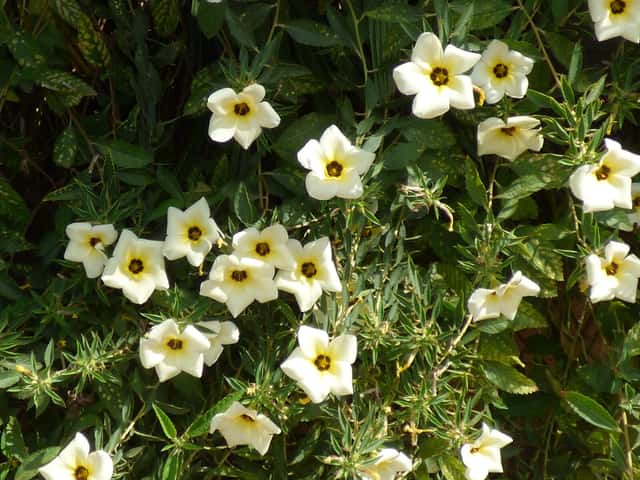
White buttercup (Turnera subulata) is a low, woody-based perennial subshrub native to Central and South America, from Panama south through Brazil, and now naturalized across many tropical regions including Malaysia, Indonesia, the Pacific Islands, the Caribbean and Florida. It grows to about 80 cm tall, with oval, toothed leaves up to 9 cm long and white-haired undersides. Its five-petaled white to pale-yellow flowers have a darker purple-brown throat and open in the early morning, closing again by around 11 a.m. The plant blooms nearly year-round and is a reliable nectar source for bees.
How to Propagate White Buttercup?
Seed sowing
Seeds germinate best in warm soil (around 24-27C); ants naturally disperse seed in the wild thanks to a fatty appendage on the seed coat.
- 1 Collect ripe seed capsules or buy fresh seed
- 2 Sow shallowly in warm, moist, well-draining potting mix
- 3 Keep in bright, warm conditions until germination
- 4 Transplant seedlings once they have 2-3 true leaves
Materials needed:
Softwood stem cutting
Faster and more predictable than seed for establishing new plants quickly.
- 1 Take a 10-15 cm softwood cutting below a leaf node
- 2 Remove the lower leaves
- 3 Insert the cutting into moist, well-draining soil or water
- 4 Keep warm and humid until roots form, then pot on
Materials needed:
How Big Does White Buttercup Grow?
TLDR: White Buttercup can reach up to 80cm tall with Fast growth rate.
Max height
80cm
Growth rate
Fast
Foliage
Evergreen
Plant Uses
Ornamental
Great for decoration
Medicinal
Medicinal properties
Medicinal Uses
- Traditional folk use for diabetes, hypertension, inflammation and fever (not clinically established; consult a professional before any medicinal use)
Is your plant showing symptoms?
Click on the symptom to discover possible causes:
What Diseases Commonly Affect White Buttercup?
TLDR: White Buttercup is susceptible to 2 known diseases. Monitor regularly for early detection.
Aphids
Aphids are small, soft-bodied, pear-shaped insects (1/16 to 1/8 inch long) that feed by sucking nutrient-rich sap from plants. They reproduce rapidly and can quickly weaken plants, causing distorted growth and transmitting plant viruses. Aphids come in various colors including green, black, red, yellow, brown, and gray. They secrete honeydew, a sticky substance that attracts ants and encourages sooty mold growth.
Spider Mites
Spider mites are tiny arachnids (less than 1/20 inch long) related to spiders and ticks that feed on plant sap. They thrive in hot, dry conditions and can cause significant damage to ornamental and vegetable plants. During severe infestations, crop losses can reach 14% or higher as these pests disrupt vital plant processes including photosynthesis, carbon dioxide absorption, and transpiration.
Meaning & Symbolism
In Brazil, Turnera subulata is the official flower of the city of Natal and is known locally as "xanana" or "chanana"; its roots have a long history in northeastern Brazilian folk medicine.
Fun Facts
Its flowers open at dawn and close by about 11 a.m. every day, earning it the nickname "eleven o'clock flower" in some regions.
It is the official flower of the city of Natal, Brazil.
Its seeds have a fatty appendage that attracts ants, which help disperse them.
The flowers have two morphs with different stamen and style lengths (heterostyly), a trick that improves cross-pollination.
Frequently asked questions
How often should I water White Buttercup?
Is White Buttercup toxic to pets?
Why do the flowers close in the afternoon?
How do I propagate White Buttercup?
Compare with similar plants
| Attribute | Difficulty | Light | Watering | Pet Safe |
|---|---|---|---|---|
| Field Maple | Easy | Bright indirect | 14d | ✓ |
| Silver Birch | Easy | Direct sun | 14d | ✓ |
| Common Blanketflower | Easy | Direct sun | 10d | ✓ |
| Cushion Bush | Easy | Direct sun | 14d | ✓ |





