Asteraceae
white snakeroot: Medicinal Uses & Care Tips
Ageratina altissima
Easy to grow once established in a shaded woodland setting: give it part shade with moist, humus-rich, well-drained soil, keep the soil lightly moist through the growing season, and expect it to spread readily by rhizomes and self-seeding, so divide or deadhead to keep it in bounds. It has few serious pest or disease problems, tolerates a wide range of soils, and needs almost no feeding, but its severe toxicity means it should be kept away from grazing animals, pets, and children.
Every 5 days
Partial shade
-37° - 35°C
% - %
Categories
What is white snakeroot?
white snakeroot (Ageratina altissima) is a easy-care plant from the Asteraceae family. White snakeroot is a shade-tolerant, clump-forming herbaceous perennial native to woodlands and forest edges across eastern North America. It grows two to five feet tall on smooth, branching stems with opposite, heart-shaped, coarsely toothed leaves, and from late summer into fall it produces flat-t...
white snakeroot grows up to 1.5m, spread of 120cm, watering every 5 days, -37°C – 35°C. It is not suitable for indoor environments and not safe for pets.
Unlike many tropical plants, white snakeroot tolerates watering mistakes. Best for beginners. Without precautions, ingestion can cause irritation in pets. Keep out of reach of cats and dogs.
How to Care for white snakeroot?
TLDR: white snakeroot needs Partial shade, watering every 5 days, and temperatures between -37-35°C with 40-70% humidity.
How Often Should You Water white snakeroot?
Keep the soil evenly and lightly moist, watering roughly every 5 days (more often in hot, dry spells); it tolerates brief dry spells but performs best without prolonged drought or waterlogging.
How Much Light Does white snakeroot Need?
Thrives in part shade to full shade, especially with protection from hot afternoon sun; it also tolerates full sun in cooler, consistently moist sites.
What Is the Best Soil for white snakeroot?
Plant in humus-rich, well-drained loam or clay-loam; it adapts to sandy, chalky, or clay soils as long as they aren't left waterlogged, and tolerates a neutral to slightly alkaline pH.
What Pot Should You Use for white snakeroot?
Best grown directly in garden soil rather than in containers; if potted for propagation or to contain its spreading rhizomes, use a wide, deep container with drainage holes and a rich, well-draining organic potting mix.
What Is white snakeroot and Where Does It Come From?
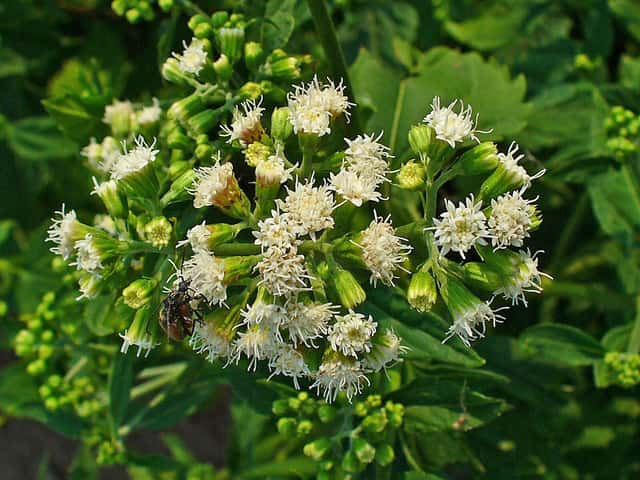
White snakeroot is a shade-tolerant, clump-forming herbaceous perennial native to woodlands and forest edges across eastern North America. It grows two to five feet tall on smooth, branching stems with opposite, heart-shaped, coarsely toothed leaves, and from late summer into fall it produces flat-topped clusters of small, fluffy white flowers that draw bees, butterflies, and other pollinators. Every part of the plant contains the toxin tremetol, making it dangerous to livestock, pets, and people if ingested.
How to Propagate white snakeroot?
How Big Does white snakeroot Grow?
TLDR: white snakeroot can reach up to 1.5m tall with Medium growth rate.
Max height
1.5m
Spread
1.2m
Growth rate
Medium
Foliage
Deciduous
Warning: Toxic Plant
This plant can be toxic if ingested. Keep out of reach of:
Plant Uses
Ornamental
Great for decoration
Medicinal
Medicinal properties
Medicinal Uses
- Used historically by Cherokee and Iroquois healers as a diuretic and to treat diarrhea, fever, and kidney stones
- Not used medicinally today -- all parts of the plant are toxic (tremetol) and unsafe for human or animal consumption
Is your plant showing symptoms?
Click on the symptom to discover possible causes:
What Diseases Commonly Affect white snakeroot?
TLDR: white snakeroot is susceptible to 2 known diseases. Monitor regularly for early detection.
leaf miners
Larval stages of leaf-mining insects are feeding on the leaf tissue of plants, building little tunnels under the leaf surface.
Flea beetle damage
Flea beetles are small, jumping insects that feed on the leaves of many vegetable crops. They chew numerous small, circular holes, creating a characteristic 'shothole' appearance. While established plants can often tolerate the damage, young seedlings are highly susceptible and can be stunted or killed if the infestation is severe.
Meaning & Symbolism
White snakeroot carries a cautionary symbolism rooted in 19th-century American history: cattle that grazed on it passed its tremetol toxin into their milk, causing the deadly "milk sickness" that killed thousands of settlers, including Abraham Lincoln's mother, Nancy Hanks Lincoln, in 1818 -- a reminder that an unassuming woodland wildflower can hide a lethal secret.
Compare with similar plants
| Attribute | Difficulty | Light | Watering | Pet Safe |
|---|---|---|---|---|
| Field Maple | Easy | Bright indirect | 14d | ✓ |
| Iberian Houseleek | Easy | Direct sun | 14d | ✓ |
| Silver Birch | Easy | Direct sun | 14d | ✓ |
| Common Blanketflower | Easy | Direct sun | 10d | ✓ |





