Marantaceae
White Star Calathea (Goeppertia majestica)
Goeppertia majestica
Prefers bright indirect light, evenly moist (never soggy) soil, high humidity (60-80%), and filtered or demineralized water. Sensitive to mineral salts and fluoride found in tap water, which commonly scorch leaf tips.
Every 7 days
Partial shade
18° - 27°C
60% - 80%
Categories
What is White Star Calathea?
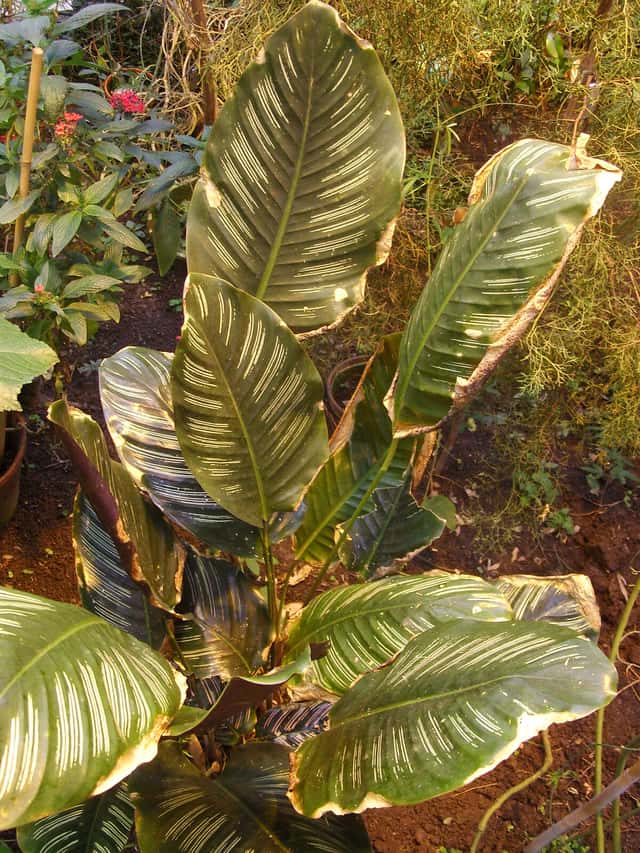
White Star Calathea (Goeppertia majestica) is a medium-care plant from the Marantaceae family. The White Star Calathea (Goeppertia majestica), formerly classified as Calathea majestica or Calathea ornata 'Majestica', is a tropical foliage plant in the Marantaceae family, closely related to the popular prayer plants. Its large, oval to lance-shaped leaves display fine white or cream pinstripes...
White Star Calathea grows up to 90cm, spread of 60cm, watering every 7 days, 18°C – 27°C, 60–80% humidity. It is suitable for indoor environments and safe for pets.
Unlike many popular species, White Star Calathea is safe to keep around pets. Without adequate drainage, root rot can develop within 14 days.
How to Care for White Star Calathea?
TLDR: White Star Calathea needs Partial shade, watering every 7 days, and temperatures between 18-27°C with 60-80% humidity.
How Often Should You Water White Star Calathea?
Water when the top 2 cm (about an inch) of soil feels dry to the touch, always using filtered water, rainwater, or tap water left uncovered overnight to let chlorine and fluoride evaporate. Never let the plant sit in standing water to avoid root rot.
How Much Light Does White Star Calathea Need?
Provide bright indirect light for 8-10 hours a day, such as near an east- or north-facing window, or a bright spot filtered by a sheer curtain. Direct sun fades the leaf pattern and can scorch it; too little light causes slow growth and dull coloring.
What Is the Best Soil for White Star Calathea?
Use a light, well-draining, organically rich mix — combine quality potting soil with coco coir or peat and perlite to retain moisture without waterlogging the roots.
What Pot Should You Use for White Star Calathea?
A ceramic or plastic pot with generous drainage holes; avoid unglazed terracotta, which dries out the soil too quickly for this moisture-loving species.
Care Schedule
Fertilize
Every 21 days
Misting
Every 3 days
Rotate
Every 14 days
Repot
Every 365 days
What Is White Star Calathea and Where Does It Come From?
The White Star Calathea (Goeppertia majestica), formerly classified as Calathea majestica or Calathea ornata 'Majestica', is a tropical foliage plant in the Marantaceae family, closely related to the popular prayer plants. Its large, oval to lance-shaped leaves display fine white or cream pinstripes radiating from the central vein against a glossy dark-green background, with undersides flushed deep purple — a dramatic contrast that earns it the "white star" nickname. Native to the humid tropical forests of South America, the plant follows the circadian rhythm typical of the genus Goeppertia, raising and folding its leaves in the evening in a movement called nyctinasty, as if in prayer. It is a highly popular indoor choice for its lush ornamental form and because it is completely non-toxic to cats, dogs, and humans, though it demands close attention to air humidity, water quality, and temperature stability to keep its leaves lush and free of crispy tips.
How to Propagate White Star Calathea?
Clump division
Divide in spring or summer during active growth, and always use sterilized tools to prevent root contamination.
- 1 Remove the plant from its pot and gently shake off excess soil from the roots
- 2 Locate natural divisions with their own roots and at least 2-3 leaves
- 3 Separate the clumps by hand or with a sterilized knife, cutting rhizomes if needed
- 4 Plant each division in its own pot with a light, organically rich mix
- 5 Water thoroughly and keep in bright indirect light with high humidity until established
Materials needed:
How Big Does White Star Calathea Grow?
TLDR: White Star Calathea can reach up to 90cm tall with Medium growth rate.
Max height
90cm
Spread
60cm
Growth rate
Medium
Foliage
Evergreen
Plant Uses
Ornamental
Great for decoration
Air Purifying
Improves air quality
Is your plant showing symptoms?
Click on the symptom to discover possible causes:
What Diseases Commonly Affect White Star Calathea?
TLDR: White Star Calathea is susceptible to 13 known diseases. Monitor regularly for early detection.
Spider Mites
Spider mites are tiny arachnids (less than 1/20 inch long) related to spiders and ticks that feed on plant sap. They thrive in hot, dry conditions and can cause significant damage to ornamental and vegetable plants. During severe infestations, crop losses can reach 14% or higher as these pests disrupt vital plant processes including photosynthesis, carbon dioxide absorption, and transpiration.
Root Rot
Root rot is a serious fungal disease that affects the root system of plants, causing them to decay and die. It is primarily caused by overwatering, poor drainage, or soil-borne fungi such as Pythium, Phytophthora, Rhizoctonia, and Fusarium. The disease thrives in waterlogged conditions where roots are deprived of oxygen, making them susceptible to fungal infection.
Leaf Spot
Leaf spot is a common fungal disease caused by various pathogens including Alternaria, Ascochyta, Colletotrichum, Septoria, and Venturia. It primarily affects leaves, causing discolored spots that can lead to premature leaf drop if left untreated.
Alternaria Leaf Spot
Alternaria leaf spot is a common fungal disease caused by Alternaria solani and Alternaria alternata that affects a wide range of plants including tomatoes, potatoes, brassicas, and ornamentals. The disease thrives in warm, humid conditions and can cause significant crop damage if left untreated. Spores overwinter on plant debris and can attach to seeds, making complete elimination difficult.
Meaning & Symbolism
Like other prayer plants, it symbolizes peace, unity, and devotion, thanks to the nightly movement of its leaves, which rise and fold as if in prayer.
Fun Facts
The "white star" name comes from the light stripe pattern radiating from the central vein, resembling star rays.
Its leaves move throughout the day, rising at night in a phenomenon called nyctinasty, shared by the entire Marantaceae family.
It was formerly classified as Calathea majestica and Calathea ornata "Majestica" before the genus Calathea was reclassified as Goeppertia.
The leaf undersides are a deep reddish-purple, creating a striking contrast with the dark green upper surface.
Frequently asked questions
Is the White Star Calathea toxic to cats and dogs?
Why are the leaf tips on my White Star Calathea turning brown?
What is the best light position for this plant?
How often should I water a White Star Calathea?
Compare with similar plants
| Attribute | Difficulty | Light | Watering | Pet Safe |
|---|---|---|---|---|
| Dark Fieldcap | Medium | Low light | 2d | ⚠️ |
| Azalea | Medium | Partial shade | 3d | ⚠️ |
| Muriel's Bamboo | Medium | Partial shade | 3d | ✓ |
| Bougainvillea | Medium | Direct sun | 7d | ⚠️ |
Choose & Compare
Sources & References
- NC State Extension - Goeppertia majestica
- Calathea White Star Care - My Little Jungle
- Goeppertia majestica Plant Care - Greg App
- Calathea Majestica White Star Care Guide - Garden Pals
- Goeppertia majestica Care Guide - ForwardPlant
- Calathea Pseudomonas Leaf Spot - UMass Amherst CAFE
- Bacterial Leaf Spot of Calathea spp. - FDACS




