Rosaceae
Whitebeam: The Complete Growing Guide for Aria edulis
Aria edulis
A tough, low-maintenance tree well suited to gardens, streets and parks. Grows best in full sun, which improves fruiting, but tolerates light shade. Once established it is drought tolerant and needs little more than occasional watering in dry spells and light winter pruning.
Every 14 days
Bright indirect
-20° - 35°C
40% - 70%
Categories
What is Whitebeam?
Whitebeam (Aria edulis) is a medium-care plant from the Rosaceae family. The whitebeam (Aria edulis, synonym Sorbus aria) is a deciduous tree in the Rosaceae family, native to Europe, North Africa and western Asia. It forms a compact, domed crown with oval, serrated leaves that are dark green and glossy above, and covered in a felty white-grey down beneath, giving the tr...
Whitebeam grows up to 12.0m, spread of 800cm, watering every 14 days, -20°C – 35°C, 40–70% humidity. It is not suitable for indoor environments and safe for pets.
Unlike many popular species, Whitebeam is safe to keep around pets.
How to Care for Whitebeam?
TLDR: Whitebeam needs Bright indirect, watering every 14 days, and temperatures between -20-35°C with 40-70% humidity.
How Often Should You Water Whitebeam?
Water regularly during the first year after planting to help roots establish. Once established, the tree is drought tolerant and only needs supplemental watering during prolonged dry spells.
How Much Light Does Whitebeam Need?
Performs best in full sun, which encourages heavier fruiting, though it also grows well in light woodland shade.
What Is the Best Soil for Whitebeam?
Adapts to sandy, clay or loamy soils as long as they are well drained. Naturally prefers chalk or limestone soils but tolerates a range from mildly acidic to alkaline.
What Pot Should You Use for Whitebeam?
A large, deep container (minimum 40L) suits young saplings before permanent planting; best grown directly in the ground given its tree habit.
What Is Whitebeam and Where Does It Come From?
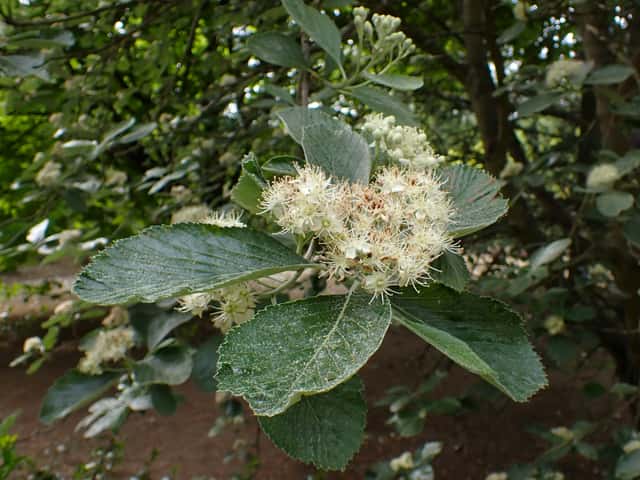
The whitebeam (Aria edulis, synonym Sorbus aria) is a deciduous tree in the Rosaceae family, native to Europe, North Africa and western Asia. It forms a compact, domed crown with oval, serrated leaves that are dark green and glossy above, and covered in a felty white-grey down beneath, giving the tree its common name. Cream-white flowers appear in clusters in spring, followed in autumn by scarlet berries that only become palatable once "bletted" (softened by frost or storage).
How to Propagate Whitebeam?
Seed sowing
Cold stratification is essential to break seed dormancy; without it germination is patchy and slow.
- 1 Collect seeds from ripe berries in autumn
- 2 Cold stratify in moist medium for 3-4 months
- 3 Sow into pots or a nursery bed with well-drained compost
- 4 Keep in a cool, shaded spot until germination
- 5 Transplant seedlings to their final position after 1-2 years
Materials needed:
How Big Does Whitebeam Grow?
TLDR: Whitebeam can reach up to 12.0m tall with Medium growth rate.
Max height
12.0m
Spread
8.0m
Growth rate
Medium
Foliage
Deciduous
Plant Uses
Ornamental
Great for decoration
Edible
Can be consumed
Medicinal
Medicinal properties
Medicinal Uses
- Flowers and fruit are mildly diuretic and laxative, traditionally used for painful menstruation, constipation and kidney complaints
Culinary Uses
- Berries edible raw once bletted (softened by frost/storage), or cooked into jams, preserves and liqueurs
Is your plant showing symptoms?
Click on the symptom to discover possible causes:
What Diseases Commonly Affect Whitebeam?
TLDR: Whitebeam is susceptible to 7 known diseases. Monitor regularly for early detection.
Fire Blight
Fire blight is a highly destructive and contagious bacterial disease caused by Erwinia amylovora. It primarily affects plants in the Rosaceae family, including apple, pear, quince trees, and various ornamental plants. The disease can destroy an entire orchard in a single growing season under ideal conditions, with the bacterium moving approximately 11 inches per week in new growth.
Canker
Canker is a disease caused by various fungi and bacteria that create necrotic, sunken areas on bark of branches, stems, and trunks. Pathogens enter through wounds and natural openings, especially when plants are stressed. Canker can gradually weaken or kill branches by disrupting water and nutrient flow.
Crown Gall
Crown gall is a bacterial disease caused by Agrobacterium tumefaciens that affects over 140 species of plants. The bacteria insert DNA into plant cells, causing them to divide uncontrollably and form large tumor-like growths (galls) primarily on roots, stems, and at the soil line. These galls restrict water and nutrient flow, severely impacting plant health and potentially killing the plant.
Powdery Mildew
Powdery mildew is a common fungal disease caused by various fungi species including Erysiphe, Podosphaera, Oïdium, and Leveillula. It affects over 10,000 plant species worldwide. The disease thrives in warm, dry climates with high humidity and appears as a distinctive white powdery coating on plant surfaces.
Meaning & Symbolism
In European tradition, the whitebeam symbolizes resilience and protection, thriving on rocky slopes and poor soils where few other trees survive. Its scarlet autumn berries evoke abundance and preparation for winter.
Fun Facts
The name "whitebeam" comes from the white-grey felted underside of its leaves
The berries were traditionally called "chess apples" in north-west England
It can take 10-20 years before the tree starts fruiting
Young leaves emerge almost white before darkening to green
Frequently asked questions
Is whitebeam toxic to pets?
When can whitebeam berries be eaten?
Does whitebeam need frequent pruning?
What soil suits whitebeam best?
Compare with similar plants
| Attribute | Difficulty | Light | Watering | Pet Safe |
|---|---|---|---|---|
| Dark Fieldcap | Medium | Low light | 2d | ⚠️ |
| Azalea | Medium | Partial shade | 3d | ⚠️ |
| Muriel's Bamboo | Medium | Partial shade | 3d | ✓ |
| Bougainvillea | Medium | Direct sun | 7d | ⚠️ |




