Orchidaceae
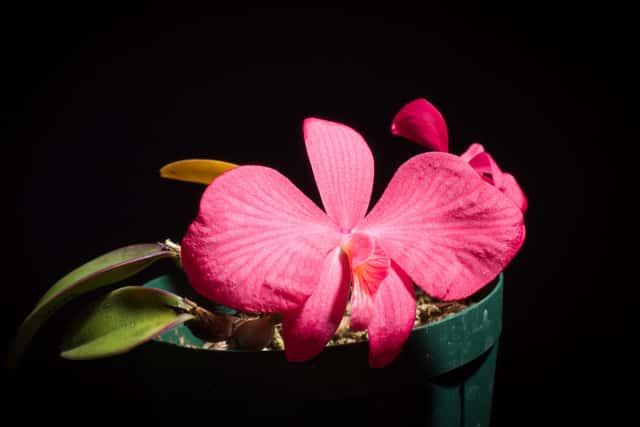
Wittig's Cattleya (Cattleya wittigiana)
Cattleya wittigiana
Grow mounted on cork or in a small, very open bark mix under bright, indirect light with strong air movement. Water generously through the growing season, tapering slightly in the coolest part of winter, and never let the plant sit in stagnant moisture. Keep humidity high and night temperatures cool for best flowering.
Every 3 days
Bright indirect
12° - 28°C
70% - 85%
Categories
What is Wittig's Cattleya?
Wittig's Cattleya (Cattleya wittigiana) is a hard-care plant from the Orchidaceae family. Cattleya wittigiana is a mini-miniature epiphytic orchid native to the misty cloud forests of the Mata Atlantica in Espirito Santo and Minas Gerais, Brazil, where it clings to mossy, rough-barked trees at elevations of 700-2000 m. Formerly classified as Sophronitis wittigiana (and closely related to...
Wittig's Cattleya grows up to 15cm, spread of 15cm, watering every 3 days, 12°C – 28°C, 70–85% humidity. It is suitable for indoor environments and safe for pets.
Unlike easy-care plants, Wittig's Cattleya demands constant attention to humidity and light. Not recommended for beginners. Unlike many popular species, Wittig's Cattleya is safe to keep around pets. Without adequate drainage, root rot can develop within 7 days.
How to Care for Wittig's Cattleya?
TLDR: Wittig's Cattleya needs Bright indirect, watering every 3 days, and temperatures between 12-28°C with 70-85% humidity.
How Often Should You Water Wittig's Cattleya?
Water frequently and generously while actively growing, keeping the roots evenly moist but never waterlogged; ease off slightly in the coolest weeks of winter to mimic its cloud-forest dry season.
How Much Light Does Wittig's Cattleya Need?
Provide bright, indirect to filtered light, similar to an unshaded greenhouse bench; some gentle early morning sun is tolerated but avoid harsh midday sun that can scorch the thin leaves.
What Is the Best Soil for Wittig's Cattleya?
Mount on cork bark or pot in a fine, fast-draining bark/sphagnum mix; excellent airflow around the roots is essential to prevent rot.
What Pot Should You Use for Wittig's Cattleya?
Mounted on cork bark, or a small clay/plastic basket with open bark mix, to maximize drainage and airflow around the roots.
Care Schedule
Fertilize
Every 14 days
Repot
Every 730 days
What Is Wittig's Cattleya and Where Does It Come From?
Cattleya wittigiana is a mini-miniature epiphytic orchid native to the misty cloud forests of the Mata Atlantica in Espirito Santo and Minas Gerais, Brazil, where it clings to mossy, rough-barked trees at elevations of 700-2000 m. Formerly classified as Sophronitis wittigiana (and closely related to Cattleya coccinea), it produces tiny globular pseudobulbs, each topped with a single stiff leathery leaf, yet surprises growers with rose-pink to magenta flowers 4-6.5 cm across during the winter months. In habitat it is pollinated by hummingbirds and thrives in cool, bright, windy, humid conditions typical of exposed mountain ridges.
How to Propagate Wittig's Cattleya?
Division of pseudobulb clumps
Avoid watering directly onto fresh cuts for the first few days; a light misting of the surrounding air is enough until new roots appear.
- 1 Wait until the clump has at least 4-6 healthy pseudobulbs before dividing.
- 2 Using a sterile blade, cut the rhizome so each new division keeps 3 or more pseudobulbs including at least one active growth.
- 3 Let cut surfaces dry and callus for a few hours before mounting or potting.
- 4 Mount each division on cork bark or pot in fresh, open bark mix and keep humidity high while new roots establish.
Materials needed:
How Big Does Wittig's Cattleya Grow?
TLDR: Wittig's Cattleya can reach up to 15cm tall with Slow growth rate.
Max height
15cm
Spread
15cm
Growth rate
Slow
Foliage
Evergreen
Plant Uses
Ornamental
Great for decoration
Is your plant showing symptoms?
Click on the symptom to discover possible causes:
What Diseases Commonly Affect Wittig's Cattleya?
TLDR: Wittig's Cattleya is susceptible to 8 known diseases. Monitor regularly for early detection.
Root Rot
Root rot is a serious fungal disease that affects the root system of plants, causing them to decay and die. It is primarily caused by overwatering, poor drainage, or soil-borne fungi such as Pythium, Phytophthora, Rhizoctonia, and Fusarium. The disease thrives in waterlogged conditions where roots are deprived of oxygen, making them susceptible to fungal infection.
Phytophthora Root Rot
Disease caused by fungus-like organisms (oomycetes) that live in soil and can survive for years. It affects roots, stem, and crown of plants, being especially severe in waterlogged or poorly drained soils. It is the second most common cause of root rot in trees and shrubs.
Scale Insects
Scale insects are small sap-sucking pests that appear as brown, shell-like bumps on plant stems and leaves. There are over 25 species, divided into armored (hard) and unarmored (soft) scales. They feed by piercing plant tissue and extracting sap, which weakens the plant and can lead to yellowing, stunted growth, and even death if left untreated. They also excrete honeydew, which attracts ants and promotes sooty mold growth.
Mealybugs
Mealybugs are small, soft-bodied insects covered with a white, waxy, cottony material. They are common pests of houseplants and outdoor plants in mild climates. These sap-sucking insects feed on plant tissue, causing damage, stunted growth, and can lead to plant death if left untreated. They produce sticky honeydew which attracts sooty mold.
Meaning & Symbolism
A prized miniature collector's orchid whose oversized, jewel-toned blooms relative to its tiny size symbolize hidden beauty, resilience, and rare refinement.
Fun Facts
Despite being one of the smallest Cattleya relatives, its flowers can span up to 6.5 cm - nearly as wide as the whole plant is tall.
It was formerly placed in the genus Sophronitis before molecular studies folded that group into Cattleya.
In the wild it is pollinated by hummingbirds drawn to its bright rosy color.
Frequently asked questions
Is Cattleya wittigiana easy to grow?
Should I mount it or pot it?
When does it bloom?
Is Cattleya wittigiana toxic to pets?
Compare with similar plants
| Attribute | Difficulty | Light | Watering | Pet Safe |
|---|---|---|---|---|
| Sticky false asphodel | Hard | Bright indirect | 1d | ✓ |
| Creeping bentgrass | Hard | Direct sun | 3d | ✓ |
| Bulbous Adder's-tongue | Hard | Partial shade | 4d | ✓ |
| Crystal Anthurium | Hard | Partial shade | 7d | ⚠️ |