Gesneriaceae
Tree Gloxinia: Perfect Indoor Houseplant
Kohleria eriantha
A moderately demanding plant: it requires bright, filtered light without direct sun, evenly moist but never soggy soil, high humidity (50-70%), and temperatures between 16-27°C (60-80°F). From fall to winter, watering and fertilization should be reduced while the plant is in its dormant state.
Every 5 days
Partial shade
16° - 27°C
50% - 70%
Categories
What is Tree Gloxinia?
Tree Gloxinia (Kohleria eriantha) is a medium-care plant from the Gesneriaceae family. Kohleria eriantha (often treated today as a synonym of Kohleria hirsuta) is a rhizomatous (scaly-rooted) perennial from the Gesneriaceae family—the same family as the African violet—native to the tropical mountain cloud forests of South America, primarily Colombia and Ecuador. Its velvety, hairy lea...
Tree Gloxinia grows up to 90cm, spread of 40cm, watering every 5 days, 16°C – 27°C, 50–70% humidity. It is suitable for indoor environments and safe for pets.
Unlike many popular species, Tree Gloxinia is safe to keep around pets. Without adequate drainage, root rot can develop within 10 days.
How to Care for Tree Gloxinia?
TLDR: Tree Gloxinia needs Partial shade, watering every 5 days, and temperatures between 16-27°C with 50-70% humidity.
How Often Should You Water Tree Gloxinia?
Water with lukewarm, soft water when the top 2-3 cm of soil has dried out, avoiding the leaves. Reduce watering frequency in the fall; once a week is usually sufficient in winter.
How Much Light Does Tree Gloxinia Need?
Prefers bright, indirect light; an east- or north-facing window is ideal. Avoid harsh midday sun, as it can scorch the hairy foliage.
What Is the Best Soil for Tree Gloxinia?
Requires a loose, well-draining, slightly acidic medium: a peat-based or African violet potting mix enriched with perlite or coarse sand.
What Pot Should You Use for Tree Gloxinia?
A shallow, well-draining clay or plastic pot with drainage holes is ideal—the shallow rhizomes do not require a deep container, and excess water must be able to escape easily.
Care Schedule
Fertilize
Every 14 days
Repot
Every 365 days
What Is Tree Gloxinia and Where Does It Come From?
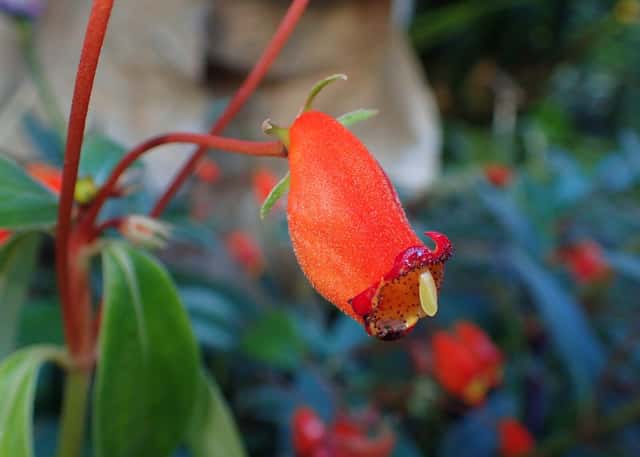
Kohleria eriantha (often treated today as a synonym of Kohleria hirsuta) is a rhizomatous (scaly-rooted) perennial from the Gesneriaceae family—the same family as the African violet—native to the tropical mountain cloud forests of South America, primarily Colombia and Ecuador. Its velvety, hairy leaves and tubular, orange-red flowers with yellow-spotted throats that bloom from summer to fall make it a popular potted houseplant. Due to its rhizomes, it tolerates drought better than persistently waterlogged soil.
How to Propagate Tree Gloxinia?
How Big Does Tree Gloxinia Grow?
TLDR: Tree Gloxinia can reach up to 90cm tall with Medium growth rate.
Max height
90cm
Spread
40cm
Growth rate
Medium
Foliage
Evergreen
Plant Uses
Ornamental
Great for decoration
Is your plant showing symptoms?
Click on the symptom to discover possible causes:
What Diseases Commonly Affect Tree Gloxinia?
TLDR: Tree Gloxinia is susceptible to 8 known diseases. Monitor regularly for early detection.
Root Rot
Root rot is a serious fungal disease that affects the root system of plants, causing them to decay and die. It is primarily caused by overwatering, poor drainage, or soil-borne fungi such as Pythium, Phytophthora, Rhizoctonia, and Fusarium. The disease thrives in waterlogged conditions where roots are deprived of oxygen, making them susceptible to fungal infection.
Powdery Mildew
Powdery mildew is a common fungal disease caused by various fungi species including Erysiphe, Podosphaera, Oïdium, and Leveillula. It affects over 10,000 plant species worldwide. The disease thrives in warm, dry climates with high humidity and appears as a distinctive white powdery coating on plant surfaces.
Rust
Rust is a common fungal disease caused by fungi in the order Pucciniales that affects a wide variety of plants. The disease gets its name from the characteristic orange, yellow, or reddish-brown pustules that appear on leaves, resembling metal rust. This obligate fungal parasite requires living plants to survive and can cause significant economic losses in agricultural crops.
Gray Mold (Botrytis Blight)
Gray mold, caused by the fungus Botrytis cinerea, is a widespread necrotrophic pathogen affecting over 1,400 plant species. It thrives in cool, humid conditions and attacks weakened or aging plant tissues, causing soft rot and characteristic gray fuzzy growth.
Compare with similar plants
| Attribute | Difficulty | Light | Watering | Pet Safe |
|---|---|---|---|---|
| Dark Fieldcap | Medium | Low light | 2d | ⚠️ |
| Azalea | Medium | Partial shade | 3d | ⚠️ |
| Muriel's Bamboo | Medium | Partial shade | 3d | ✓ |
| Bougainvillea | Medium | Direct sun | 7d | ⚠️ |




