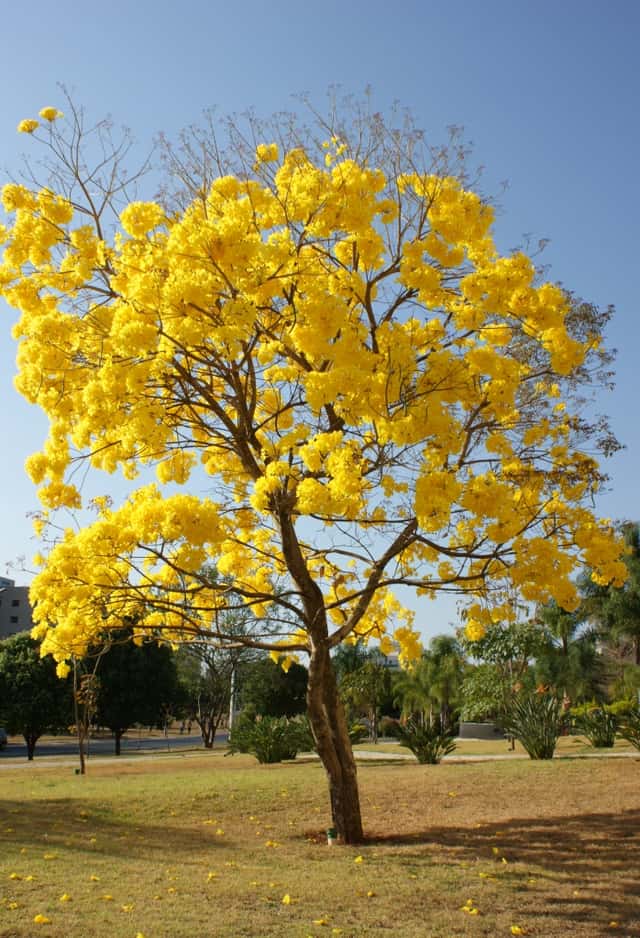
Bignoniaceae
Yellow ipê: Full Sun Plant
Handroanthus serratifolius
A large tree for full sun and well-drained soil. It needs watering in its first years but then becomes drought-resistant; ideal for streets, plazas and large gardens.
Every 7 days
Direct sun
5° - 40°C
40% - 80%
Categories
What is Yellow ipê?
Yellow ipê (Handroanthus serratifolius) is a medium-care plant from the Bignoniaceae family. Handroanthus serratifolius, the yellow ipê, is a deciduous tree native to the forests and savannas of South America, especially Brazil. In spring it drops its leaves and covers itself entirely in golden-yellow flowers, one of the most striking displays of Brazilian flora.
Yellow ipê grows up to 30.0m, spread of 2500cm, watering every 7 days, 5°C – 40°C, 40–80% humidity. It is not suitable for indoor environments and safe for pets.
Unlike many popular species, Yellow ipê is safe to keep around pets.
How to Care for Yellow ipê?
TLDR: Yellow ipê needs Direct sun, watering every 7 days, and temperatures between 5-40°C with 40-80% humidity.
How Often Should You Water Yellow ipê?
Water regularly for the first few years to establish the roots; a mature tree tolerates dry spells well.
How Much Light Does Yellow ipê Need?
Needs full sun; it will not flower or develop well in shade.
What Is the Best Soil for Yellow ipê?
Prefers deep, well-drained soil, tolerating sandy to clay types and a wide pH range.
What Pot Should You Use for Yellow ipê?
A tree for planting in the ground in a spacious site; not suited to permanent container growing.
What Is Yellow ipê and Where Does It Come From?
Handroanthus serratifolius, the yellow ipê, is a deciduous tree native to the forests and savannas of South America, especially Brazil. In spring it drops its leaves and covers itself entirely in golden-yellow flowers, one of the most striking displays of Brazilian flora.
How to Propagate Yellow ipê?
Seed sowing
- Use fresh seed — it loses viability quickly.
- 1 Collect seeds
Gather the winged seeds from ripe pods soon after flowering.
- 2 Sow
Sow in a light, moist mix, covering them lightly.
- 3 Germinate
Keep moist and sunny; they sprout in 1-3 weeks.
Materials needed:
How Big Does Yellow ipê Grow?
TLDR: Yellow ipê can reach up to 30.0m tall with Medium growth rate.
Max height
30.0m
Spread
25.0m
Growth rate
Medium
Foliage
Deciduous
Plant Uses
Ornamental
Great for decoration
Medicinal
Medicinal properties
Medicinal Uses
- The bark (pau d'arco / lapacho) is traditionally used in medicinal infusions
Is your plant showing symptoms?
Click on the symptom to discover possible causes:
What Diseases Commonly Affect Yellow ipê?
TLDR: Yellow ipê is susceptible to 4 known diseases. Monitor regularly for early detection.
Scale Insects
Scale insects are small sap-sucking pests that appear as brown, shell-like bumps on plant stems and leaves. There are over 25 species, divided into armored (hard) and unarmored (soft) scales. They feed by piercing plant tissue and extracting sap, which weakens the plant and can lead to yellowing, stunted growth, and even death if left untreated. They also excrete honeydew, which attracts ants and promotes sooty mold growth.
Aphids
Aphids are small, soft-bodied, pear-shaped insects (1/16 to 1/8 inch long) that feed by sucking nutrient-rich sap from plants. They reproduce rapidly and can quickly weaken plants, causing distorted growth and transmitting plant viruses. Aphids come in various colors including green, black, red, yellow, brown, and gray. They secrete honeydew, a sticky substance that attracts ants and encourages sooty mold growth.
Spider Mites
Spider mites are tiny arachnids (less than 1/20 inch long) related to spiders and ticks that feed on plant sap. They thrive in hot, dry conditions and can cause significant damage to ornamental and vegetable plants. During severe infestations, crop losses can reach 14% or higher as these pests disrupt vital plant processes including photosynthesis, carbon dioxide absorption, and transpiration.
Powdery Mildew
Powdery mildew is a common fungal disease caused by various fungi species including Erysiphe, Podosphaera, Oïdium, and Leveillula. It affects over 10,000 plant species worldwide. The disease thrives in warm, dry climates with high humidity and appears as a distinctive white powdery coating on plant surfaces.
Meaning & Symbolism
National pride and endurance — its golden bloom symbolises the Brazilian spring.
Compare with similar plants
| Attribute | Difficulty | Light | Watering | Pet Safe |
|---|---|---|---|---|
| Dark Fieldcap | Medium | Low light | 2d | ⚠️ |
| Azalea | Medium | Partial shade | 3d | ⚠️ |
| Muriel's Bamboo | Medium | Partial shade | 3d | ✓ |
| Bougainvillea | Medium | Direct sun | 7d | ⚠️ |




