How to Propagate Chinese Money Plant: Where to Cut the Pup Without Harming the Mother Plant
The easiest Chinese money plant propagation uses the soil pups that sprout alongside the plant: cut the connection flush against the mother plant and pot it. Learn where to cut, when to use water or soil, why a leaf alone will not grow into a plant, and how to save a black cutting.
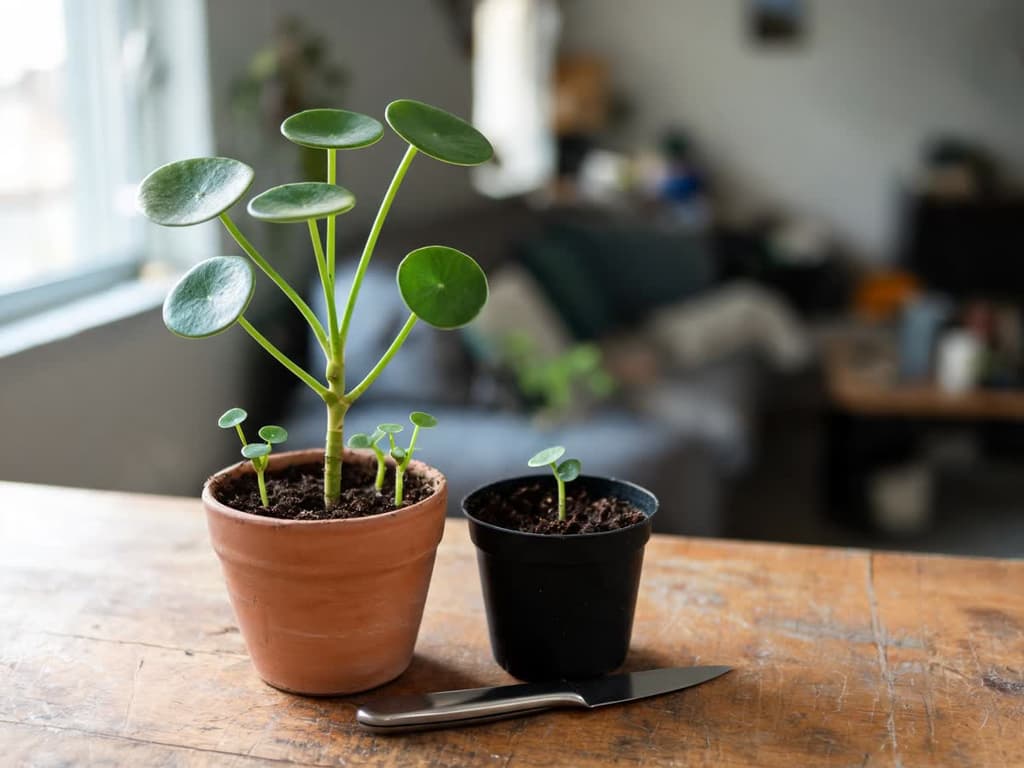
To propagate Chinese money plant, use the pups that sprout from the soil next to the plant. Push aside the soil until you see the underground stem connecting the pup to the mother plant, then cut this stem flush against the mother. Plant the pup in a small pot. The mother plant does not suffer from the cut.
A soil pup is the easiest path because it already comes with roots. Stem tips and leaves with a sliver of stem attached also become plants, but take longer. A leaf plucked alone, without any piece of the stem, produces roots but never sprouts.
This guide covers the round-leaved pilea, Pilea peperomioides, also called the Chinese money plant. The name "money plant" is also used for other plants, and they propagate differently.
Quick summary:
Soil pup 2 inches (5 cm) or taller with 3 or 4 leaves: cut flush against the mother plant and plant directly in soil.
Rootless pup (from the trunk) or stem tip: root in water or moist perlite (a lightweight white granule sold in garden stores) and plant when roots reach 1 inch (2.5 cm).
A leaf needs a sliver of the mother plant's stem to become a plant. Without it, it only grows roots.
The best time is from March to June.
The Four Ways to Propagate Chinese Money Plant
Chinese money plant propagates via soil pups, trunk pups, stem tips, and leaves with a stem sliver. The Royal Horticultural Society (RHS), the UK's gardening charity, calls Chinese money plant one of the easiest houseplants to propagate. NC State Extension, the extension service of North Carolina State University, lists pups and stem cuttings.
Method | What it is | Already has roots? | Time until established | Effect on mother plant |
|---|---|---|---|---|
Soil pup | Plantlet that sprouts from an underground stem next to the mother plant | Yes | 2 to 3 weeks | None |
Trunk pup | Plantlet that sprouts on the mother plant's trunk, above the soil | Sometimes not | No published timeline | None |
Stem tip | The top 2 to 3 inches (5 to 7.5 cm) of a tall plant | No | 4 to 6 weeks in water | The mother plant loses its top and resprouts from the stub |
Leaf with stem sliver | Leaf cut with a small piece of the mother plant's stem | No | About 2 months until a new plantlet appears | A small scar on the stem |
Single leaf | Plucked or fallen leaf, with only its petiole | No | Roots, but does not sprout | None |
The timelines come from different sources cited in each section below. None of them measured the exact success rate of each method.
Soil Pups: Where to Cut
The correct cut is on the underground stem connecting the pup to the mother plant, as close to the mother as possible. This stem runs beneath the soil, is lighter in color than the main trunk, and extends from the base of the mother plant to the pup.
Water the mother plant the day before. A hydrated plant tolerates cutting better, recommends Iowa State University.
Choose a pup that is 2 inches (5 cm) or taller with 3 or 4 of its own leaves.
Gently push the soil aside with your fingers around the pup until you can see the stem connecting it to the mother plant.
Cut this stem with a clean knife or shears, flush against the mother plant. This leaves the longest possible piece attached to the pup, giving it more stem to send out roots.
Plant the pup in a 3 to 4-inch (7 to 10 cm) pot with moist potting soil, burying it up to the base of the leaves.
Keep the soil moist, but not soggy, for the first 2 to 3 weeks.
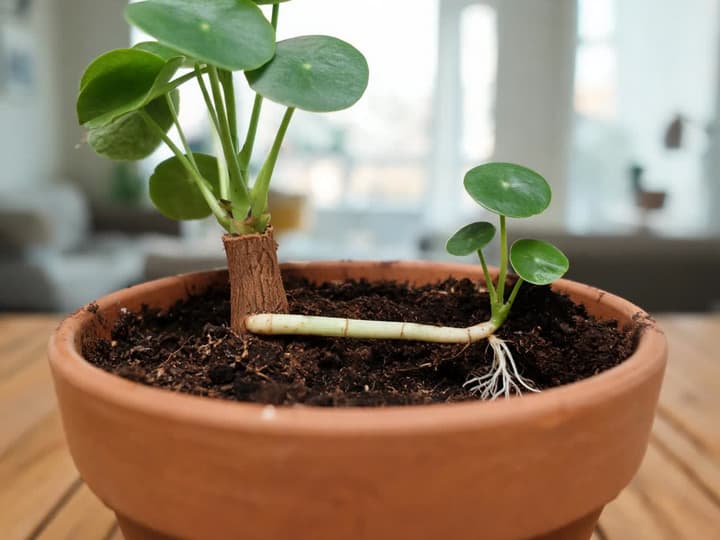
If the pups are tangled and you cannot see the connection, take the whole plant out of its pot. With the soil and roots exposed, you can easily trace which stem leads to which pup.
A soil pup does not need rooting hormone, the powder that accelerates root growth. It already develops roots while still attached to the mother plant.
What Is the Right Pup Size to Separate
No one has tested a strict minimum size. The smallest published figure recommends leaves roughly the size of a coin, around 0.8 inches (2 cm). The largest comes from the Elm Dirt shop guide, which calls for a pup 2 to 3 inches (5 to 7.5 cm) tall. The RHS simply says "when large enough".
The deciding factor is the root system. At 2 inches (5 cm), the pup already has its own roots, according to Elm Dirt, making this the safest size. You can separate a smaller pup, but it will need to go into water or perlite and will take longer to establish.
Trunk Pups and Stem Tips
A pup that grows directly on the trunk, above the soil line, often has no roots at all. Cut it flush against the trunk with a clean blade and treat it like a cutting: root it in water or moist perlite before potting.
A stem tip cutting is the method for a Chinese money plant that has grown leggy, with a bare stem at the bottom and all the leaves clustered at the top. The RHS suggests cutting back leggy stems in spring or summer to encourage fresh shoots from the base.
Cut the top 2 to 3 inches (5 to 7.5 cm) of the stem using clean shears.
Strip off the lower leaves, leaving only the top 3, as outlined in the Savvy Gardening guide.
Root in water or moist perlite. In water, roots take 4 to 6 weeks, according to Elm Dirt.
The mother plant survives this cut. The stub left in the pot usually sprouts along its sides, and these shoots give you a bushier plant. Savvy Gardening adds a caveat: if your Chinese money plant only has a single stem, you are removing its entire crown. In that case, wait for the stub to sprout new growth before pruning again.
A Leaf Alone Roots but Does Not Grow into a Plant
A Chinese money plant leaf plucked on its own, with just its petiole, will root in water but will never form a new plant. Sources diverge on root formation but agree that a new plant will not appear:
The RHS states that Chinese money plant leaves "will root in water or moist compost".
Pilea.com, a site dedicated entirely to Chinese money plants, fills in the rest. The leaf roots, survives in water for months, and then turns yellow and dies without ever producing a pup.
Savvy Gardening reports that a leaf with only its petiole simply rots in water or soil.
The explanation lies in the bud, the dormant growing point located on the stem at the base of each leaf. The leaf itself carries no bud tissue. NC State Extension explains that leaf cuttings only work on plants capable of generating adventitious buds directly from leaf tissue. Chinese money plants, as documented by these sources, cannot form buds from leaves.
A leaf becomes a plant only when cut with a small sliver of the mother plant's stem, which contains the bud. This propagation method is called a leaf-bud cutting:
Choose a healthy leaf, free of blemishes, from a mature plant.
Using a sharp, clean knife, slice a sliver of the main stem along with the petiole. Savvy Gardening instructs cutting from 1/4 inch (6 mm) above to 1/4 inch (6 mm) below the point where the petiole joins the stem.
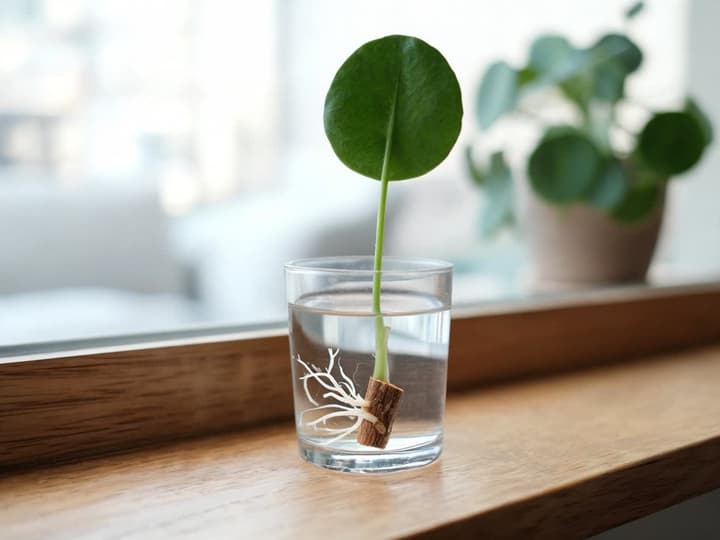
Place the base in a glass of water in bright, indirect light, and refresh the water every week.
Expect roots in 1 to 2 weeks and a new plantlet in 1 month or more, according to pilea.com. The whole process takes roughly 2 months.
Pot the plantlet when it reaches about 3 inches (7.5 cm), leaving the original mother leaf attached.
Peperomia is the opposite case: its leaf forms a bud on its own and turns into a plant, as shown in the guide on propagating peperomia. The sweetheart hoya leaf does the same as the pilea: it grows roots and never sprouts. The guide on propagating hoya teaches the stem cutting with a node that works for it. With peace lily, the leaf does not even root. The guide on propagating peace lilies shows clump division, the only method that works for it.
Chinese Money Plant Propagation in Water vs. Soil
Pups with roots go straight into soil. Rootless cuttings (trunk pups, stem tips, leaf-bud cuttings) can root in water. The key condition is potting them up early, once the roots reach 1 inch (2.5 cm).
Sources differ on water rooting. University of Vermont Extension treats water and soil as a matter of personal preference. Purdue University advises against water rooting because it deprives roots of oxygen, resulting in brittle roots, though their advice focuses on trees and shrubs. Iowa State University, writing specifically about houseplants, takes a middle ground: water works, but roots formed in water are thicker and adjust poorly to potting mix.
This guide follows Iowa State because it addresses houseplants and explains the risks. The risk grows the longer the cutting stays in water. Therefore, when rooting in water:
Change the water 1 to 2 times a week and do not let the water level drop low enough to expose the roots.
Keep only the stem submerged. Keep the petiole and leaf blade above water, as advised by Savvy Gardening.
Pot it up when roots reach about 1 inch (2.5 cm). Longer water roots suffer more shock during the transition.
In the weeks after leaving water, the cutting might wilt or drop a leaf. Iowa State describes this stress and notes that consistent care resolves it.
Another option is rooting in moist perlite, or a blend of perlite and peat moss. Iowa State considers perlite an effective rooting medium because it maintains a balance of water and air. Pure potting soil, according to the same source, drains and aerates too poorly for reliable rooting.
Black, Mushy Chinese Money Plant Cuttings in Water: How to Save Them
You can save the cutting if firm, pale stem remains above the blackened section. A black, mushy base means rot: that tissue is dead, and it will not recover.
Remove the cutting from the water and gently squeeze the stem from the base upward. Any soft, dark tissue is lost. Any firm, green or pale section is still viable.
Cut with a clean blade just above the highest mushy spot. If firm stem tissue remains below the leaves, the cutting has a chance.
Discard the old water and wash the container, or start over in moist perlite in a clean pot.
If the entire stem is soft all the way to the leaf base, discard it. University of Maryland Extension advises discarding heavily infected plants and taking cuttings only from healthy tissue.
Rot in water usually comes from stagnant conditions. Changing the water 1 to 2 times a week and keeping the foliage dry helps prevent the issue. The same rot attacks mature Chinese money plant roots when the potting mix stays waterlogged:
The First Weeks of Your New Cutting
A cutting has taken once it produces new leaves. The Elm Dirt guide gives soil pups 2 to 3 weeks to establish.
Pot: 3 to 4 inches (7 to 10 cm), with drainage holes. An oversized pot holds excess moisture for too long, warns the RHS.
Soil: moist, not waterlogged, for the first 2 to 3 weeks. After that, water when the top inches dry out, just like the mother plant.
Light: bright, indirect light for 4 to 6 hours a day, without direct sun hitting the foliage. That is the light range Iowa State recommends for rooting.
Temperature: air temperatures between 65 °F and 75 °F (18 °C to 24 °C) are ideal for root development, according to Iowa State. The RHS advises keeping temperatures consistently above 50 °F (10 °C).
To check if a cutting has rooted without unpotting it, University of Vermont Extension advises giving it a gentle tug: if it resists, roots have taken hold. Elm Dirt recommends against pulling. This guide follows the university extension, using a very light tug.
Best time to propagate pilea
The best time runs from March to June, during spring and early summer. NC State Extension points to spring and early summer, when the plant is in active growth.
Iowa State adds that most houseplants root at any time of year. In winter, from December to February, the cutting takes longer because roots form faster in the heat.
Frequently Asked Questions
Do you need rooting hormone to propagate Chinese money plant?
For soil pups, no: they already have roots. For stem tips, Savvy Gardening applies hormone powder to the base before planting. University of Vermont Extension states that rooting hormone is not required. No source marks it as mandatory for Chinese money plant. If you use it, follow the package label directions.
How long does a Chinese money plant cutting take to root?
A soil pup establishes in 2 to 3 weeks because it already has roots. A stem tip takes 4 to 6 weeks in water. A leaf-bud cutting produces roots in 1 to 2 weeks, and a new plantlet appears in 1 month or more. The entire leaf-bud process takes about 2 months.
Is Chinese money plant safe for cats and dogs?
NC State Extension lists Pilea peperomioides as nontoxic to pets and children. The ASPCA, which maintains an animal poison control database, does not have a dedicated entry for this species. Any houseplant can cause vomiting in pets if ingested in large quantities.
Can a fallen Chinese money plant leaf grow into a new plant?
No. A naturally shed leaf is usually old or declining, and even a healthy leaf plucked without stem tissue will only grow roots. To produce a new plant, you must cut the leaf with a sliver of stem tissue attached, as explained in the leaf propagation section.
Conclusion
To propagate Chinese money plant without risk, wait for a soil pup to exceed 2 inches (5 cm), slice the underground stem flush against the mother plant, and pot it up. Reserve water propagation for rootless cuttings, moving them to soil once roots reach 1 inch (2.5 cm). Remember that a leaf will only grow into a plant if you include a sliver of the stem.
If your plant does not have round leaves joined in the center, it is a different species and requires a different propagation technique. Bloom identifies your plant from a photo and provides custom care instructions. The app is available for iPhone, and the free plan includes 2 plant identifications per month.
Sources
Royal Horticultural Society (RHS). How to grow pilea.
NC State Extension. Pilea peperomioides, Plant Toolbox.
NC State Extension. Extension Gardener Handbook, chapter 13: Propagation.
Iowa State University Extension. How to propagate houseplants by stem tip cuttings.
University of Vermont Extension. More, please: propagating houseplants.
Purdue Consumer Horticulture. Propagate trees and shrubs from cuttings.
University of Maryland Extension. Root rots on indoor plants.
Pilea.com. Can you propagate Pilea from a leaf?
Savvy Gardening. Chinese money plant propagation.
Elm Dirt. Chinese money plant (Pilea) care and propagation guide.
Related articles
How to Care for a Goldfish Plant: Light, Watering, and Blooms
How to care for a goldfish plant: bright light without strong sun, water when the soil surface dries, and humid air. Learn how to tell a Nematanthus from a Columnea, why it drops leaves, and how to get it to bloom again.
Lavender Leaves Turning Yellow: Where the Yellowing Starts Shows the Cause
Lower leaves turning yellow with moist soil means overwatered roots, the most common cause. Old leaves drying one by one on woody stems is normal. Take the stem and root test, see if your plant can still be saved, and find out what to do today.
How to Propagate Lavender: Where to Cut and Why Cuttings Rot
A lavender cutting comes from a non-flowering branch tip, about 4 inches long, planted in sandy soil that never stays soggy. Learn where to cut, rooting times, seasonality in Brazil, and what to do if the base turns black.