How to Propagate Hoya: Where to Cut and How Long It Takes
Take a 2-node cutting, root it in water or soil, and see why a single sweetheart hoya leaf grows roots but never turns into a vine. Here is where to cut without hurting the mother plant and how long new leaves take to appear.
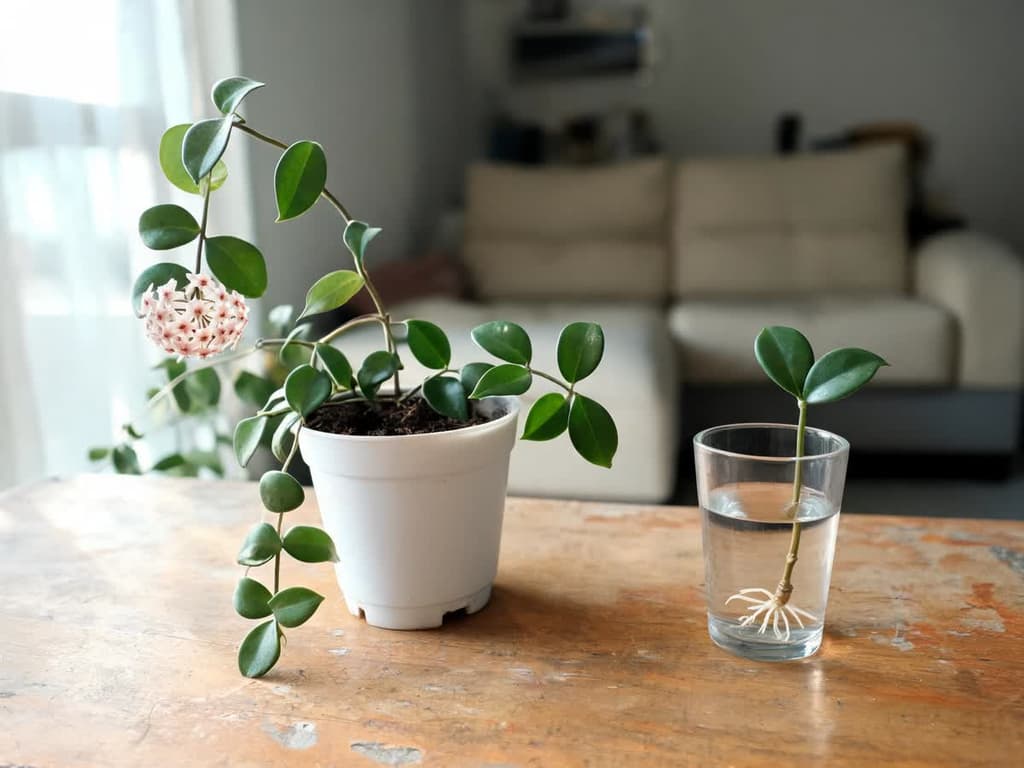
To propagate a wax plant (Hoya), cut a stem section with 2 nodes and strip the leaves from the bottom node. Set that bare node in water or bury it in potting mix, which gives the stem a light medium to root into. Roots show up within a few weeks, and warmer temps speed things up.
A single leaf without a node will grow roots, but it can sit there for the rest of its life without ever putting out a vine. That is why single sweetheart hoya (Hoya kerrii) leaves sold in tiny pots almost never grow. The mother plant will be just fine as long as your cut ends just above a node and avoids the flowering spurs.
Quick summary:
A node is the swelling along the stem where leaves attach. That is where new roots and growth buds emerge.
Aim for a 2-node cutting: bury or submerge the bottom node, and leave the top node exposed with its leaves intact.
In spring and early summer, a wax plant cutting roots in 2 to 3 weeks in a glass of water (Royal Horticultural Society).
A sweetheart hoya leaf without stem tissue can root, but it will never turn into a climbing vine, according to Iowa State University Extension.
Rooting hormone is completely optional: in a 2021 study on two hoya species, every single cutting rooted without it.
Where to cut your hoya for propagation
A node is the slightly swollen point on the stem where a pair of leaves meets the vine. In the pocket between each leaf and the stem, called the axil, sits a dormant bud. Iowa State University Extension notes that new roots on a cutting develop from the buds along the lower stem.
Your cutting and your mother plant need cuts in different spots. The cutting needs 2 nodes, so you make your cut right below the bottom node. On the mother plant, trim just above a remaining node, leaving an active bud ready to push out new growth. If you leave a bare stub on the mother plant, snip it back to just above the nearest node.
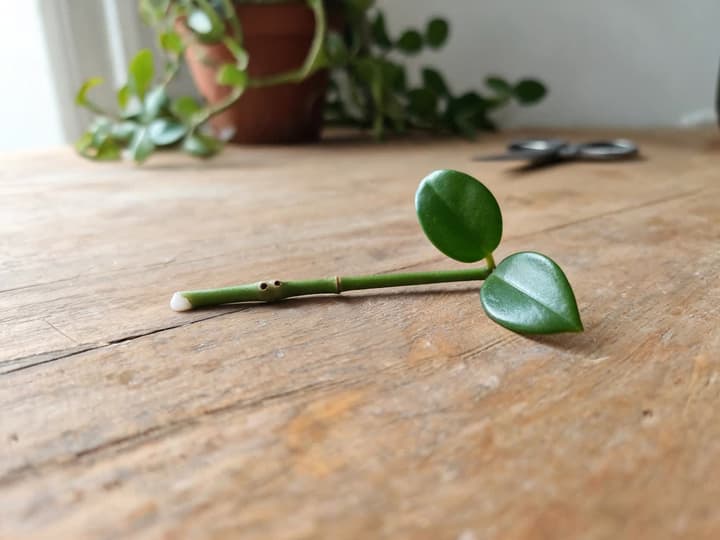
Taking off one or two stems will not kill the plant. The Royal Horticultural Society (RHS), the British horticultural society, says that vigorous species can be pruned every year to keep them smaller. The mother plant, however, cannot be cut twice:
The flower spur, the short stub where the cluster of flowers emerged. The North Carolina State University hoya carnosa plant profile (NC State) notes that flowers bloom from it again for several years. Cutting off the spur means cutting off future blooms.
The tender, thin tip with no mature leaves. The RHS recommends taking cuttings from the previous year's growth, which is firmer and holds fully developed leaves.
Wear gloves. The RHS cautions that milky hoya sap can irritate bare skin, and the University of Florida reminds growers to keep drips off furniture. Spread some newspaper over your table or floor before you start snipping.
Propagating hoya from a leaf: why single leaves do not grow vines
A hoya leaf without a node usually roots and almost never produces shoots. According to the NC State propagation manual, a leaf cutting does not carry an axillary bud. That is why it only works on plants capable of forming adventitious buds, which are buds created from scratch on the cut tissue.
About hoyas, Iowa State says that a leaf roots, but does not form a vine without a node attached. Sweetheart hoya is usually sold as a single leaf, almost always without a node. Kept like that, it remains a single leaf its entire life, barely changing.
The NC State manual puts hoya on a list of plants that propagate from a leaf with a petiole, the leaf stalk. African violet and peperomia are on the same list. The sweetheart hoya profile from the same university says the opposite: a detached leaf rarely grows well without a piece of stem attached.
This guide follows the NC State profile on sweetheart hoya and Iowa State Extension, since both address hoyas directly. The general manual simply groups hoya into a broad list of five plants. To date, no published study has documented how often a blind leaf cutting actually beats the odds and sprouts.
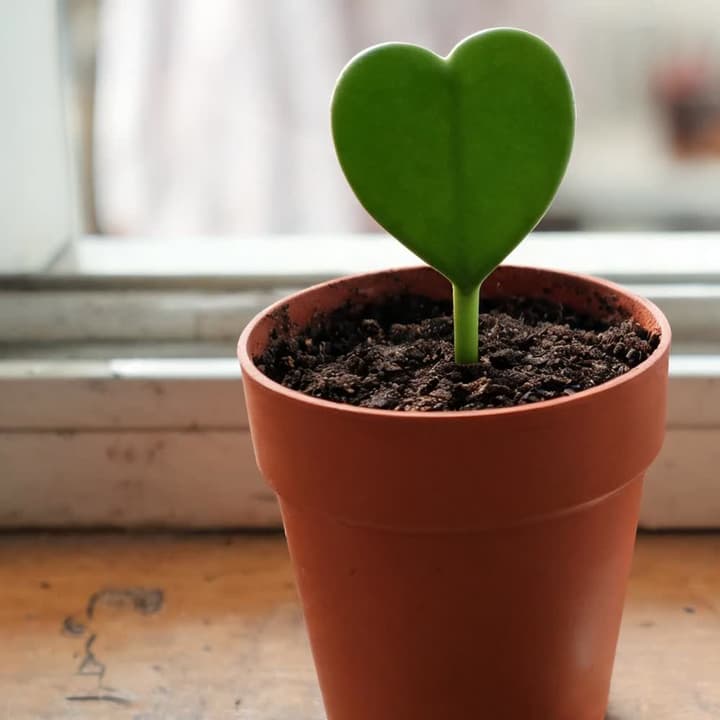
If you brought home a potted heart leaf, check where the base enters the potting mix. A sliver of true stem, thinner than the leaf base and showing a node mark, gives you a real shot at a growing vine. A leaf that enters the mix purely by its petiole will stay a single heart leaf forever.
A watermelon peperomia leaf produces fresh plantlets from the base of its stalk because the species forms buds along cut tissue. A peace lily leaf in water does not even root and rots from the base.
You can take single-leaf cuttings from a wax plant, provided each leaf has its own node. NC State calls this a leaf-bud cutting and recommends this method for many vines. Every node on the stem becomes a cutting. Cut the stem into single-node pieces, keeping the leaves and a small piece of stem. Bury the node about an inch deep and let the leaves stick out.
Step-by-step: how to propagate hoya from stem cuttings
Stem cuttings are the most reliable way to propagate hoyas, according to Iowa State. Grab clean shears, gloves, a small pot with drainage or a glass, perlite or sphagnum moss, and a clear plastic bag.
Water the mother plant the day before. Rootless cuttings struggle to take up moisture, and Iowa State recommends taking stems when the parent plant is fully hydrated.
Pick a firm, mature vine from the prior season with well-developed leaves. Before cutting, inspect the leaf axils: mealybugs love to tuck themselves right into those joints.
Wearing gloves, take a 4 to 6-inch cutting with 2 nodes, snipping right below the lower node. Then trim the remaining stem on the mother plant back to just above its nearest node.
Strip the leaves from the bottom node, as well as any flowers and buds. If the top leaves are large, cut each one in half so the cutting loses less water.
Keep the cutting oriented the way it was growing, since upside-down cuttings fail to root. If you are taking several cuttings at once, make your bottom cuts at an angle so you never mix up which end goes down.
Submerge the lower node in water, or insert it into moist rooting mix. Keep all remaining leaves completely above water or soil level.
Place the cutting in a spot between 65 and 75 °F (18 to 24 °C) with 4 to 6 hours of bright, indirect light. Tent a plastic bag loosely over the top to keep humidity high around the foliage.
Once roots reach about an inch long, pot the cutting into a small container filled with a chunky, fast-draining mix.
According to Iowa State, mealybugs regularly hide in leaf axils and along hoya stems. They will gladly hitchhike right onto your cutting. If you spot fluffy white residue, treat the mealybug infestation on the parent plant before taking any cuttings.
Some houseplant guides tell you to let the cut callous over for several hours before potting. None of the university extension services we consulted advise waiting, and there is no research showing it improves hoya strike rates. It is entirely up to you.
Propagating hoya in water vs. potting mix: which works better?
Both water and solid mediums work well for hoyas. Iowa State recommends water, moist sphagnum moss, or a light rooting mix as viable choices. By medium, we mean sterile rooting bases like straight perlite, moss, or a 50/50 blend of peat and perlite.
In water | In rooting mix | |
|---|---|---|
Daily care | Change the water 1 to 2 times a week, always keeping the root covered | Keep the mix evenly moist without letting it sit waterlogged |
What you see | You can watch the roots sprout through the clear glass | Only the top leaves, since the root action happens underground |
After rooting | Water roots are thicker and adapt poorly to soil: the cutting can wilt and lose leaves during its first weeks in the pot | The plant is already settled into a solid medium and avoids transplant shock |
Choose water if you enjoy checking on root progress and do not mind helping the plant adapt to soil later on. Choose perlite if you want a one-and-done method; Iowa State notes that perlite delivers an ideal balance of moisture and aeration for emerging roots. In a 2021 study on two hoya species, cuttings rooted easily in a 50/50 mix of peat and perlite.
Stem layering: rooting a cutting while still attached to the plant
Stem layering lets you root a hoya without making an initial cut. The vine develops roots while still connected to the mother plant, and you only separate it once it can support itself. It is a fantastic option if you are nervous about butchering your prize plant. The RHS outlines the process:
Fill a small pot with light rooting mix and set it right next to the mother plant.
Choose a strong, low stem and bend it down to the new pot. Secure a node into the soil with a U-shaped bent wire clip.
Remove any leaves that would sit directly against or beneath the soil.
Keep the soil consistently moist until roots anchor into the new pot.
Once the stem is well rooted, cut the connection to the parent plant.
According to NC State, layering usually succeeds because the stem continues receiving water and reserves from the mother plant while roots form. A shallow cut on the side of the stem at the point that goes into the soil stimulates rooting. The RHS gives no set timeframe.
In a clear plastic pot, you can see the roots through the side. With a hanging wax plant, the vine trailing down easily reaches a second pot resting below. The wax plant guide describes another version, with moist sphagnum wrapped around the vine and covered with plastic.
How long does it take for a hoya cutting to root and grow leaves?
Roots appear within weeks: 2 to 3 weeks in a glass of water, according to the RHS. Iowa State notes that most houseplant cuttings root in 3 to 6 weeks. Warmth and light speed things up. New leaves take much longer.
The only documented trial tracking growth all the way to new leaf emergence comes from a 2021 study at Universiti Brunei Darussalam. Researchers tested two hoya species, Hoya imperialis and Hoya coronaria. Two-node cuttings were placed in a misting greenhouse at 77 °F (25 °C) with 80% to 90% humidity. Every cutting rooted, and rooted specimens were potted into medium containers by week 12.
By week 20 (about 5 months), untreated cuttings had produced an average of 5.2 new leaves on H. imperialis and 7.9 on H. coronaria. Nobody has clocked this under standard, drier home conditions. Expect it to take several months before your cutting starts looking like an actual plant.
On Hoya carnosa, the most common potted species, new growth sometimes comes out as a long, leafless stem. The leaves on that stem open later. Iowa State describes this habit. Do not cut this shoot thinking the cutting failed.
Blooms take much longer than leaves. NC State points out that most Hoya carnosa plants need 2 to 3 years of growth before they ever set flower buds.
Which hoya do you have, and how does it propagate?
Every hoya has thick leaves and tight clusters of star-shaped flowers with a waxy appearance. NC State notes that most species in the genus root easily from stem cuttings. Among the species in the table, the difference lies in how fast they grow, and each row names the species described by the source.
Species | How to recognize it | What the sources say |
|---|---|---|
Wax plant (Hoya carnosa) | Oval, thick, and leathery leaves; solid green or with white, pink, or yellow splashes | The most common and most forgiving; vines shoot out before leaves emerge (Iowa State); most bloom at 2 to 3 years old (NC State) |
Hindu rope plant (Hoya carnosa 'Compacta') | Heavily crinkled, curled leaves clustered tightly along the stem | Identical care to standard carnosa, but noticeably slower growth (Iowa State) |
Sweetheart hoya (Hoya kerrii) | Distinctive heart-shaped succulent leaves spaced out along a stiff vine | Less vigorous; demands higher light and humidity; takes years to flower (Iowa State) |
Hoya pubicalyx | Narrow, elongated leaves heavily speckled with silver flecks | Vigorous, fast-climbing grower (Iowa State) |
Hoya australis | Rounded to broadly oval leaves in a lively lime green | Vigorous climber; tends to bloom earlier indoors than other species (Iowa State) |
If your plant does not match any of these descriptions, or if you are not sure it is a hoya at all, snap a picture. Bloom (available on iOS) identifies plant species from a quick photo. The free tier gives you 2 free identifications each month.
Does rooting hormone help hoya cuttings?
Wax plants do not require rooting hormone. In the Brunei study, cuttings of both species had a 100% rooting rate without any added hormones, and applying them did not reliably improve results overall. Iowa State also points out that excessive rooting hormone can actually inhibit root initiation.
IBA (indole-3-butyric acid) and NAA (naphthaleneacetic acid) are the two most common synthetic rooting hormones, according to Iowa State. For Hoya imperialis, an application of 500 mg/L IBA yielded an average of 3.1 new leaves per cutting compared to 5.2 untreated, along with fewer total roots. With that same species, 500 mg/L NAA raised new leaves to 6.3. Yet for Hoya coronaria, that identical NAA dose dropped leaf production from 7.9 down to 4.5.
When is the best time to propagate a hoya?
The RHS recommends taking cuttings during spring and early summer. In the southern hemisphere, that translates to September through December. Iowa State considers early spring the sweet spot, though the extension adds that most houseplants can be rooted indoors year-round if conditions are right.
Roots form much quicker when room temps stay between 65 and 75 °F (18 to 24 °C), according to Iowa State. The extension warns that hoyas cannot handle temperatures below 55 °F (13 °C) and should be kept well away from drafty winter windows. If your home runs cold during winter, hold off on taking cuttings until spring.
Taking cuttings to save a dying hoya
If your hoya looks limp while sitting in soggy soil, take emergency cuttings right away. Iowa State separates underwatering from overwatering. Wrinkled, soft leaves can mean dehydration, but wilted foliage in soaking soil points straight to root rot. The RHS warns that hoyas with rotted root systems rarely recover on their own, advising growers to harvest healthy cuttings immediately.
Choose the firmest vines with green leaves and no dark spots, as far away from the base of the plant as possible. Keep 2 nodes per cutting, just like in the step-by-step instructions. If the leaves are wrinkled and the soil is dry, the plant needs water.
Troubleshooting hoya cuttings: what went wrong
What you see | Common cause | What to do |
|---|---|---|
Stem base is mushy, dark, and soft | Rot, most common in low light (Iowa State) | Cut cleanly above the mushy tissue (as long as a healthy node is left) and restart in fresh water in a brighter location |
Leaves puckering or wilting before roots appear | The cutting is transpiring moisture faster than it can absorb water | Tent a clear plastic bag over the cutting and trim broad leaves by half |
Healthy roots in water but no new leaves after several months | A blind leaf cutting with no active stem node (Iowa State) | Inspect the base for a true node; if none exists, start over with a proper stem cutting |
Cutting wilts and drops foliage right after potting up from water | Water-adapted roots struggling to take hold in soil (Iowa State) | Keep the soil lightly moist and provide bright indirect light; cuttings usually bounce back once adapted |
Zero roots after 6 weeks | Temperatures are too chilly or light levels are too low | Move to a spot between 65 and 75 °F (18 to 24 °C) receiving 4 to 6 hours of filtered light |
Frequently asked questions
Can hoya cuttings root in water?
Wax plants root in water. The RHS recommends placing the wax plant cutting in a glass of water, and roots appear in 2 to 3 weeks. Keep the bottom node submerged and the leaves out of the water. Change the water 1 to 2 times a week and move the cutting into a pot once the roots exceed 1 inch (2.5 cm).
Can I use pruning trimmings to propagate hoyas?
Pruning trimmings work well as cuttings, provided each piece has at least one node and, preferably, two. Discard the thin, leafless tips, which are new growth and still soft. Before pruning, locate the spurs where the flowers bloomed and leave all of them on the plant, because flowers bloom from them again.
How do I pot up a rooted hoya cutting?
Use a small container with ample drainage holes and pot into a blend of potting soil, orchid bark, and perlite, as recommended by Iowa State. Large pots hold excess moisture for too long. Keep the medium lightly moist for the first couple of weeks. Once the plant settles in, switch to watering deeply only when the mix has nearly dried out.
Can hoya cuttings be planted outside in the garden?
A wax plant cutting can go outdoors in a sheltered spot without harsh direct sun, which burns the leaves. Sources differ on cold tolerance: the University of Florida says it tolerates down to 45 °F (7 °C), and Iowa State says hoyas dislike anything under 55 °F (13 °C). When in doubt, follow the higher limit. Give the vine a support to climb, such as a trellis.
Where to start today
Check your hoya for a sturdy vine with 2 consecutive nodes and no flowering spurs along that section. Make a clean cut just below the bottom node and snip off that node's leaves. Pop the cutting into a glass of clean water and set it near a bright window out of direct sun.
Sources
Iowa State University Extension and Outreach, Yard and Garden: All About Hoyas (published in February 2026) and How to Propagate Houseplants by Stem Tip Cuttings. Accessed on September 15, 2026.
NC State Extension Gardener Plant Toolbox: Hoya carnosa, Hoya kerrii, and Hoya. Accessed on September 15, 2026.
NC State Extension, Extension Gardener Handbook: chapter 13, Propagation. Accessed on September 15, 2026.
Royal Horticultural Society: How to grow hoya and plant profile for Hoya carnosa. Accessed on September 15, 2026.
University of Florida IFAS, Gardening Solutions: Hoya. Accessed September 15, 2026.
Mohd Don, S. M.; Taha, H.; Sukri, R. S.; Metali, F. et al. Vegetative Propagation of Hoya imperialis and Hoya coronaria by Stem Cutting and Micropropagation. Tropical Life Sciences Research, vol. 32, no. 3, 2021 (Universiti Brunei Darussalam). Accessed September 15, 2026.
Related articles
How to Care for a Maidenhair Fern: Light, Water, and Revival Tips
Learn how to care for a maidenhair fern indoors: bright indirect light, consistently moist soil, high humidity, and how to revive it if it dries out completely.
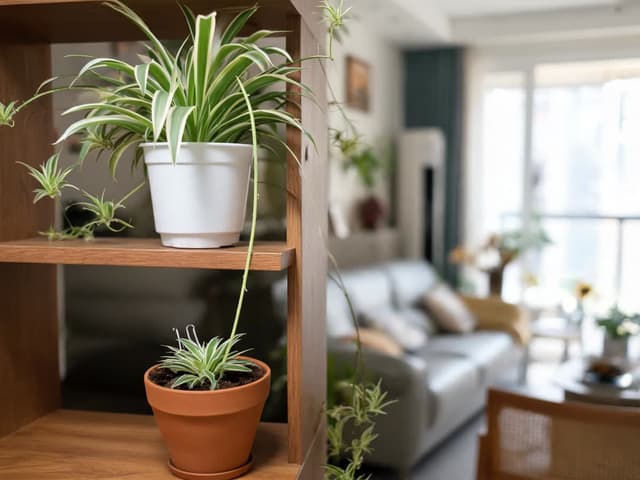
How to Propagate Spider Plants: Root the Pup Before Cutting
The safest spider plant cutting comes from a pup still attached to the mother plant: rest the plantlet on soil in a small pot, wait for roots to establish, and only then cut the stolon. Learn when the pup is ready, whether rooting in water is worth it, how to divide the clump, and why plants fail to produce babies.
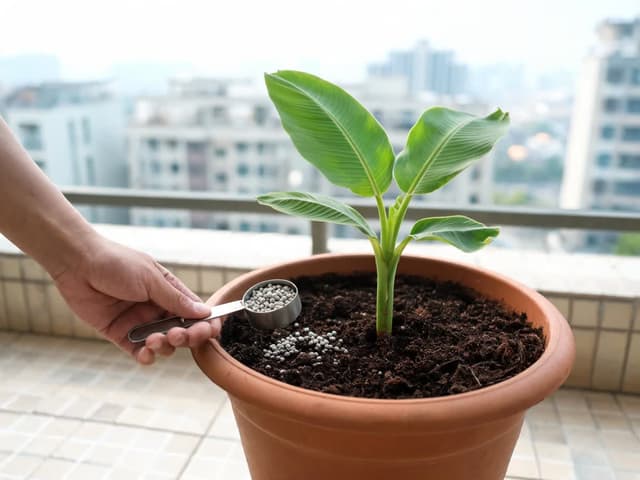
Banana plant fertilizer: fertilizing potted and backyard plants
Banana plant fertilizer needs more potassium than nitrogen, in a 3-1-6 ratio. For a potted plant on a balcony, use the label dose in spring and summer. In the backyard, fertilize every 2 months, adjusting the amount by mat age. Learn the formula, timing in Brazil, and signs of deficiency or excess.