How to Get Rid of Aphids on Houseplants for Good
Wondering if it's actually aphids (and not mealybugs)? Here is the exact insecticidal soap recipe, how to apply it, and why the pests always seem to return a week later.
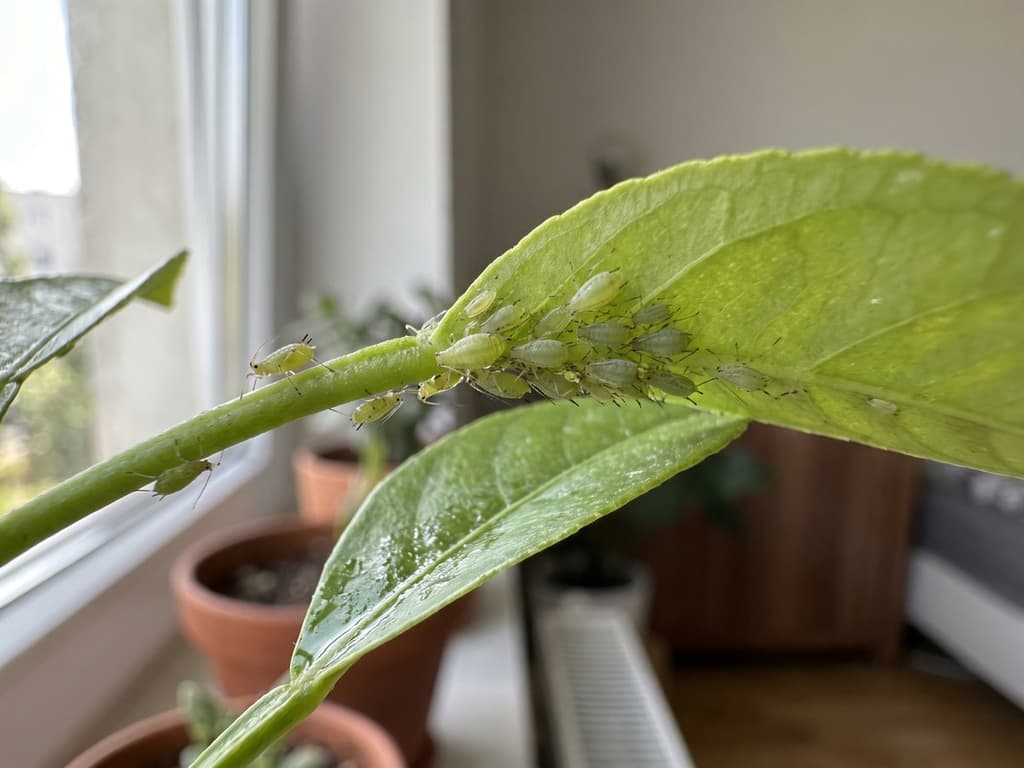
Aphids are tiny, pear-shaped sap-suckers (about 1/16 to 1/8 inch long) that cluster on new growth and the undersides of leaves, leaving behind a sticky residue. To get rid of them on indoor plants: wash the plant with a sharp spray of water, apply a 1–2% soap solution directly to the undersides of the leaves, and repeat every 5–7 days, at least three times. This repetition is not optional—it is the single biggest difference between solving the problem and watching the pests crawl back a week later.
This guide is specifically for indoor potted plants, not commercial agriculture. Most advice you find online is written for farmers growing wheat, corn, or cotton, and those heavy-duty recommendations just do not apply to a pothos in your living room.
Quick summary:
Adult aphids are 1.5–3 mm long, have pear-shaped bodies, and sport two tiny tailpipes (cornicles) on their rear end—this is the key feature that distinguishes them from mealybugs.
A single female can produce up to 12 offspring per day, and those newborns become reproducing adults in just 7 to 10 days (UC IPM). This is why their population explodes in less than two weeks.
Soaps and oils only kill the pests that are on the plant at the exact moment of application; they have no residual effect (Colorado State University Extension). If you do not repeat the treatment, the next generation will simply restart the infestation.
What Is an Aphid?
Aphids (family Aphididae) are soft-bodied insects, about 1.5 to 3 mm long, that pierce plant tissue to suck out the sap. They live in colonies on new growth and the undersides of leaves. They excrete a sugary liquid called honeydew, which makes the leaves sticky and serves as a breeding ground for a black fungus called sooty mold. They can be green, black, yellow, pink, or grayish-white.
Color is not a reliable way to identify them: the same type of plant can host both green and black aphids. Body shape is a much better indicator.
Are You Sure It's an Aphid?
This is where most plant owners make their first mistake. When people complain about "white aphids" on houseplants, they are usually dealing with mealybugs—a completely different pest with a waxy coating that repels water and soap. Trying to treat mealybugs with an aphid recipe will not work, which leads people to assume that "nothing works."
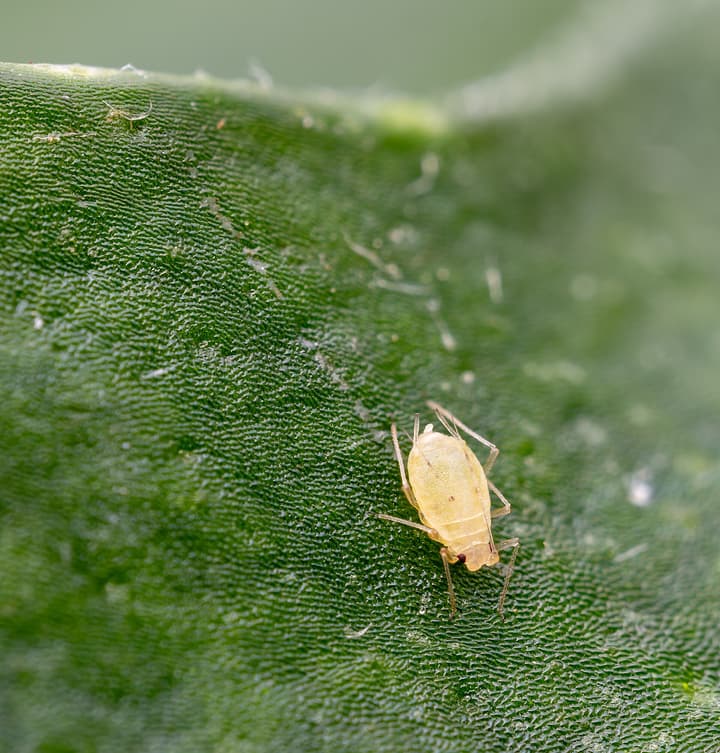
Look closely at the insect against the light:
Sign | Aphid | Mealybug | Whitefly | Spider Mite |
|---|---|---|---|---|
Size | 1.5–3 mm | 2–5 mm | 1–2 mm | less than 0.5 mm |
Appearance | Pear-shaped, smooth, shiny body | White, cottony mass or brown scale | Tiny white moth-like insect with wings | Tiny red or brown speck |
Does it move when touched? | Crawl slowly | Barely moves | Flies away in a cloud | Crawls very slowly |
Two tailpipes on the rear end | Yes | No | No | No |
Fine webbing | No | No | No | Yes |
Where to find them | New growth, undersides of leaves | Leaf joints, stems | Undersides of leaves | Undersides of leaves |
Those two tiny tailpipes on the rear end (called cornicles) are the deciding factor: none of the other common pests have them. If you see a fluffy white mass that looks like cotton and does not move, you have mealybugs, which require a different treatment.
If you still cannot tell, take a close-up photo with your phone and zoom in—your camera can see much better than your eyes at this scale.
Why Did They Appear Indoors?
Aphids do not just materialize out of thin air. In an apartment, they usually get inside in one of three ways: on a new plant brought home from the nursery (the most common route), through contaminated soil, or through an open window—winged adult aphids are surprisingly good fliers.
Once inside, an infestation grows much faster than it would outdoors for two simple reasons: indoor temperatures are stable year-round, and there are absolutely no natural predators. Ladybugs, lacewings, and parasitic wasps keep aphid populations in check outside. In your living room, there is nothing to stop them.
Why They Always Seem to Come Back a Week Later
This is the crucial detail that most articles miss, and it is the real cause of plant-parent frustration.
Female aphids can reproduce without mating and give birth to live young—up to 12 per day. A newborn aphid can become a reproducing adult in just 7 to 10 days, meaning a new generation is born every single week under ideal conditions (UC IPM).
On top of that, insecticidal soaps and horticultural oils are contact insecticides: they only kill the insects they actually touch. The Colorado State University Extension notes that because these soaps have no residual effect, "repeat applications may be needed at short intervals, such as four to seven days" (fact sheet 5.547).
Put those two facts together: you kill 90% of the colony today, but a few hide away in a tightly curled new leaf. Within 7 days, those survivors are adults, giving birth to 12 new pests a day. Your single application did not fail because the recipe was weak. It failed because you only did it once.
How to Get Rid of Them—Step by Step
You will need: pure liquid Castile soap or mild unscented soap, water, a spray bottle, and about 15 minutes. Difficulty level: easy.
Take your plant to the shower or sink and spray it down with a firm stream of water, paying close attention to the undersides of the leaves and new buds. This alone will knock off the vast majority of the colony—which is the very first step recommended by the UC IPM. Do this in the morning so the leaves have time to dry during the day.
Mix a 1–2% soap solution. Mixing about 5 tablespoons of pure soap into 1 gallon of water gives you roughly a 2% concentration. Use pure Castile soap or a mild liquid soap—do not use dish detergent: dish detergents contain degreasers that strip the protective waxy cuticle from leaves, which can cause severe foliage burn.
Test it first. Spray a single leaf and wait 24 hours. Ferns, waxy succulents, and plants with fuzzy leaves (like African violets) are highly sensitive and burn easily. If you see spotting or burnt edges, cut the concentration in half to 1%.
Thoroughly drench the undersides of the leaves. Soap does not produce toxic fumes and does not work systematically: any aphid that does not get physically wet with the solution will survive. Be sure to flip every single leaf.
Repeat every 5–7 days, at least three times. This timeframe is short enough to catch the next generation of aphids before they are old enough to reproduce. Skipping the second or third spray is the most common mistake that restarts the whole cycle.
Isolate the plant from your other greenery during treatment, and inspect its neighbors twice a week just to be safe.
The plan below summarizes the full treatment cycle and expected recovery time:
If you have a small plant with an infestation localized to a single new shoot, you can simply prune that shoot off and throw it in the trash. This solves in one quick snip what would otherwise take three weeks of spraying.
What Does Not Work (and Why You See It Everywhere)
Vinegar. This is one of the most common DIY suggestions online, but the honest answer is no. Acetic acid is used in gardening as a contact herbicide—it burns the plant tissue of any leaf it touches, making no distinction between a weed and your prized houseplant (UC ANR). No university extension recommends using vinegar to control aphids. You are highly likely to damage your plant long before you solve the pest problem.
Dish soap. Dish soap is not the same thing as insecticidal soap. Commercial dish soaps contain harsh surfactants that dissolve the protective waxy layer on leaves, leading to dehydration and leaf burn.
Buying ladybugs. This works great in a greenhouse or an outdoor garden bed. Inside an apartment, they will simply fly out of your windows or die—there is no way to maintain a healthy predator population indoors with only a few house pots.
A single application of anything. For the exact reasons explained in the section above.
How to Keep Them from Coming Back
Quarantine new plants: Keep any new green addition away from your other plants for 2 weeks, checking the undersides of the leaves every 3 days. This is the single most effective way to prevent an infestation, as most pests enter the home on newly purchased plants.
Inspect the undersides of leaves whenever you water. Aphids hide underneath, and by the time you see them on top of the leaves, you are already dealing with a massive colony.
Do not over-fertilize. Too much nitrogen stimulates a flush of soft, tender new growth, which is the exact tissue aphids love to feed on.
Wipe away honeydew with a damp cloth. The sticky residue attracts ants, and ants will actively protect aphid colonies from predators in order to "farm" the sweet honeydew.
If you are not sure what kind of plant you have before you spray—and soap sensitivity depends entirely on the species—you can take a quick photo of the leaf with Bloom. The app identifies the plant instantly and gives you a complete care guide. The app is available for iPhone.
Frequently Asked Questions
What is the best way to get rid of aphids on plants?
A 1–2% soap solution (using pure Castile soap, never dish soap) sprayed directly on the undersides of the leaves and repeated every 5–7 days, three times. Before your first spray, wash the plant down with a firm stream of water to knock off the bulk of the pests.
What is a good home remedy to kill aphids on houseplants?
The only home remedy backed by university extensions is a mild solution of 1–2% pure soap diluted in water. It works on contact by disrupting the insect's cell membranes. Always test it on a single leaf and wait 24 hours before spraying the whole plant, as some species are sensitive to soap.
Does vinegar kill aphids?
It is not recommended. Acetic acid acts as a contact herbicide and will burn any foliage it touches. You risk severely damaging your plant without actually eliminating the pests. No university extension recommends using vinegar for aphid control.
How do you get rid of mealybugs and aphids on plants?
The treatment is different for each. Mealybugs have a protective waxy coating that repels soap solutions, so you should dab them individually with isopropyl alcohol on a cotton swab before washing. Identify your pest first: aphids have two tailpipes on their rear, while mealybugs look like tiny cotton balls.
Can aphids travel from one plant to another?
Yes. Winged aphids can fly between nearby pots, and wingless ones will crawl across touching leaves. This is why you must isolate any plant undergoing treatment and check neighboring plants twice a week.
Conclusion
Dealing with aphids on houseplants is a matter of persistence, not finding a magic product. Identify them correctly (look for the two tailpipes on the rear), wash the plant down, apply a 1–2% soap solution to the undersides of the leaves, and repeat three times at 5-to-7-day intervals to catch the next generation.
Your next step: isolate your affected plant today and write down your three treatment dates on the calendar. Sticking to the schedule, more than the recipe itself, is what guarantees success.