Houseplant Pests: The 6 Most Common and How to Identify Them
Spotted a bug on your plant and don't know what it is? This guide helps you identify it by color and location, name the pest, and treat it effectively.
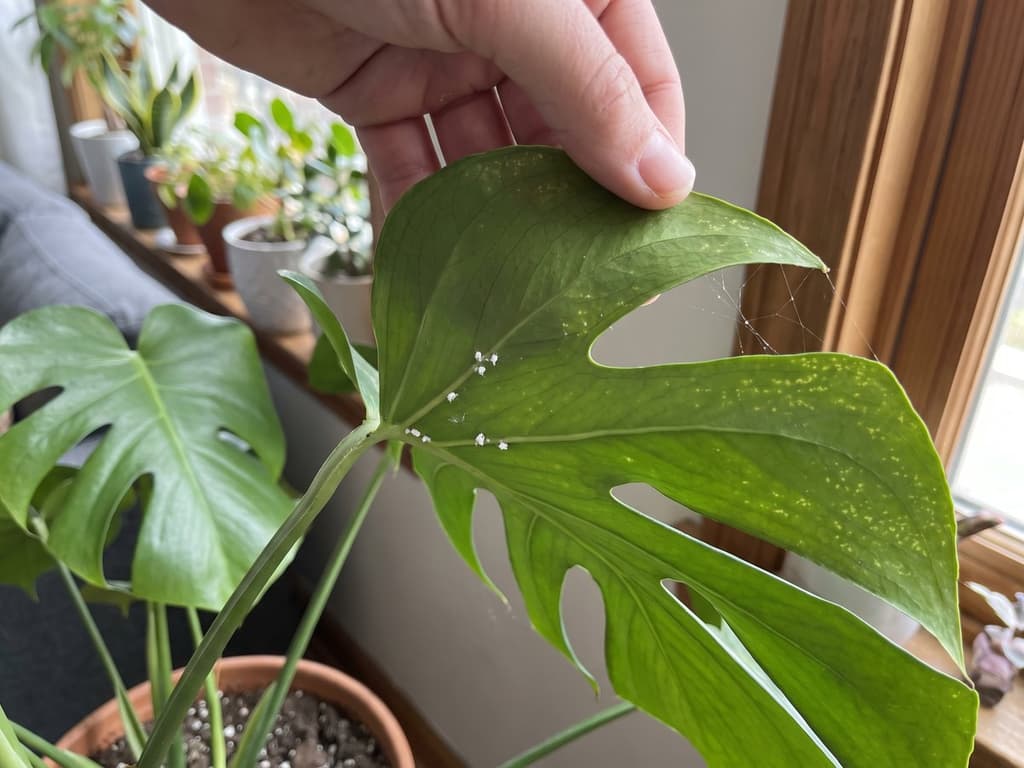
Six pests account for almost everything that attacks indoor potted plants: aphids, mealybugs, scale insects, spider mites, thrips, and fungus gnats. All can be identified with the naked eye, or close to it—what sets them apart is where they live, whether they move when touched, and if they leave sticky residue on the leaves.
Most guides are organized by the pest's name. The problem is, you don't know the name yet; you just saw a white speck, a fine web, or a tiny fly buzzing around the soil. This guide starts right there—with what you are actually seeing—and then identifies the culprit.
Quick Summary:
A fuzzy, white bug sitting in a leaf joint is a mealybug. A white bug that flies when disturbed is a whitefly. They are not treated the same way.
Tiny black flies emerging from the soil aren't eating your plant; they are feeding on fungi in soggy potting mix. The cure is adjusting your watering, not spraying insecticide.
Insecticidal soap should be used at 1–3% (Colorado State, fact sheet 5.595) and has no residual effect: you must repeat the application every 4–7 days (fact sheet 5.547). A single application almost always fails.
This guide is for indoor potted plants. Agricultural recommendations—doses per acre, backpack sprayers, registered commercial products—don't make sense for a pothos in your living room, yet that is what you often find online.
Identify by Color and Location
Before the table, here is a step to avoid wrong treatments: confirm there is actually a bug. Yellow leaves, dry tips, and brown spots are much more frequently caused by watering, light, or fertilizer issues than by pests. Pests leave physical signs—the insect itself, webs, hard shells, or sticky residue. If you don't find any of these four, the problem is likely not a pest.
Found a sign? Start with what you see and where.
What you are seeing | Where | Likely pest | How to confirm |
|---|---|---|---|
Fuzzy white mass, looks like cotton | Leaf joints, axils, stems | Mealybug | Doesn't move when touched; water beads up and rolls off it |
Tiny white specks that fly away in a cloud | Underside of leaves | Whitefly | Shake the plant: they will fly |
Hard, brown or tan shell-like bump stuck to the plant | Stems and midribs | Scale insect | Doesn't rub off with a finger; you need a fingernail to scrape it off |
Clustered green, black, or pinkish bugs | New growth, stem tips | Aphid | Two tiny tubes on their rear; leaves underneath feel sticky |
Leaves with light speckling, like dust, and fine webbing | Underside of leaves, between leaf and stem | Spider mite | Tap the leaf over white paper: look for moving specks |
Silvery or bronzed streaks with tiny black dots | Upper leaf surface, flower buds | Thrips | Black dots are feces; they won't rub off |
Tiny black flies flying low, emerging from the pot | Potting soil, not on leaves | Fungus gnat | Appears when you water; disappears when the soil dries out |
Sticky, shiny leaves with no visible bugs | Leaves below other leaves | Aphids, mealybugs, or soft scale | The sticky residue (honeydew) drips from above: look for the pest on the leaf ABOVE |
Black, sooty powder on the sticky residue | Anywhere | Sooty mold | A fungus that grows on honeydew. Treat the pest, not the fungus |
Two common mix-ups account for most failed treatments.
The first is "white aphids": on houseplants, this is almost always mealybugs. The waxy coating on their bodies repels contact insecticides (UC IPM)—the recipe that works on aphids will just roll off them without killing them.
The second is calling any white bug a "mealybug." If it flies, it's a whitefly. If it's a hard, unyielding shell, it's a scale insect—and that is the most stubborn of the six.
Whiteflies didn't make the top six because they are much less common indoors than in greenhouses, but their treatment is simple: yellow sticky traps for adults and 1–3% insecticidal soap on the undersides of leaves, repeated every 5–7 days—soap works well on their soft bodies (Colorado State).
If you are torn between two possibilities, take a close-up photo with your phone and zoom in—the camera sees much better than the naked eye at this scale. Bloom identifies plants from photos and, on the Premium plan, also diagnoses diseases and pests from leaf images. It is currently available on iOS.
The 6 Side-by-Side
Pest | Size and appearance | Where it lives | Sticky leaves? | Decisive sign |
|---|---|---|---|---|
Aphid | A few mm, pear-shaped, smooth body | New growth, young leaves | Yes | Two tiny tubes on the rear (siphunculi) |
Mealybug | 2–5 mm, white cottony mass | Leaf joints, axils, stems | Yes | Doesn't move; water rolls off it |
Scale insect | 2–5 mm, hard brown shell | Stems, midribs | Soft scale only | Doesn't rub off; needs a fingernail to scrape |
Spider mite | Under 1.3 mm, moving speck | Underside of leaves | No | Fine webbing + light speckling |
Thrips | Under 1.3 mm, dark slender line | Buds, young leaves | No | Silvery patches with black dots |
Fungus gnat | 2–4 mm, tiny black fly | Potting soil | No | Flies up when you water |
Two shortcuts the table makes clear: only spider mites make fine webbing, and only the three sap-sucking pests make sticky leaves (aphids, mealybugs, and soft scale). Mites, thrips, and gnats never leave sticky residue—if you find stickiness, you can rule those three out immediately.
Aphid
Aphids are soft-bodied insects just a few millimeters long that cluster on new growth and the undersides of young leaves to suck sap. They have two tiny tubes on their rear, called siphunculi, which no other pest on this list has. They can be green, black, yellow, or pink—the color doesn't identify them, but their shape does.
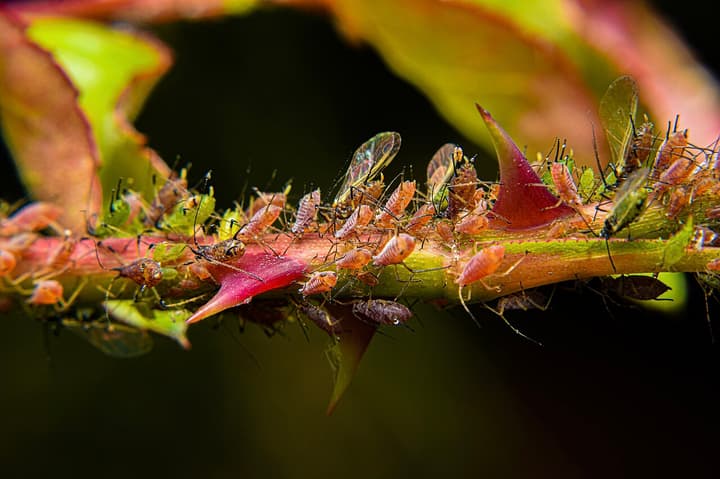
This is the pest that takes over a new shoot the fastest. Females reproduce without mating and give birth to live young—up to 12 per day. In warm weather, the offspring become reproducing adults in 7 to 8 days, and a single adult can lead to 80 descendants in a week (UC IPM). Within two weeks, the entire shoot is covered.
What to do: Wash the plant with a strong spray of water—Colorado State considers periodic washing particularly effective against aphids and spider mites (fact sheet 5.595). Then, apply 1–3% insecticidal soap, thoroughly wetting the undersides of the leaves, and repeat every 5–7 days for three rounds.
For the complete protocol, including recipes and what to do when they return, check out our guide to aphids on plants.
Mealybug
Mealybugs are the fuzzy white bugs that look like cotton balls in leaf joints. They are wingless, oval, segmented females covered in wax, sometimes with filaments along their edges (UC IPM). They don't move when touched—which separates them from aphids in three seconds.
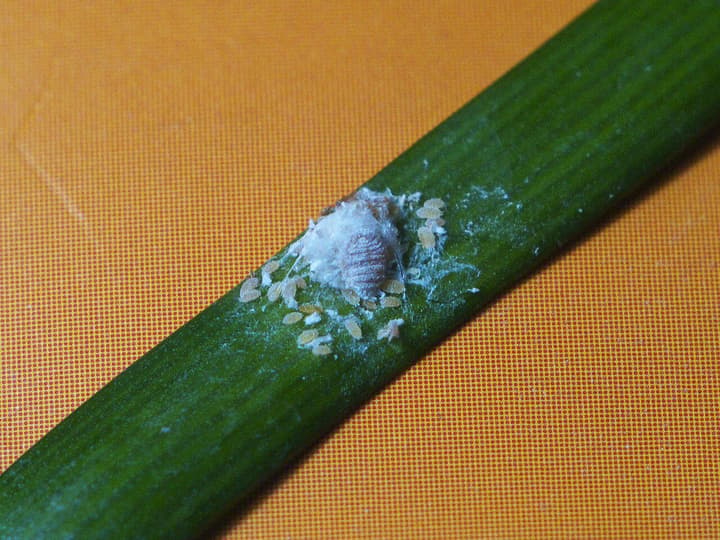
They settle where it is hardest to reach: in the crown of the plant, in branch crotches, on stems near the soil, and where leaves touch. Some species live on the roots inside the soil; in this case, you can treat the top of the plant forever and the infestation will never end.
A female lays 100 to 200 eggs, or more, in a waxy sac over 10 to 20 days. The waxy coating on their bodies repels most contact insecticides—these two facts combined explain why they seem immortal.
What to do: Applying 70% or weaker isopropyl alcohol directly to the bugs with a cotton swab kills them by dissolving their wax (UC IPM). Treat visible colonies bug by bug, test it on a single leaf first, and inspect the entire plant every 5 days for three weeks—any eggs you missed will hatch during this window.
Scale Insect
Scale insects don't look like bugs; they look like a 2 to 5 mm brown or tan bump or shell stuck to the stem or leaf vein. The adult remains motionless under this shell, sucking sap from underneath.
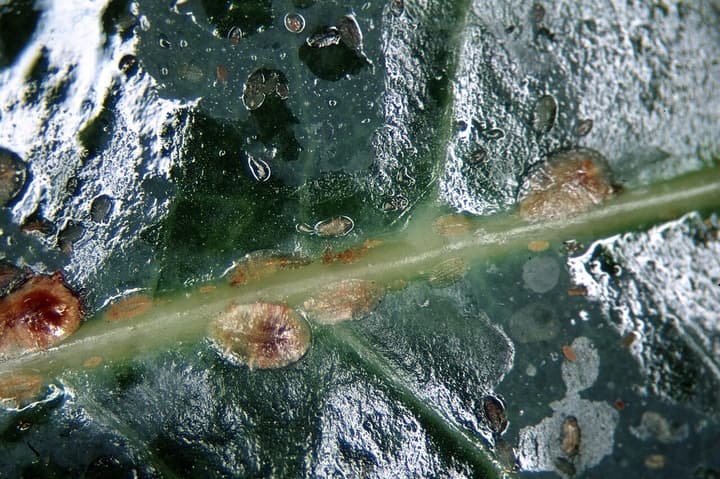
There are two types, and the difference changes the treatment. Soft scale leaves sticky honeydew; armored scale produces no honeydew at all (UC IPM). If you have scale bumps but the leaves are dry, it is armored scale—the most stubborn of the six.
For two reasons: the shell acts as physical armor against any contact product, and imidacloprid, the most common systemic insecticide sold for potted plants, controls soft scale but does not control armored scale.
The treatment window is the crawler stage—the only stage with legs, which emerges from under the mother's shell and crawls until it finds a spot to settle. To find out if you are in this stage, wrap clear double-sided tape around the infested stem: crawlers will get stuck and appear as tiny yellow or orange dots.
What to do: Scrape off the shells with your fingernail or an old toothbrush, one by one, and then apply horticultural mineral oil or 1–3% soap to target the crawlers, repeating weekly for a month. Soap and oil work best when the scale insects are in the small nymph stage and require repeated applications.
Spider Mite
Spider mites are not insects; they are arachnids, and adult females, the largest, measure less than 1.3 mm (UC IPM). In practice, you see the damage before you see the pest: light speckling on the leaves, as if someone sprayed them with dust, which guides call stippling.
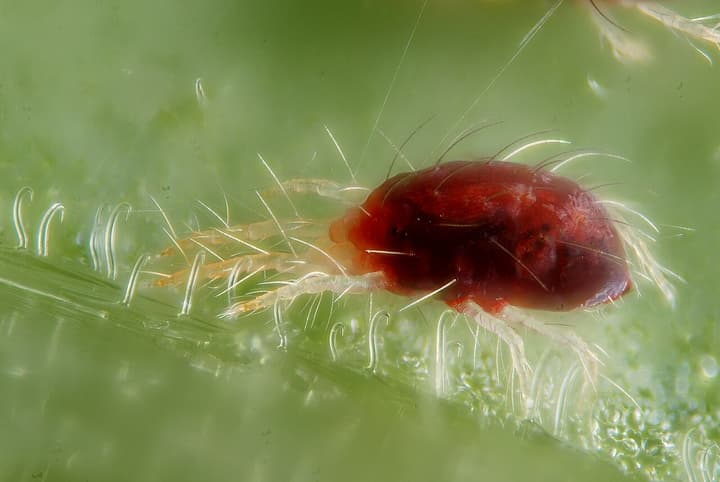
The white paper test works. Hold a sheet of white paper under a suspect leaf and tap it a few times. If tiny specks fall off and start crawling, it's spider mites. If they fall and stay still, it's just dust.
Two things favor spider mites indoors, and both are normal apartment conditions: dry air and dust. The low humidity typical of indoor environments favors mite development, and dusty environments favor their activity.
A generation is completed in less than a week when it is warm. This is the shortest cycle of the six pests, which is why infestations seem to appear out of nowhere.
Be careful of what makes it worse: Spider mites often become a problem after an insecticide application. The product kills the mites' natural predators, and some chemicals even stimulate their reproduction. Using a broad-spectrum insecticide on a plant with spider mites is usually the step that turns a small issue into a full-blown infestation.
What to do: Spray the undersides of the leaves with water to clean off the dust, and apply 1–3% soap repeated every 4–7 days for three rounds. Increasing the humidity around the plant helps prevent reinfestation.
Thrips
Thrips are slender, elongated insects under 1.3 mm long that scrape the leaf surface and suck up the plant sap. The damage is highly characteristic: silvery or bronzed streaks on the upper leaf surface, speckled with tiny black dots, which are their feces (UC IPM).
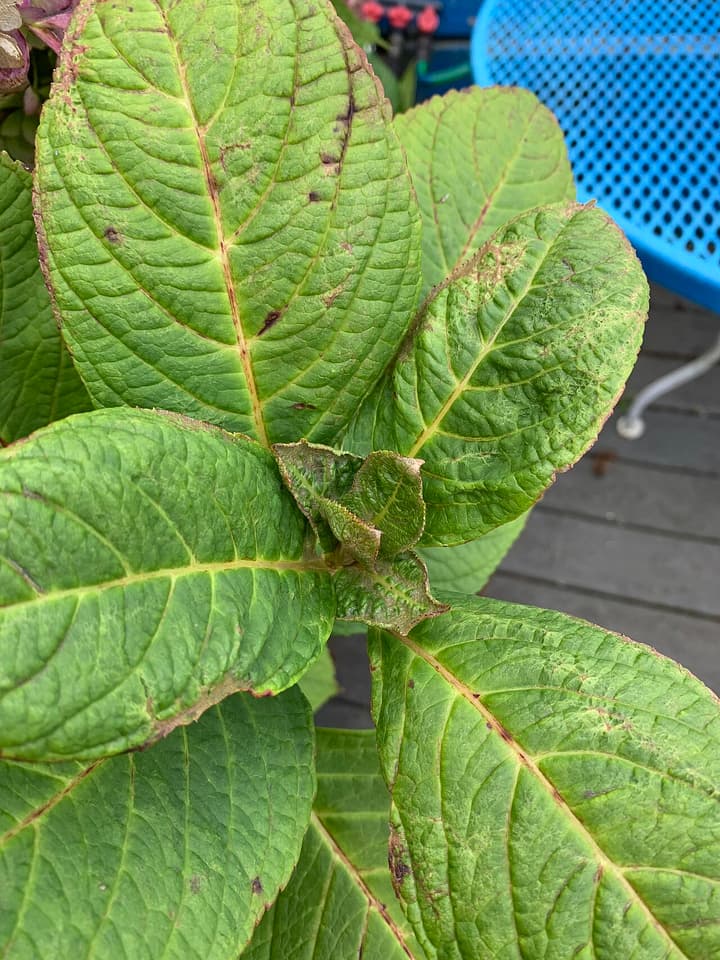
These black dots are the detail that confirms the diagnosis: they won't rub off with a dry finger because they are glued to the scraped surface.
Thrips are difficult because of where they live: they feed hidden inside buds and at the tips of shoots, protected by the sepals. Worse, the damage only shows up as the tissue grows and opens—by the time you see the damage, the thrips that caused it are often already gone.
What to do: Use the same white paper test (shake the foliage over paper), hang blue or bright yellow sticky traps to monitor flying adults, and apply 1–3% soap carefully inside buds and on new leaves—which is where they actually are, not where the damage is showing.
Fungus Gnat
Fungus gnats are the only pest of the six that doesn't live on the leaves. The adult is a tiny black fly, 2 to 4 mm long, that flies low, flies out of the pot when you water, and ends up in your face while you are watching TV. The adult does not eat the plant. The larvae, which live in the soil, eat fungi, decaying organic matter, and, if the population is large, fine roots.
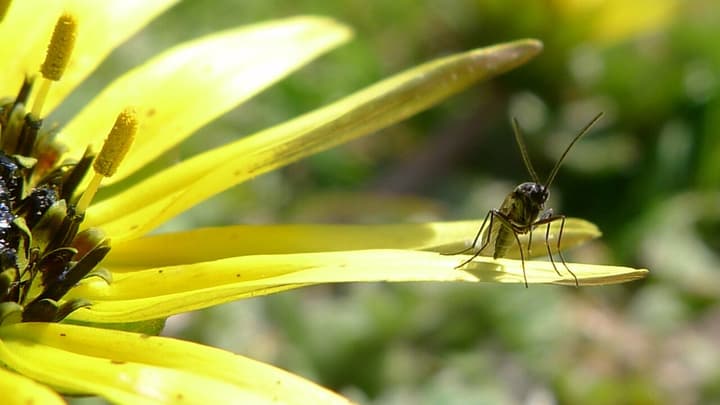
The cause is always the same: soil that stays wet on the surface. A complete generation is completed in about 17 days, depending on the temperature (UC IPM, Pest Note 7448).
What to do, in order:
Fix your watering. Let the soil surface dry out between waterings—this is Colorado State's primary recommendation for this pest (fact sheet 5.595), and it alone resolves most cases.
Yellow sticky traps on the soil surface to catch the adults that are already flying.
Bti or nematodes (Steinernema feltiae) diluted in your watering can, applied as a soil drench to kill the larvae. Bti does not reproduce or persist indoors: in pots, it may require reapplication at intervals of about 5 days (UC IPM). Nematodes, on the other hand, reproduce and continue searching for hosts, so a few initial applications can establish long-term control.
Killing only the adults with contact insecticide won't work: the next batch is already in the soil.
Why the Pest Returns a Week Later
The pest returns because its life cycle is shorter than the interval between your applications. This is the real cause of frustration for people who treat their plants correctly only to see everything return a week later.
On one hand, the cycle is short: spider mites complete a generation in less than a week, aphids in 7 to 8 days, and fungus gnats in about 17 days.
On the other hand, soap and oil are contact insecticides: they only kill what they touch. Colorado State is explicit—because the residual effect is short, it may be necessary to repeat applications at four- to seven-day intervals to control pests like spider mites and scale crawlers (fact sheet 5.547).
Put these two facts together. You kill 90% of the colony today. The eggs and the bugs hidden in the leaf joints survive. In a week, the survivors are already reproducing adults, and the population starts all over again. A single application didn't fail because it was weak. It failed because it was a single application.
Pest | One generation takes | Repeat treatment every |
|---|---|---|
Spider mite | less than 7 days | 4–7 days, 3× |
Aphid | 7–8 days | 5–7 days, 3× |
Fungus gnat | ~17 days | fix watering + Bti every ~5 days |
Mealybug | female lays eggs over 10–20 days | 5 days, for 3 weeks |
Scale insect | crawlers in waves | 7 days, for 1 month |
Thrips | variable, usually 2–3 weeks | 5–7 days, 3× |
What to Do in Any Case
These six steps apply to any of the six pests, before you buy any product:
Isolate the plant. Move it to another room today. Winged aphids fly, scale crawlers crawl, and spider mites can travel on air currents.
Wash it. Spray it with water in the sink or shower, focusing on the undersides of the leaves. This alone removes a large portion of aphids and spider mites.
Treat with what works for that pest—which changes from one to another, as detailed in each section.
Test first. Apply to a single leaf and wait a day. Soap can burn leaves, especially on sensitive plants, in direct sun, or in high heat—and the damage accumulates with repeated applications.
Repeat at the correct interval for that pest—4 to 7 days in most cases. Write down the date of the first application; this is the step people usually skip.
Inspect weekly for a month after you stop seeing pests.
What Doesn't Work
Dish soap instead of insecticidal soap. Household dish soaps contain harsh surfactants that can injure plants, damage soil, and contaminate water (Colorado State). It is not the same thing as insecticidal soap.
A single application. Soap and oil leave no protective residue: survivors of the first application will rebuild the colony in days.
Broad-spectrum insecticide on plants with spider mites. This usually makes it worse: it kills the mites' natural predators, and some products even stimulate their reproduction (UC IPM).
Releasing ladybugs in an apartment. Predators work in closed greenhouses with a large enough prey population. In a living room, they will just fly out the window.
Treating the leaves when mealybugs are in the roots. If the infestation returns exactly the same after a thorough treatment, unpot the plant and check the roots.
Killing adult gnats while watering the same way. The problem is in the soil.
How to Prevent: The 3-Week Quarantine
The most common way pests enter an apartment is on a new plant. Nurseries, garden centers, and supermarkets are crowded environments—the perfect setup for an infestation to go unnoticed.
Two steps solve almost everything:
Inspect before you buy. Carefully examine all parts of the plant: the leaf surfaces and bases, flower and fruit stems, and the roots if visible. Do not bring a plant with signs of pests home—even "to treat it at home."
Quarantine for at least 3 weeks in a room separate from your other plants. Colorado State recommends exactly this, followed by a thorough inspection at the end of the period before letting the plant join the others (fact sheet 5.595).
Three weeks seems like overkill until the first time a new monstera spreads spider mites to the other six plants in your living room.
Frequently Asked Questions
What is the hardest houseplant pest to get rid of?
Among the common six, armored scale is the hardest: its shell blocks contact sprays, and systemic imidacloprid doesn't control it. Outside this list, cyclamen mites are the worst because they hide deep in leaf folds. Colorado State recommends simply discarding infested plants to prevent further spread (fact sheet 5.595).
What are those tiny bugs that look like specks of dust?
If they are on leaves and crawl when tapped onto white paper, they are spider mites—real dust stays still. If they are in the soil and jump when watered, they are likely harmless springtails. If they fly low around the pot, they are fungus gnats.
What is this white bug on my plant?
If it is fuzzy, white, and stays still in leaf joints, it is a mealybug. If it is a hard, flat shell stuck to the stem, it is a scale insect. If it flies up in a cloud when disturbed, it is a whitefly. All three require different treatments.
Can I use the same product on all pests?
No. A 1–3% insecticidal soap covers aphids, spider mites, thrips, and scale nymphs. However, it won't solve adult mealybugs, whose waxy coating repels contact sprays, or fungus gnat larvae, which live in the soil and are best treated by correcting your watering and applying Bti.
Do I need to throw the plant away?
Rarely. It is only worth discarding a plant if the infestation is severe on a cheap, easily replaceable plant, or in cases of cyclamen mites. For most other pests, isolating the plant, pruning heavily damaged parts, and applying three treatments at the correct intervals will successfully resolve the issue.
In Summary
Start with what you see, not the name: color, location, and whether the bug moves will already narrow it down to one or two possibilities. Then treat with what works for that specific pest—and repeat at the correct interval, because repetition, not the strength of the product, decides the outcome.
The next practical step is both the most tedious and the most effective: isolate the attacked plant from the others today, before you buy anything.
Related articles
How to Care for a Maidenhair Fern: Light, Water, and Revival Tips
Learn how to care for a maidenhair fern indoors: bright indirect light, consistently moist soil, high humidity, and how to revive it if it dries out completely.
How to Propagate Spider Plants: Root the Pup Before Cutting
The safest spider plant cutting comes from a pup still attached to the mother plant: rest the plantlet on soil in a small pot, wait for roots to establish, and only then cut the stolon. Learn when the pup is ready, whether rooting in water is worth it, how to divide the clump, and why plants fail to produce babies.
Banana plant fertilizer: fertilizing potted and backyard plants
Banana plant fertilizer needs more potassium than nitrogen, in a 3-1-6 ratio. For a potted plant on a balcony, use the label dose in spring and summer. In the backyard, fertilize every 2 months, adjusting the amount by mat age. Learn the formula, timing in Brazil, and signs of deficiency or excess.