Mealybugs on Indoor Plants: How to Identify and Get Rid of Them for Good
How to tell if that white fluff on your plant is mealybugs, mold, or powdery mildew, the two rubbing alcohol dilutions that actually work, and why a single treatment never works — backed by science.
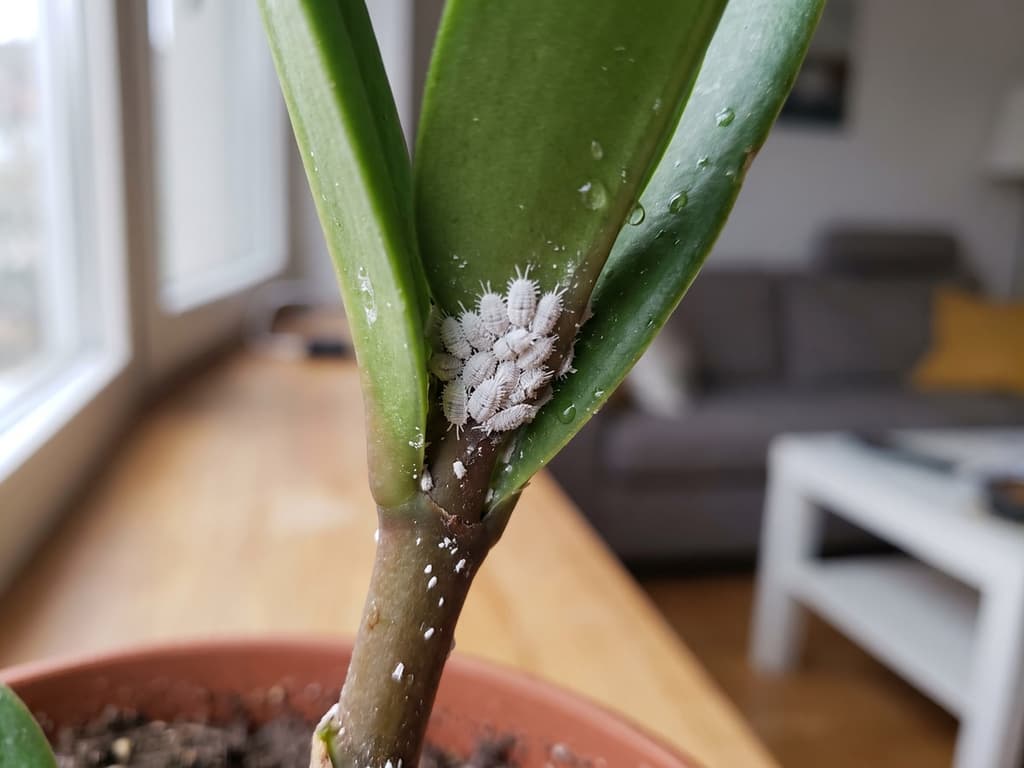
Mealybugs are sap-sucking pests up to 3 mm long, covered in a white, cottony wax. They love to hide in leaf joints, along stems, and even under your plant pots. To eliminate them from an indoor plant: isolate the plant, dab away visible bugs using a cotton swab dipped in 70% or lower isopropyl alcohol, and repeat every single week for 8 to 10 weeks. Consistency is the real cure — a single treatment never works, and the reason is pure biology.
This guide is for anyone growing potted houseplants indoors. If you ended up here because you noticed a strange "white fuzz" and aren't sure if it's a pest or a fungus, the next section will help you diagnose the issue before you start treating. Getting the diagnosis wrong is the number one reason people say, "I've tried everything and nothing works."
Quick summary:
Mealybugs have segmented bodies up to 3 mm long beneath their waxy coating, and they move very slowly. Fungus does not move.
A single female can lay 100 to 200 eggs inside a waxy sac over a period of 10 to 20 days (UC IPM) — and up to 300 to 600 eggs in the case of citrus mealybugs (NC State Extension). These eggs are "relatively waterproof" inside their waxy protection, as NC State puts it.
It takes 6 to 10 weeks for an egg to grow into an egg-laying adult (NC State Extension); the House Plant Journal, which focuses on indoor gardening, estimates this lifecycle at 6 to 8 weeks (House Plant Journal). This developmental window is what dictates how long your treatment needs to last, regardless of the remedy you choose.
What Are Mealybugs?
Mealybugs (family Pseudococcidae) are soft-bodied, oval-shaped, sap-sucking insects that grow up to 3 mm long (NC State Extension) and are covered in a white, powdery wax. They feed by sucking plant juices and excreting honeydew — a sticky, sugary substance that coats leaves and serves as a breeding ground for sooty mold, a black fungus. They are closely related to scale insects but lack the hard, protective shell (UC IPM).
They rarely sit out in the open. Instead, they prefer tucked-away spots: the crotches where leaves meet the stem, the base of the plant near the soil line, and the tight crevices between overlapping leaves. On indoor plants, they are most frequently reported on aglaonema, dracaena, ficus, hoyas, orchids, cacti, ferns, philodendrons, palms, jade plants, poinsettias, and even indoor herbs like rosemary and sage (UC IPM).
Is It Really Mealybugs?
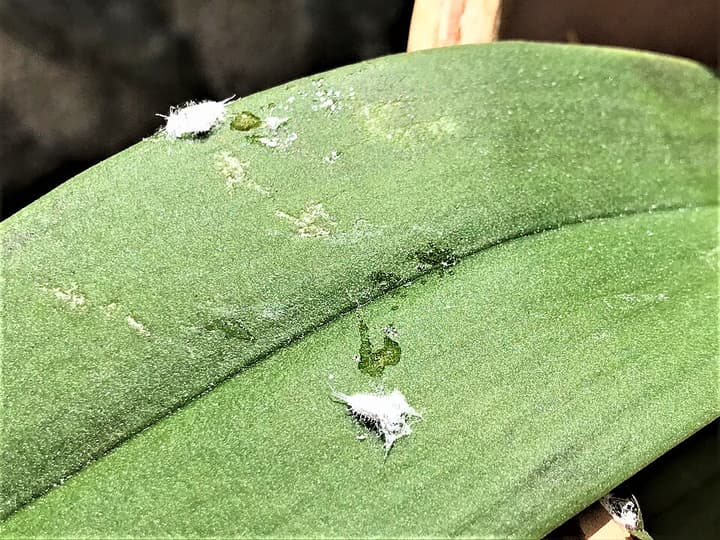
There are four different white substances that commonly appear on houseplants, and three of them should never be treated with insecticides. Before you buy or mix any treatments, take a close look — ideally by snapping a photo with your phone and zooming in, as your camera can capture details your eyes might miss at this scale.
Symptom | Mealybug | Scale Insect | Powdery Mildew (Fungus) | Soil Mold |
|---|---|---|---|---|
Where It Appears | Leaf joints, stems, undersides of leaves | Clamped onto stems and leaf veins | On top of leaves, on both sides | Only on the soil surface |
Appearance | Isolated cottony clumps, oval body underneath | Hard brown or beige dome, resembles a tiny scale | Continuous, powdery or web-like white-gray coating | Flat, uniform fuzzy layer |
Does it move when nudged? | Yes, very slowly | No (adults are completely stationary) | No | No |
Can you scrape it off with a fingernail? | Yes, and it squishes | Pops off in one piece, hard | Smudges off like baby powder | — |
Does it leave sticky leaves? | Yes (honeydew) | Yes | No | No |
Treatment | Rubbing alcohol + weekly repetition | Physical removal of the shell | Better airflow, keeping foliage dry | No insecticide required |
Two simple rules of thumb will solve most mysteries: if the white fluff moves, it's a bug; and if the white fuzz is on the soil rather than the plant, it's not mealybugs — applying insecticide there is completely useless.
Powdery mildew is the most common point of confusion in online searches, but it is easy to tell apart: it "starts as circular, powdery white-to-gray spots on leaves, stems, flowers, or fruit" (Missouri Botanical Garden) — meaning it blankets the leaf surface in a continuous layer rather than forming distinct, cottony lumps in specific nooks.
Scale insects also require close attention because they need a different treatment approach: that hard outer dome is a protective armor that resists insecticidal soap sprays (House Plant Journal), meaning they must be physically scraped or wiped off.
Why Did Mealybugs Appear Indoors?
Mealybugs don't materialize out of thin air, and adult females cannot fly — they must be physically carried to your plant (NC State Extension). In an indoor environment, they usually sneak in through three main entry points: a new plant brought home from a store (by far the most common), reused pots, stakes, or tools, and contaminated potting soil.
Once inside, the indoor climate is perfect for them. Depending on the species and the temperature, mealybugs can produce 2 to 6 generations a year, thriving in environments that don't experience freezing winters. Inside a climate-controlled home with stable year-round temperatures, all life stages can coexist simultaneously and breeding never stops (UC IPM). Combine that with a complete lack of natural predators in your living room, and you have a pest population that grows unchecked.
Why They Keep Coming Back — The Four Facts People Overlook
This is the core issue behind almost every frustrating battle with mealybugs. It isn't just one factor, but a combination of four distinct biological realities.
1. Eggs are shielded by wax. Females lay their eggs inside a dense, waxy sac called an ovisac. NC State Extension explains this literally: the eggs are "enveloped in a white, cottony, waxy sac, which makes them relatively waterproof." Alcohol, soaps, and oils cannot easily penetrate this barrier.
2. They lay an incredible number of eggs. A single female lays 100 to 200 eggs according to the UC IPM, and up to 300 to 600 eggs in the case of the citrus mealybug — one of the most common species found on indoor plants, per NC State. Because these are laid over a 10 to 20-day period, the hatching is staggered, meaning they don't all emerge at once.
3. Newly hatched nymphs are practically invisible. Newly hatched mealybugs, known as crawlers, have not yet developed their signature waxy coating. They are tiny, yellow-orange or pinkish, and highly active as they crawl around the plant (UC IPM). Measuring under 1 mm (House Plant Journal), they are easily missed. If you only treat the bugs you can see, you are wiping out the adults while leaving the next generation completely untouched.
4. Part of the colony isn't even on the plant. Mealybugs frequently nest along the inner rim of pots, underneath the base of the container, and inside drainage saucers. Furthermore, root mealybugs can wash out of drainage holes during watering and migrate to infest neighboring pots (NC State Extension).
When you put these four facts together, the cycle becomes clear: you kill the visible adults today, the protected eggs hatch over the coming days, the microscopic 1 mm nymphs go unnoticed for weeks, and in 6 to 10 weeks, they mature into egg-laying adults. Your previous treatment didn't fail because it was weak. It failed because you only did it once.
How to Get Rid of Mealybugs — Step-by-Step
You will need: isopropyl alcohol (rubbing alcohol), water, cotton swabs, a spray bottle, masking tape, a clean cloth, and clean pruning shears. Set aside 30 minutes for your first treatment session, and 10 minutes per week after that. Difficulty level: easy, but requires strict consistency.
Isolate the plant immediately. Simply moving it a few inches away won't cut it. Because mealybug colonies crawl across shared surfaces, remove the infested plant from its shelf or communal tray and move it to a completely different room. Check its former neighbors twice a week for the duration of the treatment.
Prune heavily infested areas. Any leaf or shoot that is completely blanketed in white cotton should be snipped off and thrown straight into an outdoor trash can — do not toss them into an indoor compost bin near your other plants. If an infestation is concentrated on a single stem, pruning can solve in one snip what would otherwise take weeks of treatment.
Always spot-test before treating the entire plant. Apply your alcohol solution to a single leaf and wait 1 to 2 days to check for any chemical burns (UC IPM). There is no universal list of sensitive plant species — Colorado State University Extension notes that "certain plants are sensitive and can be damaged," which is why they recommend testing a small area first (Colorado State University Extension). If you are worried, dilute your mixture by half.
For small spots: use a cotton swab dipped in 70% or lower rubbing alcohol and touch it directly to each insect. They will turn brown and die instantly. Be careful not to drench the surrounding leaf tissue — UMD Extension warns that alcohol pooling on the leaves, rather than just hitting the pest, is what causes plant damage.
For widespread infestations: use a spray bottle with a 10% to 25% alcohol solution. This is a highly effective dilution rate that is rarely shared online, sourced directly from UC IPM. If the infestation is too extensive for spot treatments, dilute isopropyl alcohol to 10% to 25% with water and spray the plant thoroughly, repeating weekly until the pests are gone. Be sure to wet the leaf joints, the stem bases, and the undersides of the leaves where they hide.
Use masking tape on flat surfaces. Sticky tape can lift away both adults and tiny nymphs without having to rub alcohol over the entire plant, which is incredibly useful for catching those 1 mm crawlers that cotton swabs miss (House Plant Journal). Avoid using this method on fuzzy or highly delicate leaves.
Repeat the process weekly for 8 to 10 weeks. This weekly schedule catches each new wave of crawlers before they reach reproductive maturity, covering the entire transition from egg to adult. Your plant is officially cleared when you complete two consecutive weekly inspections with zero signs of pests.
These seven steps make up the complete treatment protocol — from initial isolation to final clearance, including both alcohol concentrations and pot inspections.
If you prefer to use horticultural sprays instead of alcohol, keep in mind how they work: insecticidal soaps, horticultural oils, and neem oil are highly effective against young nymphs that haven't developed thick wax, but they have very little effect on fully waxed adults (UC IPM). This means they should be used as weekly preventative follow-ups rather than a single curative spray.
Don't Forget the Pot
This section is crucial because ignoring it is the main reason otherwise perfect treatments fail. While you are treating the foliage, a hidden colony could be multiplying just inches away, completely off the plant.
Grab a flashlight and inspect the following spots: the inside rim of the pot, the underside of the pot, the drainage saucer, the top layer of soil, and any plant stakes. Look for any cottony white masses tucked into crevices (House Plant Journal). You can wash plastic or ceramic pots and saucers with regular soap and hot water without worry; for anything inside the pot, stick to insecticidal soap.
If the plant is heavily infested and you decide to repot it, discard all of the old soil, wash the pot thoroughly, and never reuse that old soil for any of your other plants.
What Doesn't Work (And Why You See It Suggested Everywhere)
Dish soap. Dish soap is not insecticidal soap. Commercial insecticidal soaps are specifically formulated to minimize plant damage; household dish detergents are not. They "contain strong detergents that can injure plants, damage soil, and pollute waterways" (Colorado State University Extension). Additionally, when dealing with mealybugs, any contact spray has to contend with the insect's protective wax, which naturally repels liquids (UC IPM).
Vinegar and dish soap mixtures. This recipe is highly popular online but is not supported by any university extension for mealybug control. Acetic acid is a non-selective contact herbicide that "disrupts cell membranes, resulting in cell death," burning any plant tissue it touches without distinguishing between a weed and your favorite houseplant (UC ANR).
Buying ladybugs for indoor use. Mealybugs do have a highly effective natural predator: the ladybug Cryptolaemus montrouzieri, commonly known as the "mealybug destroyer." However, UC IPM explains the limitations of this method: these predators are typically released in greenhouses, orchards, or massive indoor atriums. Releasing them only makes sense when there is a massive population of mealybug egg sacs to stimulate their reproduction. If you only have three plants in your living room, the ladybugs will simply starve and fly away.
Systemic insecticides in indoor pots. While products containing imidacloprid or dinotefuran can reduce nymph numbers in certain outdoor situations, UC IPM classifies neonicotinoids as less reliable for mealybug control compared to other sap-sucking pests. They recommend avoiding them whenever possible, especially on flowering plants, due to their negative impact on beneficial predatory insects and pollinators.
A single treatment session. No contact spray can reach the eggs safely tucked inside their waxy sacs. As long as there are viable eggs waiting to hatch, a new generation is on the way. The success of your treatment is determined by your weekly repetition over a full lifecycle, not by finding a magic one-time spray.
When to Give Up on a Plant
It is worth addressing what consumer care guides usually gloss over: sometimes, the smartest move is to throw the plant away. Both UMD Extension and UC IPM recommend discarding heavily infested plants rather than attempting long-term chemical control — with UC IPM adding that no available insecticide is likely to eradicate every single pest on a heavily infested plant.
Here is a practical decision-making rule: discard the plant if the infestation has reached the main stem base and most leaf joints, if it has already lost a significant amount of foliage, or if you have completed a full 10-week treatment cycle with no visible improvement. Keep treating if the infestation is limited to one or two spots, if the plant is still actively pushing out healthy new leaves, or if it holds sentimental value that justifies months of effort. Whatever you decide, remember that chronically infested plants will act as a constant source of infection for any new plants you bring home (UC IPM).
If you aren't completely sure of your plant's species before applying alcohol — and chemical sensitivity varies wildly by species — you can quickly identify it using Bloom. The app identifies plants from a photo and provides detailed care guides. Disease and pest diagnostics are available with Premium, and the app is available on iPhone.
How to Prevent Mealybugs from Returning
Quarantine new plants: Keep any new additions in a separate room for 2 to 4 weeks, inspecting leaf joints and leaf undersides every 3 days. This is the single most effective way to prevent an infestation, as most mealybugs enter the home on newly purchased plants. UC IPM goes a step further, suggesting you return or discard a new plant if you cannot easily remove all visible mealybugs before bringing it inside.
Inspect the leaf joints, not just the leaf surface. This is their favorite hiding spot. By the time you can easily see white fluff on the face of a leaf, the colony is already quite large.
Avoid over-fertilizing. Excessive nitrogen combined with frequent watering produces soft, rapid plant growth which, according to UC IPM, actually increases mealybug egg production.
Control indoor ants. Ants will actively transport mealybugs from one houseplant to another (NC State Extension) and protect the colony from natural predators in order to harvest their sweet honeydew (UC IPM).
Thoroughly clean pots, saucers, and stakes before reusing them on a different plant.
This same habit of close inspection applies to other common houseplant pests. For example, aphids also target fresh new growth and leave behind sticky honeydew, but their treatment methods and lifecycles require a completely different approach.
Frequently Asked Questions
What is the best way to kill mealybugs on plants?
Isopropyl alcohol (rubbing alcohol) is highly effective. For small spots, apply 70% or lower alcohol directly to individual bugs using a cotton swab. For widespread infestations, dilute rubbing alcohol to a 10% to 25% solution with water and spray the plant thoroughly, repeating weekly. Always spot-test a single leaf 1 to 2 days prior, as some species can burn.
How do you get rid of mealybugs with dish soap and vinegar?
This method is not recommended. Household dish soaps can severely damage plant tissues, and vinegar acts as a non-selective contact herbicide, killing any plant cells it touches. No university extension recommends this mixture for mealybug control, and the insect's waxy coating naturally repels contact liquids.
What are the natural enemies of mealybugs?
The ladybug Cryptolaemus montrouzieri (the "mealybug destroyer"), along with parasitic wasps, lacewings, and spiders. According to UC IPM, these are primarily released in commercial greenhouses and large interior landscapes; their reproduction depends on a high density of egg sacs, meaning they cannot establish a stable population in a typical home.
Do mealybugs spread from plant to plant?
Yes. While adult females cannot fly, they easily crawl between touching leaves and across shared surfaces like shelves and saucers, and ants will actively transport them. Root mealybugs can also wash out of drainage holes during watering to infect neighboring plants. This is why isolating an infested plant is absolutely critical.
How long does it take to completely get rid of mealybugs?
Expect to treat your plant weekly for 8 to 10 weeks. Mealybugs take 6 to 10 weeks to grow from egg to adult, and your treatment must cover this entire cycle. A plant is only considered cured after two consecutive weekly inspections turn up absolutely zero pests, including around the base and underside of the pot.
Conclusion
Dealing with mealybugs on indoor plants is a matter of scheduling, not finding a miracle product. Confirm the diagnosis first (if the white fluff moves, it's a bug; if it's on the soil, it isn't mealybugs), isolate your plant, apply rubbing alcohol at the correct dilution for the size of the infestation, and repeat weekly for 8 to 10 weeks — making sure to clean the pot and saucer as well.
Your next step: move your infested plant away from your other plants right now, and mark your weekly inspection dates on your calendar. Consistency, not the recipe, is what wins the battle.
Related articles
How to Care for a Maidenhair Fern: Light, Water, and Revival Tips
Learn how to care for a maidenhair fern indoors: bright indirect light, consistently moist soil, high humidity, and how to revive it if it dries out completely.
How to Propagate Spider Plants: Root the Pup Before Cutting
The safest spider plant cutting comes from a pup still attached to the mother plant: rest the plantlet on soil in a small pot, wait for roots to establish, and only then cut the stolon. Learn when the pup is ready, whether rooting in water is worth it, how to divide the clump, and why plants fail to produce babies.
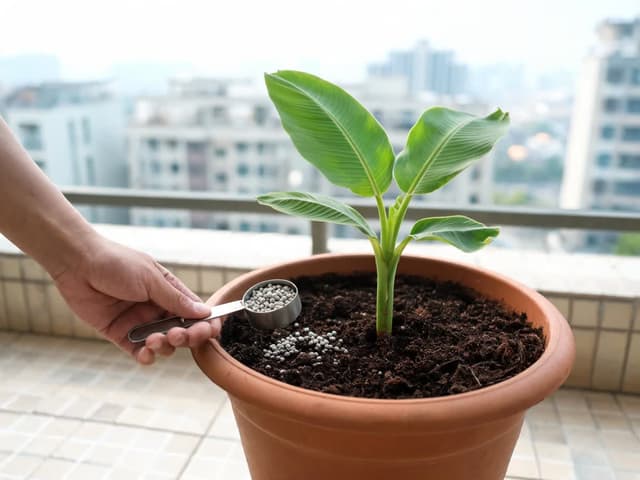
Banana plant fertilizer: fertilizing potted and backyard plants
Banana plant fertilizer needs more potassium than nitrogen, in a 3-1-6 ratio. For a potted plant on a balcony, use the label dose in spring and summer. In the backyard, fertilize every 2 months, adjusting the amount by mat age. Learn the formula, timing in Brazil, and signs of deficiency or excess.