How to Propagate Bougainvillea: The Right Stem, Rooting Hormone, and Signs It Took
Bougainvillea propagation starts with an 8-inch woody stem, rooting hormone, moist sandy soil, and bright indirect light. Without rooting hormone, almost no hairy-leaf bougainvillea cuttings rooted in two Brazilian studies. Discover which stem to cut, water versus soil, timing, and why new shoots do not prove roots.
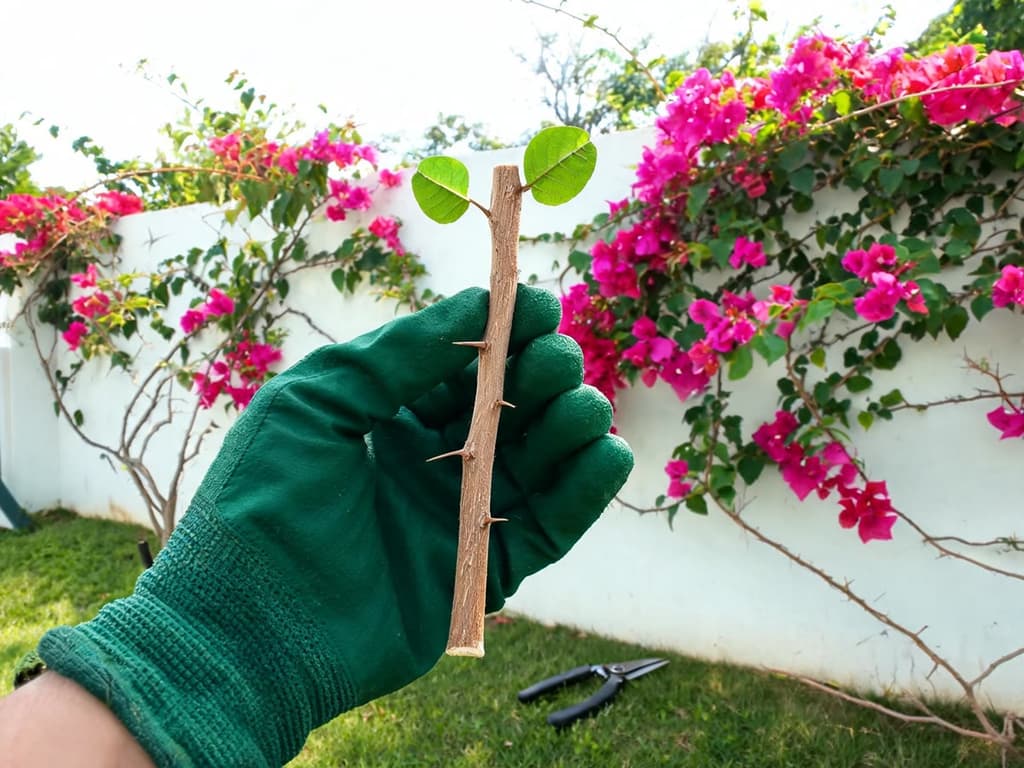
To propagate bougainvillea from cuttings, start with the branch: cut an 8-inch (20 cm) woody piece (the cutting) and coat the base with rooting hormone. Bury one-third of it in moist sandy soil, in bright indirect light. Roots take 4 to 12 weeks. Bougainvillea, which in Brazil is also called primavera, roots poorly without help: take several cuttings on the same day.
Quick summary:
In a study by the Universidade Federal Rural do Rio de Janeiro, no hairy-leaf bougainvillea cuttings without rooting hormone formed roots within 56 days. With woody stems and rooting hormone, 60% rooted.
New shoots on a cutting do not prove it has rooted: in that same study, 63% of the woody cuttings without rooting hormone sprouted leaves, yet none developed roots.
Cuttings root best when night temperatures stay above 13 °C (55 °F), which across most of Brazil runs from October to March.
Why bougainvillea cuttings fail so often
Bougainvillea has very fine roots, making propagation slow and difficult, according to the production guide from the University of Florida (UF/IFAS). To take root, cuttings require high humidity at all times and must never wilt.
Two Brazilian studies measured the rooting success rate in hairy-leaf bougainvillea (Bougainvillea spectabilis). At UFRRJ, in Seropédica (RJ), no cuttings without rooting hormone formed roots within 56 days. At UTFPR, in Dois Vizinhos (PR), only 1.56% rooted within 90 days, and 70% died.
With rooting hormone, success rates improved in both studies: 60% of woody cuttings rooted at UFRRJ and 40.63% at UTFPR. Even under the best results, nearly half of the cuttings were lost. Based on the rates from both studies, taking 10 cuttings will likely yield about 4 to 6 successful plants with rooting hormone, and possibly none without it.
Which stem to cut for bougainvillea propagation
The stem type with the highest rooting rate was hardwood: a firm branch with brown bark, measuring about 1 cm (0.4 in) thick. In the UFRRJ study, each 1-meter branch was divided into three 20 cm (8 in) cuttings. The thickest base cutting had the highest success rate.
Stem type | How to recognize it | Rooted cuttings at UFRRJ (rooting hormone with 2,000 mg of hormone per liter) |
|---|---|---|
Herbaceous (the tip) | green, soft, bends easily | 13.3% |
Semi-hardwood (the middle) | green on the outside, firm, bends slightly | 23.3% |
Hardwood (the base of the branch) | brown bark, firm, about 1 cm thick | 60% |
Semi-hardwood also works, and it is the type recommended by the University of Florida production guide. It simply had lower success rates in this study. If your plant only has thin growth, take more cuttings to compensate.
To avoid harming the mother plant, take the cutting from a long branch of this year's growth. Cut right above a bud (the little point on the stem where the leaf emerges). Never cut the main trunk. Bougainvillea responds well to pruning, according to the University of Hawaii guide (CTAHR), and taking 2 or 3 branches equals a light pruning. Wear thick gloves: the stem has curved thorns.
Rooting hormone on bougainvillea cuttings: when it makes a difference
Rooting hormone is a powder or gel sold at garden centers containing IBA (indole-3-butyric acid), a plant hormone that triggers root development. For hairy-leaf bougainvillea, both Brazilian studies show it determines whether your cutting succeeds: without it, rooting rates ranged between 0% and 1.56%.
In the other common species, the smooth-leaf variety (Bougainvillea glabra), the result differs. A 2023 study in Nepal using hardwood cuttings found no difference in rooting rates with or without hormones. And the Hawaii guide notes that green tips of easy-to-root cultivars can root without hormone.
This guide follows the two Brazilian studies because they evaluated the same species and reached the same conclusion: use rooting hormone. To determine which species you have, check the leaves. B. spectabilis has fuzzy leaves, hairy stems, and large thorns; B. glabra features smooth, glossy leaves and smaller thorns.
If the leaves leave any doubt, a photo in Bloom (available for iOS) will identify the species. Each species has a care guide on the website: the hairy-leaf bougainvillea and the smooth-leaf bougainvillea.
Cinnamon powder and honey frequently appear in videos as DIY rooting agents. No scientific studies have tested either on bougainvillea, so do not rely on them to replace IBA.
Step-by-step bougainvillea stem propagation
Supplies: clean pruning shears, gloves, IBA rooting hormone, clear plastic cups with 3 drainage holes punched in the bottom, coarse sand and potting mix, and a clear plastic bag.
Cut the branch and prepare your cuttings immediately in the shade. The cutting must not wilt at any point, according to the Florida guide.
Divide the branch into 20 cm (8 in) cuttings with 3 to 5 nodes. Make the bottom cut right below a node and the top cut right above another.
Strip off flowers and leaves from the section that will sit under the soil. Keep 2 leaves at the top and cut each in half to reduce water loss from the cutting.
Moisten the base and coat it with rooting hormone according to the package directions. Pour a small amount onto a saucer and discard any leftover powder without returning it to the container.
Fill the cup with half coarse sand and half potting mix. Poke a hole with a pencil and bury one third of the cutting, keeping at least 1 node under the soil.
Water until moisture drains from the bottom holes. Cover the cup with the clear plastic bag secured by an elastic band to keep the air humid. Remove the bag once the first root shows against the wall of the cup.
Place in a bright spot out of direct sunlight. Water the soil when the surface starts to dry, making sure the cup never sits in standing water.
In the UFRRJ study, cuttings were inserted one third of their length deep into washed sand and watered daily. The Hawaii guide recommends equal parts peat moss and perlite, or sand mixed with coconut coir: any fast-draining substrate works.
Propagating bougainvillea in water versus soil
Propagate bougainvillea cuttings in soil. No scientific studies have measured bougainvillea rooting success in a cup of water, and every method with documented results relies on sand, peat, or coconut coir. The practical reason comes down to the roots: they are delicate and brittle, according to guides from Florida and Hawaii, and break when moved from water to a pot.
This recommendation is drawn from what sources explain about the root system rather than tested comparisons. A clear plastic cup gives you the transparency of water without that breakage risk. You can watch roots press against the sides of the cup while the cutting remains settled in the medium where it will continue growing.
If your cutting is already rooting in water, move it to soil as soon as the first white root appears. Hold the cutting by its stem and plant it without pressing down on the roots, which snap easily.
How to tell if your bougainvillea cutting has rooted
New shoots do not mean roots have formed. Hardwood cuttings store energy reserves in their stem and can sprout on their own. At UFRRJ, 63% of woody cuttings without rooting hormone pushed new growth within 56 days, yet none had developed roots.
Look for these three reliable signs:
white roots visible through the clear cup walls or emerging from the bottom drainage holes;
shoots that continue expanding and unfurling fresh leaves for more than 3 weeks after the plastic bag has been removed;
a cutting that holds firm when you nudge it with a finger, rather than shifting like it did on planting day.
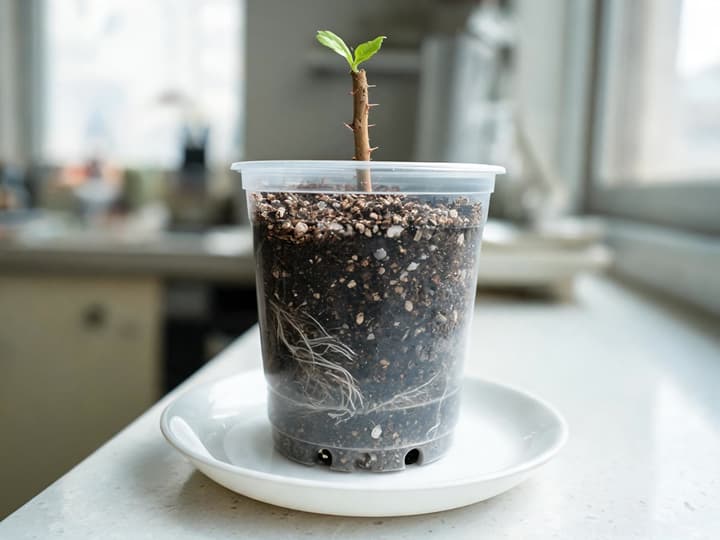
Do not tug on the cutting to check it: newly formed roots are thin and break easily. Plan on 4 to 12 weeks, matching the timeline from the Hawaii guide. A cutting that turns dark and mushy at the base has rotted: discard it and do not reuse the potting medium from that cup.
Best time to take bougainvillea cuttings in Brazil
Cuttings root faster in the heat, and cold soil delays rooting, according to the Florida guide. The guide uses nighttime temperature as a rule. With nights above 13 °C, it suggests tips or semi-hardwood stems; with colder nights, only hardwood stems. This guide suggests hardwood stems at any time of year, because they rooted best in the UFRRJ study.
In most of Brazil, night temperatures exceed 13 °C in spring and summer, from October to March. This is the best time to take cuttings. In the South and in the mountains, check the minimum temperature in the forecast: from June to August it usually drops below 13 °C, and during these months only woody stems are worth trying.
Where nights stay above 13 °C year-round, the temperature rule does not limit the month. The UFRRJ study, on the coast of Rio de Janeiro, collected branches in early April and had cuttings rooted in 56 days.
Air layering and simple layering: propagating without cutting the branch
Air layering and simple layering trigger root growth while the branch remains attached to the parent plant. The mother plant continues supplying water and nutrients, preventing the stem from drying out before roots form. This approach is ideal for a specimen you cannot risk losing, such as a garden vine when moving homes, or for anyone hesitant to take cuttings.
For simple layering, bend a low branch down to the ground or into a nearby pot. Bury 5 to 10 cm (2 to 4 in) of the branch, with at least 1 bud under the soil. Secure it with a wire staple and leave the tip exposed. According to the Iowa State University Extension, roots usually appear in 6 to 12 weeks. Cut the branch from the mother plant only when the new plant is firm in the soil without wobbling.
For air layering, select a branch about 30 to 45 cm (12 to 18 in) back from the tip. Remove a ring of bark 2.5 cm (1 in) wide, apply rooting hormone, wrap it in moist sphagnum moss, and seal it with plastic wrap tied at both ends. Sever the branch directly below the plastic wrap only when roots become visible through the moss.
No scientific studies have documented air layering or simple layering specifically on bougainvillea: the timelines above reflect the general techniques. The main advantage is the low risk, since the branch never leaves the mother plant until it has grown its own roots.
Bougainvillea seeds and grafting: when propagation produces different plants
Cuttings create an exact genetic replica of the parent plant, keeping identical flower color and growth habits, as noted in the UFRRJ study. Because of this, cuttings are the preferred route when saving a specific variety.
Seeds are a different story. The Hawaii guide notes that seeds germinate readily without special pretreatment. The North Carolina State University (NC State) profile lists the plant as sterile (producing no viable seed) and recommends propagation only from cuttings. Taken together, both sources suggest that seeds germinate well when available, but many garden bougainvilleas never set seed at all. Furthermore, only cuttings guarantee an exact copy: seedlings may produce unexpected flower colors.
Grafting joins a scion branch of one bougainvillea onto the rootstock of another. The Hawaii guide recommends grafting for variegated cultivars with pale foliage that root poorly on their own, or to combine multiple flower colors onto a single specimen.
Transplanting bougainvillea cuttings without damaging roots
Transplant once the roots wrap around the bottom of the clear cup. According to the University of Washington Botanic Gardens library, bougainvillea roots barely hold soil into a firm root ball. They are also very sensitive to disturbance. Guides from Florida and Hawaii advise the same care with the new cutting.
Cut the plastic cup open with shears rather than pulling the plant out. Transfer the entire root ball into the new container without loosening the roots, then fill around it with well-draining potting soil. Move up just one pot size: in containers, bougainvilleas prefer being slightly root-bound, according to the same horticultural library.
Following transplant, keep the plant in bright indirect light for 1 week before gradually introducing direct sun, starting with gentle morning exposure. Overwatering during this stage rots the fine roots: water only when the surface of the soil dries out, as recommended by the Hawaii guide for potted bougainvilleas.
Frequently asked questions
Can you propagate bougainvillea from just a leaf?
A single leaf blade without a piece of stem attached is not mentioned as a viable method in any consulted reference. The University of Hawaii guide describes leaf-bud cuttings: an individual leaf attached to 2.5 to 4 cm (1 to 1.5 in) of stem tissue and its axillary bud. This method helps when stem material is limited. Plant the stem piece and bud about 0.5 cm deep, leaving the leaf blade exposed above the soil.
How long does bougainvillea take to root?
Bougainvillea cuttings take 4 to 12 weeks to root, according to the University of Hawaii guide. The Florida guide gives a timeline of 6 to 12 weeks. Cultivar, ambient temperature, and rooting hormones influence this duration. In the UFRRJ study, woody cuttings treated with rooting hormone showed roots by day 56 in an automatically misted greenhouse.
Can I take cuttings from a flowering bougainvillea?
Yes, but strip off all blossoms and colorful bracts before planting the cutting. The vibrant display on a bougainvillea comes from bracts, which are modified leaves surrounding tiny white true flowers. On an unrooted cutting, flowers and bracts consume water that the stem cannot yet replace.
Where to start
Select 2 or 3 mature woody branches on your bougainvillea, prepare 6 to 10 cuttings measuring 20 cm (8 in), apply rooting hormone, and set them into clear plastic cups. Look for root development along the cup walls after 4 weeks rather than relying on new leaf growth. Dipladenia is another climbing vine easily grown from cuttings, with complete instructions in the guide on how to propagate dipladenia.
Related articles
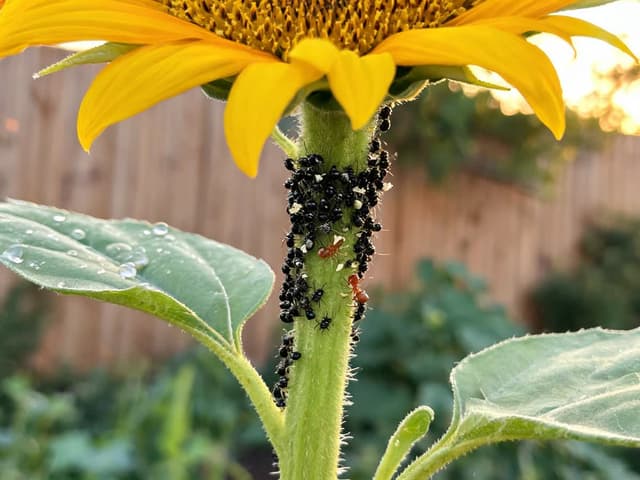
Bugs on Sunflowers: What They Are and What to Do
The bordered patch caterpillar is the main pest among the bugs on sunflowers in Brazil. Learn how to recognize this caterpillar, aphids, leaf beetles, stink bugs, and birds by the damage, when to treat, and when to let the plant finish its cycle.
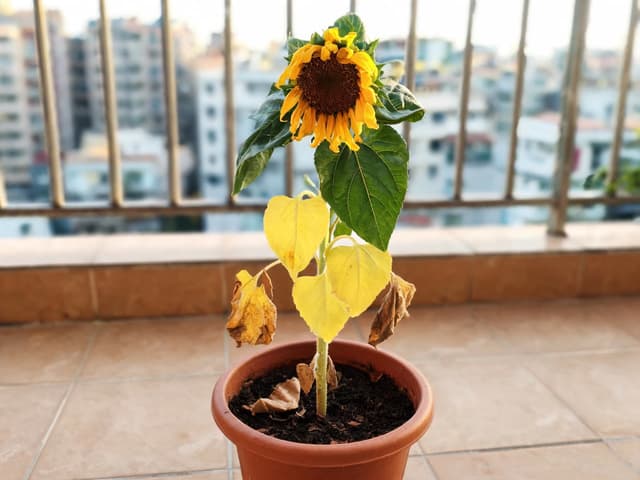
Yellow Leaves on Sunflowers: Causes and What to Do
Yellow leaves on sunflowers: use the plant's stage and where the yellow sits to tell end of life cycle, watering, low fertilizer, fungus or mites apart, plus the test that confirms each cause.
How to Prune Bougainvillea: When, How Much, and Where to Cut
How to prune bougainvillea: cut after flowering, right above a node, and save hard pruning for when the plant starts growing again. See how much to remove, the three types of pruning, and how to train potted bougainvillea.