How to Prune Bougainvillea: When, How Much, and Where to Cut
How to prune bougainvillea: cut after flowering, right above a node, and save hard pruning for when the plant starts growing again. See how much to remove, the three types of pruning, and how to train potted bougainvillea.
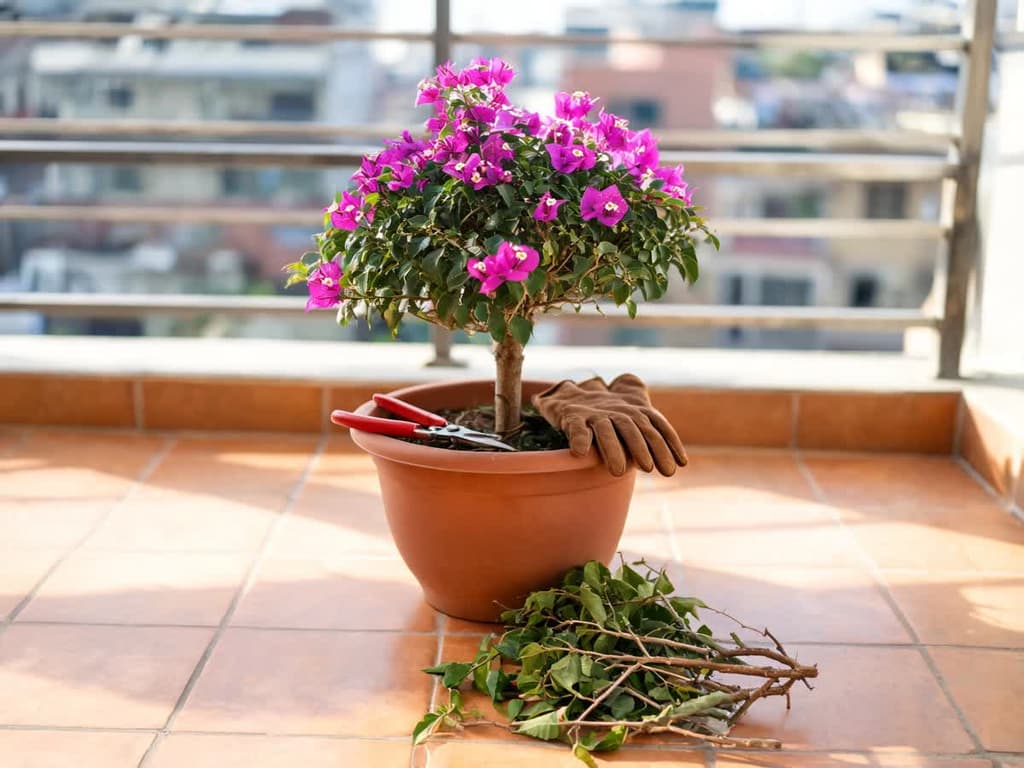
To learn how to prune bougainvillea, start with the timing: wait until flowering ends and cut new shoots right above a node. A node is the point on the branch where a leaf emerges, and that is where you find buds, the small growth points that become new stems.
Shorten lateral branches until 2 or 3 buds remain, counting from the main stem. To reduce the plant's size, remove up to one-third. Wear thick gloves and long sleeves because of the thorns.
Hard pruning on bougainvillea (also called paperflower) should not be done before cold weather. Before the cold, cut only what is necessary. Save major cuts for when the plant resumes growing, once the risk of frost has passed.
Quick summary:
When: after flowering ends, when the tiny white center flowers wither and the bracts (the colorful part) begin to fade.
How much: up to one-third to reduce the plant; lateral branches shortened to 2 or 3 buds, counted from the main stem.
Where: right above a node, about 1/4 inch (6 mm) above the bud, without leaving a stub.
Avoid: hard pruning in late summer and early fall, which runs from February to April in Brazil.
Protect yourself: thick gloves and long sleeves, because bougainvillea thorns can measure 1 to 2 inches (2.5 to 5 cm).
When to prune bougainvillea
The best time to prune bougainvillea is right after flowering ends. The University of Hawaii (CTAHR) explains that pruning at this point encourages new shoots, and that is where the next flush of color appears.
The sign is in the center of the bracts: the small white tubes, which are the true flowers, wilt. The bracts can keep their color for several months after that and fade gradually to a papery texture, according to the same CTAHR. You do not need to wait for the papery stage to prune.
UF/IFAS is the extension service of the University of Florida. It warns that pruning in late summer or early fall can reduce flowering the following season (UF/IFAS). In Brazil, this period runs from February to April. Therefore, avoid hard pruning during these months: the plant may produce fewer flowers in the next blooming cycle.
Bougainvillea (Bougainvillea glabra) and Great Bougainvillea (Bougainvillea spectabilis): Pruning Changes with the Species
Pruning frequency follows the flowering rhythm of the species you have. CTAHR describes Bougainvillea glabra as a plant that blooms multiple times a year. Bougainvillea spectabilis has one flowering cycle per season, following a dry or cold period.
*Bougainvillea glabra*, the bougainvillea with smooth leaves and fewer thorns: give it a light prune after each flush of flowers. Another CTAHR publication, on shrubs in Hawaii, recommends pruning bougainvillea throughout the year, after each wave of blooming.
Bougainvillea (*B. spectabilis*), the bougainvillea with hairy leaves and large thorns: do a main prune after the season's blooming. NC State Extension, the extension service of North Carolina State University, advises pruning this species after flowering, if needed.
If you do not know which of the two you have, follow the rule that applies to both: prune after flowering and avoid pruning in the middle of it.
Before Cold Weather: Cut Only What Is Necessary
Before the cold, cut only what keeps the plant from fitting into the space where it spends the winter. In Germany, 4 out of 6 surveyed gardening websites tell you to prune potted plants before bringing them indoors in autumn. Only one advises hard pruning.
This guide follows UF/IFAS and the RHS, the Royal Horticultural Society of the United Kingdom. UF/IFAS places the main pruning after flowering. The RHS directs you to do the main pruning just before growth resumes (RHS).
Where there is frost, save hard pruning for after the cold weather passes. The University of Arizona advises cutting frost-damaged bougainvillea back to living wood. Wait to cut until the risk of frost ends or new growth resumes (Arizona Extension). Cold-weather care details are in bougainvillea in winter.
Why Pruning Makes Bougainvillea Bloom
Bougainvillea blooms on new wood, and pruning is what triggers the plant to produce these shoots. NC State Extension and CTAHR agree that flowers appear on new growth. CTAHR notes that trimming and pinching tips are necessary to encourage the plant to sprout.
Pruning too much also removes flowers. CTAHR warns that pruning too frequently reduces flowering, and UF/IFAS notes that pruning too often can cut off new flower buds. In pots, CTAHR itself says frequent trimming maintains continuous shooting and flowering. That is why this guide recommends a light prune after each flush of color, rather than repeated heavy pruning.
If your bougainvillea has foliage but no color, the cause may lie in light, watering, or fertilizer, not just pruning. See why bougainvillea fails to bloom.
How Much to Cut When Pruning Bougainvillea
To reduce a bougainvillea, cut back about one-third of the plant and remove all thin and weak branches, according to CTAHR. NC State uses the same guideline for shrubs in general: remove no more than one-third of the canopy per year (NC State Extension).
For side shoots, the measurement is counted in buds. A bud is the small shoot at the point where the leaf attaches to the branch. CTAHR directs cutting each side shoot back until 2 or 3 buds remain next to the main branch, because these short shoots produce the next flowers. The RHS leaves 3 or 4 buds (RHS). This guide follows CTAHR's 2 or 3 buds. It describes bougainvillea in a tropical climate, closer to the climate of most of Brazil.
The RHS gives a third guideline for long shoots. After the bracts fall, it cuts these shoots back by half to trigger a second flush of color in the same season. This guide uses one-third to reduce the entire plant. Cutting by half applies only to long shoots after flowering, and only the RHS offers this recommendation.
Goal | How much to cut | Source |
|---|---|---|
Reduce the plant | Up to one-third per year | CTAHR and NC State |
Lateral branch | Until 2 or 3 buds remain | CTAHR (RHS leaves 3 or 4) |
Long shoot after flowering | By half, just to encourage a second flush of blooms | RHS |
Dead or diseased branch | Only the dead part, down to where scratched bark shows green | CTAHR and Purdue |
One of the German sites consulted advises cutting back two-thirds of all stems at once. No consulted university source recommends that much for bougainvillea.
Where to Cut: Right Above the Node
Cut about 6 mm (1/4 inch) above a bud facing the direction you want the new branch to grow. NC State Extension gives this distance for shrubs in general and warns against two mistakes: leaving a stub and cutting too close to the bud. No source gave a specific distance for bougainvillea.
On bougainvillea, the bud sits at the node, alongside the leaf and the thorn. New growth emerges from the buds directly below the cut, according to NC State. The University of Arizona explains that a stub left above the bud usually dies back.
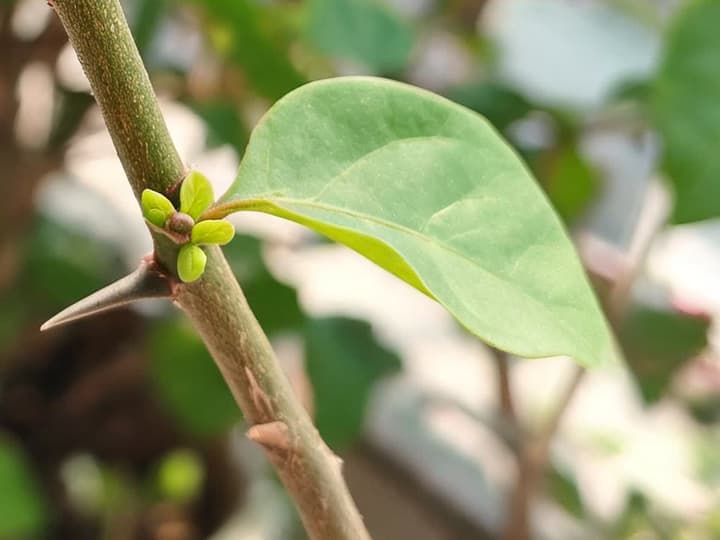
To encourage the plant to grow outward rather than inward, select an outward-facing bud. The University of Arizona recommends cutting at varied heights. CTAHR warns that shearing all branches to the same height creates a top-heavy plant.
Formative, Maintenance, and Hard Pruning
Bougainvillea receives three types of pruning: formative pruning on young plants, maintenance pruning after each bloom cycle, and hard pruning to downsize an overgrown plant.
Formative Pruning: Pinching Tips
Formative pruning shapes a young plant and makes it bushy. To make potted bougainvillea bushy, pinch with your fingers only the soft tip of new shoots coming off the main stem. The Indian Council of Agricultural Research (ICAR) explains that the branch puts out several side shoots near the pinched point. CTAHR instructs pruning the young plant to develop a framework of strong branches from below.
No consulted source specifies how much to remove or how often to pinch. Pinch once and wait for lateral shoots to appear before pinching again.
Maintenance Pruning: After Each Bloom Cycle
Maintenance pruning preserves size and bloom production. After each flush of color, remove tips with spent bracts and cut away dead wood. Shorten lateral branches to 2 or 3 buds. CTAHR advises removing dead branches as soon as they appear. It also warns that without regular pruning, bougainvillea becomes a tangled mass of old and new stems, and this dense clump frequently attracts pests and diseases.
Hard Pruning: When Bougainvillea Can Take It
Bougainvillea tolerates hard pruning, but old plants are a special case. The RHS notes that plants should respond to hard pruning and that replacing an old plant is often better. It also warns that a plant renovated with hard cuts may take longer to flower again. No consulted source specifies how well bougainvillea resprouts from a thick, leafless trunk.
Therefore, the safest option is to reduce the plant in stages:
Remove no more than one-third of the plant per year. CTAHR recommends about one-third to downsize the plant, and NC State instructs not to exceed one-third of the canopy per year.
Always cut above a point that still carries leaves or buds.
Repeat the following year until you reach the desired size.
Do not perform hard pruning on newly planted specimens. NC State advises against renovating recently planted shrubs with hard cuts.
Water Sprouts and Upright Shoots
Water sprouts are very vigorous branches that sprout from the base of the plant or grow straight and tall upward. UF/IFAS Nassau County warns that these branches can slow the growth of the rest of the plant if left to grow (UF/IFAS Nassau). CTAHR advises removing suckers from the base so the plant grows taller.
Cut the entire water sprout flush with the branch it grows from. The RHS offers an alternative for vigorous lateral shoots: bend and tie them down at the start of the growing season. Arching slows vigor and stimulates bract formation.
Bougainvillea in Pots, Standards, and on Walls
Pruning determines bougainvillea's form. UC Master Gardeners at the University of California explains that without support or pruning, bougainvillea becomes a wide, sprawling shrub. With deliberate pruning, it can be trained into a tree or other shapes.
In pots: CTAHR advises pruning and shaping after each flowering cycle, keeping the plant around 3 feet (90 cm) tall. CTAHR also notes that frequent pruning in pots keeps new growth soft with few thorns.
As a standard (small tree): the RHS notes that bougainvillea can be trained on a single stem into a standard form. Lateral branches are kept short to limit size. No consulted source details the step-by-step training process.
On a wall, fence, or trellis: standard-sized varieties can be trained along a fence, trellis, or against a wall, according to the UF/IFAS of Charlotte County (UF/IFAS Charlotte). Dwarf varieties require almost no pruning.
Support structures, ties, and plant placement are covered in the bougainvillea care guide.
How to Prune Bougainvillea: Step by Step
Before maintenance pruning, gather sharp bypass pruners, heavy gloves, and a long-sleeved shirt.
Check the timing. Tiny white flowers from the last bloom cycle must have withered, and there should be no frost danger.
First remove dead, diseased, or crossing branches. NC State suggests starting with the easy cuts, pruning back to a vigorous bud or to the branch of origin. Next, remove weak shoots and those growing toward the center.
Cut water sprouts flush with the parent branch.
Shorten lateral shoots until 2 or 3 buds remain from the main stem, cutting roughly 1/4 inch (6 mm) above the final bud.
Reduce the plant, if needed, by no more than one-third.
Collect all pruned branches. Thorns remain sharp on clippings that fall to the ground.
Firm new stems trimmed during pruning can be used for propagation: step-by-step instructions are in how to propagate bougainvillea.
Tools and Thorns: What to Use for Pruning
Use bypass pruners, whose blades overlap like a regular pair of scissors. CTAHR explains that this design cuts branches cleanly without crushing them. For thick stems, the University of Arizona recommends loppers (long-handled pruners).
Wipe sap off the blade with a damp cloth, then apply 70% alcohol (UF/IFAS). If you are cutting diseased parts, CTAHR instructs you to disinfect the blade between each cut.
Bougainvillea thorns can measure 1 to 2 inches (2.5 to 5 cm), according to UF/IFAS Nassau, and size varies by variety. UF/IFAS Charlotte shares that staff have been injured pruning the plant and recommends thick gloves and long sleeves.
Dead or Alive: The Scratch Test Before Pruning
Before cutting a branch that looks dead, scratch a little bit of the bark with your fingernail. Purdue Extension, from Purdue University, describes the test for a Japanese maple: green under the bark indicates there is still a chance of sprouting (Purdue). A dead branch snaps dry when bent, while a live one still bends. None of the consulted sources describe the scratch test on bougainvillea.
Cut only the brown tissue and stop where scratched bark shows green. If the plant dropped its leaves from cold, do not cut anything yet: wait for new growth and only then remove dead wood. This matches instructions from the University of Arizona for frost-damaged bougainvillea.
Dead branches following intense heat may relate to moisture levels, which the guide on how to water bougainvillea explains.
Cold damage on bougainvillea exhibits distinct signs:
Unfamiliar Vines: Confirm It Is Bougainvillea Before Hard Pruning
A vine covering a wall at a new home is not always bougainvillea, and other climbing plants follow different pruning rules. The RHS categorizes climbers into pruning groups, each with its own timing and method. Bougainvillea belongs to the moderate vigor group.
Three signs help identify bougainvillea:
thorns where leaves join the stem;
paper-thin, colorful "flowers," which are bracts grouped in threes;
a small white tube at the center of each bract, representing the true flower.
If the plant lacks these traits, verify its identity before making major cuts. Bloom (available for iOS) identifies plants from a photo.
Frequently Asked Questions
Can I prune bougainvillea while it is blooming?
You can, but cutting colorful stems removes the bracts on them. It is best to wait until flowering ends, when the tiny white flowers wither, as advised by CTAHR. UF/IFAS notes that trimming too often can remove new flower buds. To tidy a stray stem blocking a walkway, cut only that branch just above a node.
Can you prune bougainvillea in winter?
You can, provided blooming has ended, frost risk is absent, and the plant is close to resuming growth. The RHS recommends major pruning shortly before new growth starts. Where frost occurs, wait until cold weather passes and growth resumes, as directed by the University of Arizona. Before cold weather, cut only what is necessary.
Do you need to apply wound sealant to bougainvillea cuts?
No. None of the consulted pruning sources tell you to apply paste or any product to the cut on a bougainvillea. For trees, Clemson Extension explains that pruning sealer does not prevent rot and can even encourage it when it cracks. What helps is making a clean cut with a sharp blade, about 6 mm above the bud, without leaving a stub.
Can bougainvillea tolerate severe pruning?
Yes, though old specimens are an exception. The RHS notes that bougainvillea should respond to hard pruning and that old plants are often better replaced. A renovated plant may take longer to flower again. The safest method is taking off at most one-third per year, always cutting above a point with foliage.
Summary: How to Prune Bougainvillea
Prune bougainvillea after flowering ends, when the small white flowers wither and the bracts fade. Cut about 1/4 inch (6 mm) above a bud and shorten lateral branches to 2 or 3 buds. Take off at most one-third of the plant per year. In Brazil, avoid hard pruning from February to April and, where frost occurs, wait for new growth. Before cutting a branch, scrape the bark to see if there is still green.
Related articles
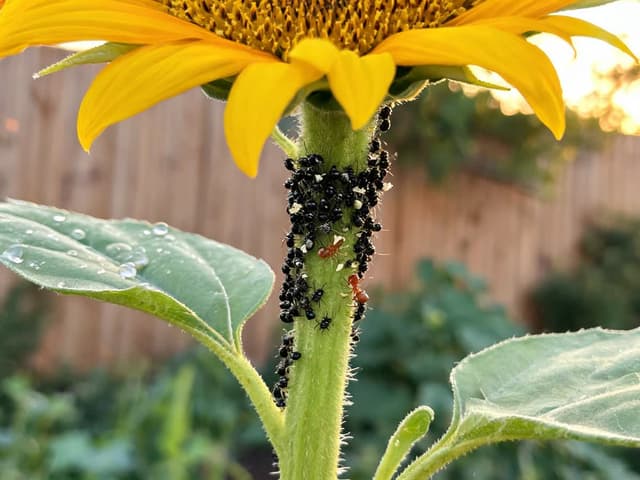
Bugs on Sunflowers: What They Are and What to Do
The bordered patch caterpillar is the main pest among the bugs on sunflowers in Brazil. Learn how to recognize this caterpillar, aphids, leaf beetles, stink bugs, and birds by the damage, when to treat, and when to let the plant finish its cycle.
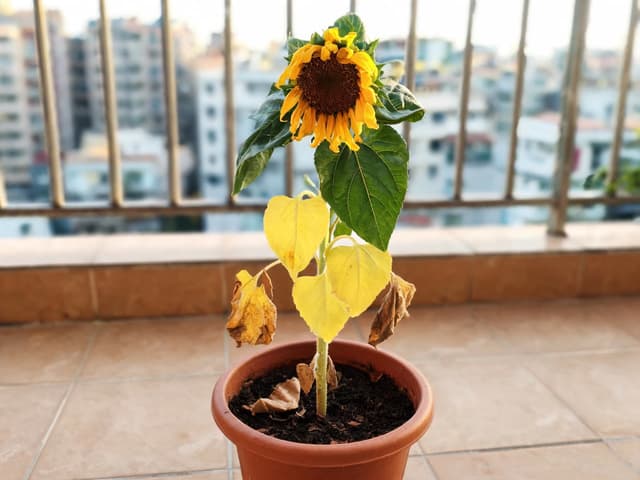
Yellow Leaves on Sunflowers: Causes and What to Do
Yellow leaves on sunflowers: use the plant's stage and where the yellow sits to tell end of life cycle, watering, low fertilizer, fungus or mites apart, plus the test that confirms each cause.
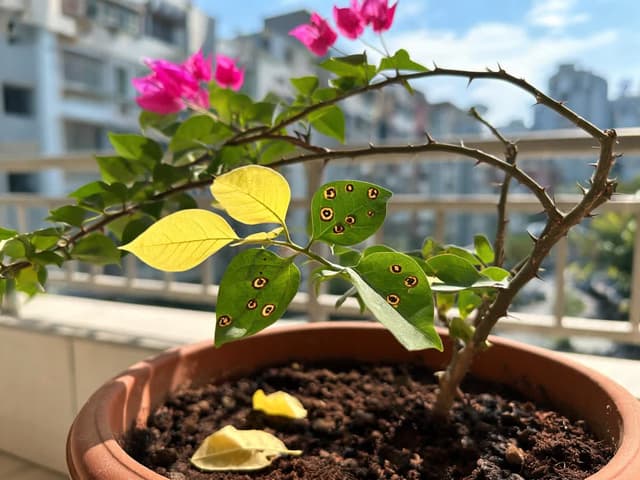
Bougainvillea with Yellow Leaves or Spots: Causes and Fixes
Bougainvillea with yellow leaves or yellow spots: tell apart leaf spot, pests, watering, cold, and iron deficiency by the pattern, and see what to do in each case.