How to Water Dipladenia: When, How Much, and Error Signs
How to water dipladenia: check the soil with your finger and water when the top 1 to 2 inches are dry. Pour water until it drains from the pot hole. See watering in heat, cold, and during vacation, and tell overwatering apart from underwatering.
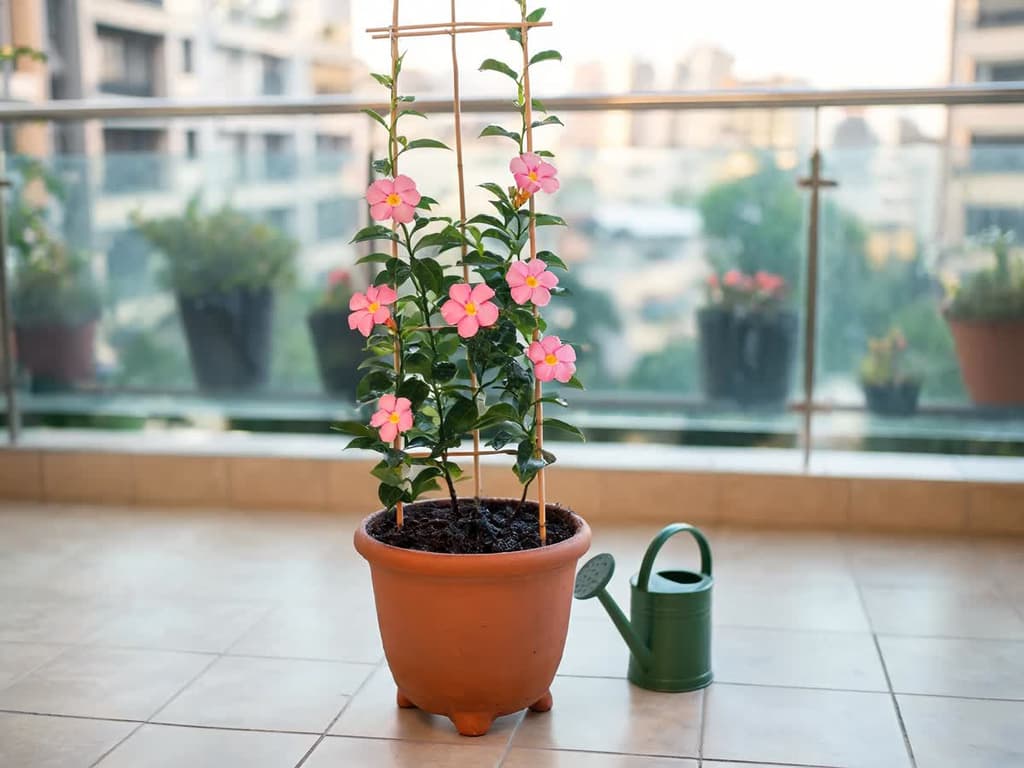
To water dipladenia, stick your finger into the potting soil and water only when the top 1 to 2 inches (2.5 to 5 cm) are dry. Pour water slowly until it drains out the bottom hole, and empty the saucer as soon as the water stops draining. On hot summer days, soil in a pot can dry out in a single day. In the cold, it takes much longer.
Yellow leaves alone do not tell you if the plant has too much or too little water: the soil decides. Wet soil and yellow leaves mean you need to stop watering. Dry soil and wilted leaves call for a deep watering. That is why dipladenia does not have a fixed watering day, and the soil test works all year round.
How to tell when to water dipladenia
The time to water dipladenia is when the top 1 to 2 inches (2.5 to 5 cm) of soil are dry. That is the measurement from a University of Illinois Extension specialist on Ask Extension. When in doubt, he recommends watering less, because the plant likes slightly moist soil, but not wet.
Dipladenia and mandevilla are two names for plants in the same botanical group, the genus Mandevilla, and watering is identical for both. The differences in growth habit between the compact type and the climbing vine are covered in the guide on how to care for dipladenia.
To do the test, push your finger into the soil near the edge of the pot, down to the first or second knuckle (1 to 2 inches / 2.5 to 5 cm):
Dry soil that feels loose and warm to the touch: water until water runs out the drainage hole.
Soil that still feels damp or cool at the tip of your finger: do not water, and test again the next day.
This is the guidance from another Ask Extension answer: dipladenia is sensitive to overwatering, and your finger works better than a watering schedule. On very hot days, the same answer recommends testing the soil every day.
How much water to give: water until it runs out the drainage hole
The right amount of water is what wets all the soil in the pot and begins to come out through the bottom hole. Iowa State University Extension says water should drain out the bottom of the pot after watering. Texas A&M AgriLife Extension gives the same rule: water when the top layer dries out and stop when the water drains out.
The pot must have a drainage hole. Without a hole, excess water stays at the bottom and the roots remain wet all day.
Empty the saucer as soon as the water stops running out. Iowa State recommends never leaving the pot sitting in a saucer or cachepot (a decorative outer pot covering the plant pot) filled with water.
Some people recommend watering lightly and frequently, while others recommend watering thoroughly and spacing sessions out. This guide follows the deep watering method backed by university extensions. A single cup of water every day wets only the top layer, leaving the roots at the bottom of the pot dry.
How often to water dipladenia
How often you water dipladenia changes with heat, pot size, and where it sits. Because of this, the watering day comes from testing the soil, not from a fixed number. The Royal Horticultural Society (RHS), in the United Kingdom, states that in the heat you may need to water the pot every day. Potted soil dries out quickly.
Dipladenia situation | When to test the soil | What to expect |
|---|---|---|
Small or medium pot, full sun, hot days | Every day | Frequent watering, sometimes daily |
Large pot or partial shade, hot days | Every day | Watering spaced further apart than in a small pot |
In-ground garden bed, rainy season | After days without rain | Rain usually keeps the soil moist |
Garden bed, dry winter (Cerrado, in central Brazil) | Before each watering, with your finger | Rain stops and the plant depends on your watering |
Nights below 50 °F (10 °C) | Before each watering | Watering spaced much further apart, without letting the soil dry out completely |
NC State Extension calls for plenty of water in the summer, with moist, well-drained soil. Clemson Cooperative Extension advises spacing waterings further apart when cold temperatures and weaker light cause growth to stall. In Brazil, the same potted dipladenia can require daily watering in January and waterings spaced much further apart in July.
Potted dipladenia: what makes the soil dry out faster
For potted dipladenia, four things speed up soil drying: heat, direct sun, wind, and a small pot. Iowa State lists pot size, soil type, and the environment among what determines how much water each plant needs. That is why a small pot in afternoon sun dries out before a large pot in partial shade, even when watered on the same day.
The UF/IFAS Extension, from the University of Florida, states that mandevilla needs full sun to bloom well. The same page notes that compact dipladenias, such as 'Rio Pink', tolerate a bit more shade than the large vines. A plant in strong sun uses more water, so the soil test becomes a daily routine.
NC State recommends afternoon shade in hot, humid climates and accepts partial shade, with 2 to 6 hours of direct sun. This guide combines both extensions: direct morning sun for blooming and afternoon shade on hot days. On a patio with harsh afternoon sun, that shade helps the soil dry out more slowly.
Does dipladenia store water in its roots?
Potted dipladenia may or may not have a storage root: that depends on the variety, and no one has measured how much this reserve can hold. Some Mandevilla species store reserves in a thick root, called a tuberous root. A study published in 2000 in the Revista Brasileira de Botânica described this root in two species native to the Cerrado, with accumulated starch. These two species are not the dipladenia sold in pots.
In potted dipladenias, the root varies from one variety to another. Patents for three commercial hybrids describe the young plant's root in different ways: thin, branched, and without fleshy parts (USPP24704), between fibrous and somewhat fleshy (USPP29848), and thick and fleshy (USPP36757).
No source has measured how many days a potted dipladenia can survive without water. The safest choice is to treat this root reserve as a backup cushion against an accidental missed watering. It is not a reason to skip watering during hot weather. Waterlogged soil is a real threat. Iowa State points to overly wet soil as one of the most common stresses leading to root rot.
Is your dipladenia overwatered or underwatered?
To tell whether a dipladenia is overwatered or underwatered, check the soil before checking the leaves. Both issues cause yellow and wilted leaves, and soil moisture is what separates one from the other.
What you see | With dry soil | With wet soil |
|---|---|---|
Wilted leaves | Underwatering | Probable root rot |
Yellow leaves falling off | Underwatering, if the plant is also wilting | Overwatering |
Tiny gnats flying above the soil | Unlikely | Overwatering |
Roots when taken out of the pot | Light-colored and firm | Dark and soft |
Iowa State explains that waterlogged soil promotes root rot. A plant with root rot wilts, often from the bottom leaves to the top, and the leaves turn yellow and drop. The roots turn dark and mushy. Watering again at this point makes the plant worse.
The tiny black gnats flying over the pot are another sign. Iowa State notes that these fungus gnats prefer moist soil and indicate overwatering.
What to do in each case:
Dry soil and a wilting plant: water slowly until water drains through the hole.
Wet soil and a wilting plant: do not water. Empty the saucer and allow the soil to dry out until the top 1 to 2 inches (2.5 to 5 cm) are dry. If the roots are dark and soft, Iowa State recommends watering less frequently from then on.
Root rot has its own dedicated dipladenia guide, detailing treatment:
When yellowing stems from another cause, such as cold temperatures, lack of fertilizer, or pests, the guide on dipladenia with yellow leaves breaks down each one. For a wilted plant, the page on dipladenia with wilted leaves gathers all other causes of the symptom.
Dry soil that no longer absorbs water
Soil that has dried out too much can start repelling water. The Texas A&M AgriLife Extension explains that many potting soils contain peat moss (dark, fluffy plant material). Dry peat moss becomes hard to wet again. Water runs down between the pot wall and the root ball (the block of soil with the roots) and drains out the hole. The center of the root ball stays dry.
The telltale sign is water running out of the drainage hole almost the moment you pour it, while the soil stays dry and pulled away from the pot wall. To rehydrate the entire root ball, AgriLife recommends three methods:
Submerge the pot in a bucket of water. Leave it submerged until air bubbles stop rising.
Or set the pot in a shallow basin or sink filled with water for 1 to 2 hours, so the soil absorbs moisture through the bottom hole. Only in this scenario should the pot sit in water. Remove the pot as soon as the soil is moist.
For pots too large to lift, leave a hose trickling with a very thin stream of water over the soil surface until it absorbs.
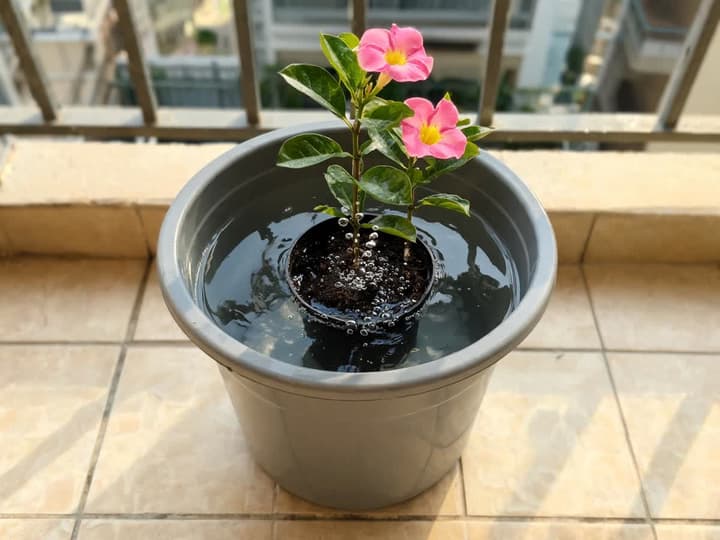
After rehydrating the root ball, go back to using the finger test.
Dipladenia wilted after heat: it can be saved
You can save a dipladenia that wilted after a heatwave. Soak the entire root ball using one of the three methods above. Afterward, prune only the stems that stay dry and brittle.
Clemson states that mandevilla blooms in the same summer on new growth, even when pruned nearly to the ground.
Misting dipladenia and the best time to water
The RHS recommends misting dipladenia leaves every day in summer, because the plant is tropical and thrives in humid air.
An expert from Ask Extension points out the other side: he recommends avoiding standing water on the leaves and says watering from above in strong sun can damage the flowers. This guide follows Ask Extension, a university extension network, and not the RHS, a horticultural society. Water the soil, not the leaves or the flowers. If you still want to mist, as the RHS recommends, do it early and keep the water away from the flowers.
The best time to water is early in the morning or late in the afternoon, according to the RHS. At these times, temperatures are lower.
Watering dipladenia in the cold and in winter
During the Brazilian winter, from June to August, dipladenia slows its growth and requires less water. Clemson notes that the plant tolerates a minimum of 45 to 50 °F (7 to 10 °C). When nights drop below 50 °F (10 °C), test the soil before every watering and wait for it to dry out more between waterings.
Sources differ on how much the soil can dry out in the cold. NC State advises letting the soil dry out in winter for plants brought indoors in frosty areas. The RHS advises keeping the soil slightly moist, without letting it dry out completely. This guide follows the RHS for watering dipladenia outdoors in Brazil: in the wind and sun, soil dries out faster than indoors. The RHS also advises bringing the plant indoors before nighttime temperatures drop below 50 to 59 °F (10 to 15 °C).
In the garden bed, winter watering depends on rainfall in your region. According to Embrapa Cerrados, the dry season in the Cerrado coincides with winter and runs from May to September. In these regions, rain stops right when it gets cold, and dipladenia planted in the ground comes to depend on your watering. The plant grows less, but the soil still dries out anyway.
If you received a pink-flowering vine and do not know if it is actually a dipladenia, confirm the species before following these rules. Bougainvillea, hoya, and Madagascar jasmine are also vines with pink or white flowers, and each has its own care requirements. Bloom (available for iOS) identifies plants from a photo, and the free version allows 2 identifications per month.
How to water dipladenia while on vacation
To water dipladenia while on vacation, choose the method based on how long you will be away. The UF/IFAS Extension recommends deep watering before leaving, for both the pebble and the cotton cord methods:
1 to 2 weeks: use a self-watering pot, which has a water reservoir at the bottom. Another option is a deep tray filled with pebbles and water, resting the pot directly on the pebbles above the water line: this buys roughly 1 extra week.
3 to 4 weeks: set a bucket of water higher than the pot. Run a cotton cord from the bottom of the bucket into the potting soil. The wick slowly draws water down into the soil.
More than 4 weeks: leave the plant with someone, or ask someone to stop by at least once a week to test the soil.
UF/IFAS also notes that plants moved out of direct sun consume less water. For trips lasting up to 2 weeks, move potted dipladenia into partial shade, away from direct sunlight. For plants in garden beds, the same source calls for watering thoroughly enough to soak the top 12 inches (30 cm) of soil before your trip.
Frequently asked questions about watering dipladenia
Does dipladenia need a lot of water?
Dipladenia needs plenty of water in summer and little during the cold. NC State calls for ample water during hot months, always in well-drained soil. In winter, waterings are spaced much further apart. In both cases, water only when the top 1 to 2 inches (2.5 to 5 cm) of soil are dry.
Can I water dipladenia every day?
You can, whenever the soil dries out every day. This happens in small pots placed in full sun and heat, and the RHS notes that daily watering may be necessary in such conditions. If the soil still feels damp at your fingertip, daily watering becomes overwatering and can rot the roots.
Does dipladenia like sun?
Yes. UF/IFAS states that dipladenia needs full sun to bloom well, though compact varieties tolerate slightly more shade. In hot, humid climates, NC State recommends afternoon shade. The more sun the plant receives, the faster the soil dries out and the more frequently it needs water.
Are yellow leaves on dipladenia a sign of underwatering or overwatering?
It depends on the soil. Yellow leaves accompanied by wet soil point to overwatering and root rot risk: stop watering until the top layer dries out. Yellow leaves with dry soil and a wilting plant indicate underwatering: water until it drains from the pot hole.
Summary: how to water dipladenia
Water when the top 1 to 2 inches (2.5 to 5 cm) of soil are dry, checking with your finger.
Water until water flows out through the drainage hole, and empty the saucer as soon as drainage stops.
During hot weather and in small pots kept in full sun, test the soil every day; watering can be daily.
When nighttime temperatures drop below 50 °F (10 °C), space waterings out without letting the soil dry out completely.
Wilting with wet soil signals root rot rather than thirst: stop watering.
Soil that repels water: submerge the pot in a bucket until bubbles stop rising.
Related articles
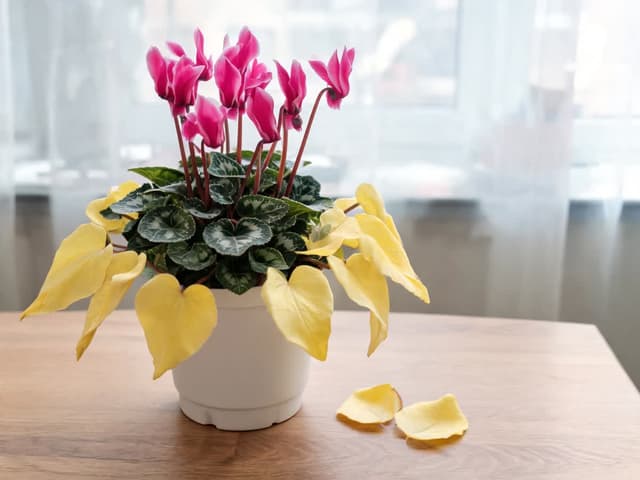
Cyclamen with Yellow Leaves: Causes and What to Do
A cyclamen with yellow leaves might just be going dormant. Learn how the tuber and the time of year tell dormancy apart from rot, heat, thirst, and mites, and what to do in each case.
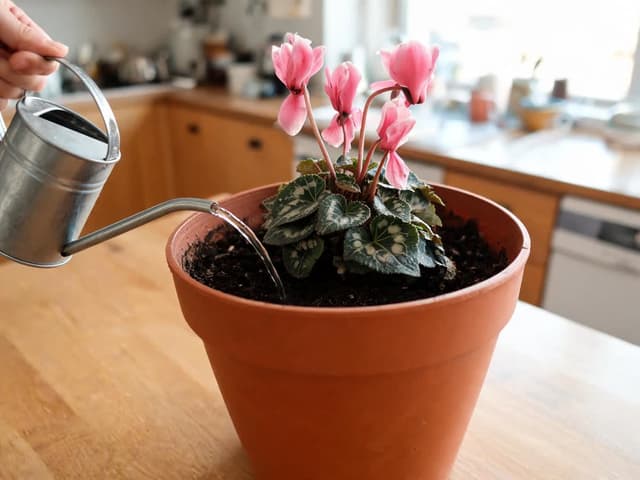
How to Water Cyclamen: Bottom Watering, Edge Watering, and the Wilt Test
How to water cyclamen without rotting the tuber: when the soil surface dries out, from below for 15 minutes or around the edge, never in the center. Plus the test to tell wilting from thirst apart from rot.
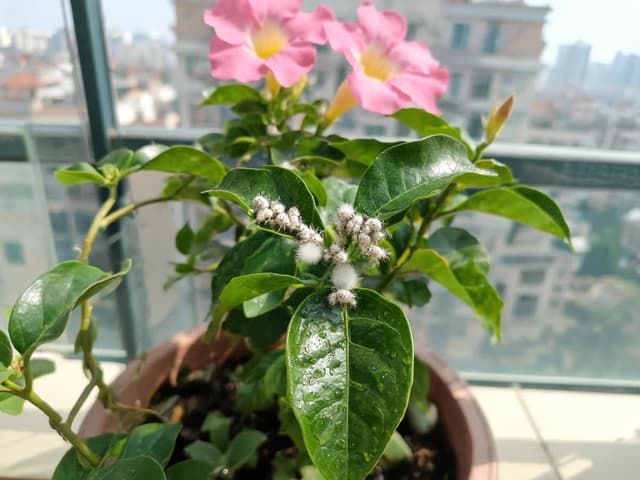
Dipladenia with Sticky White Dots: Which Pest Is It?
A sticky white dot on a dipladenia is almost always a mealybug, but whiteflies, aphids, spider mites, and the plant's own sap leave similar marks. See the test that separates each one and the source-backed treatment.