How to Care for Dipladenia (Mandevilla): Light, Water, Pruning, and Cold
How to care for dipladenia: morning sun, water when the top layer of soil dries out, 10-20-10 fertilizer every 2 weeks in spring and summer, late winter pruning, and protection when nights drop below 50°F (10°C).
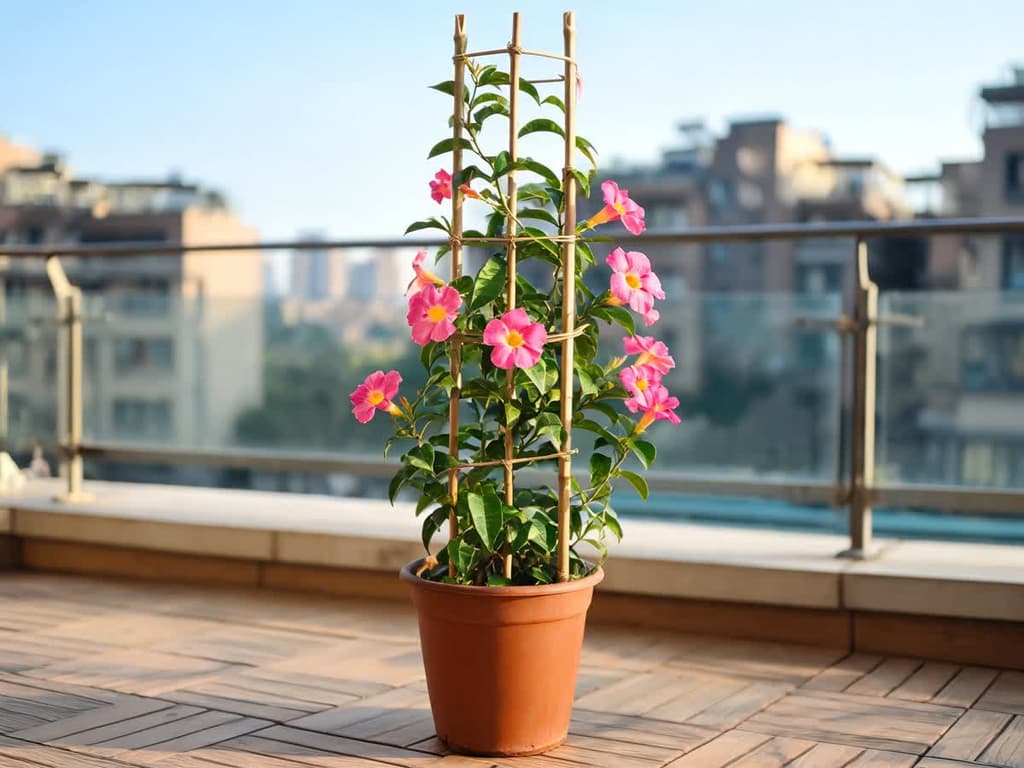
To care for dipladenia, give the plant direct sun for part of the day and water when the top layer of soil dries out. In spring and summer, fertilize every 2 weeks. Prune in late winter and protect the plant from cold below 50°F (10°C). These care guidelines come from three US university extension services that advise plant growers: NC State, UF/IFAS, and Clemson.
Dipladenia comes from Brazil, and NC State Extension records the genus's origin in Rio de Janeiro. In Brazil, it stays on the porch, on walls, or in garden beds year-round where winter nights do not drop below 50°F (10°C). Dipladenia and mandevilla are names for the same group of plants, the genus Mandevilla.
Dipladenia care: quick reference
Care task | What to do |
|---|---|
Light | Direct sun for part of the day, preferably in the morning; shade during hot afternoons |
Water | When the top layer of soil feels dry to the touch; more water in summer, less in cold weather |
Soil | Well-drained, pH 6.0 to 8.0, pot with drainage holes |
Fertilizer | 10-20-10 every 2 weeks in spring and summer (from September to March in Brazil) |
Temperature | Likes heat; the minimum it tolerates is between 45 and 50°F (7 and 10°C) |
Pruning | In late winter, before new growth starts (August or September in Brazil) |
Size | 3 to 10 ft (0.9 to 3 m) tall, depending on the variety; compact varieties are bushier |
Pets | The ASPCA does not list dipladenia; the sap can irritate skin |
Dipladenia or mandevilla: what is the difference?
Dipladenia and mandevilla are names for the same group of plants, the genus Mandevilla. "Dipladenia" is the old name for the group. According to the Clemson Home & Garden Information Center (HGIC 1109), the genus Mandevilla includes the plants formerly called Dipladenia.
Both names appear on labels, and growth habit varies from one variety to another. Compact varieties, such as 'Rio Pink' and those in the Sun Parasol series, were once treated as a separate species, Dipladenia. Today they are back in the genus Mandevilla, explains UF/IFAS, the University of Florida extension service. Because of this, the name on the label does not guarantee the plant's growth habit. Check whether it is compact or vining before choosing the pot and support.
The two forms have practical differences:
Compact dipladenia: grows upright, twines very little, and tolerates slightly more shade than large vining types (UF/IFAS). Works well for pots and window boxes.
Vining mandevilla: twines its stems around any support and reaches up to 10 ft (3 m) in height, according to NC State. Requires a trellis, wire, or fence.
Almost every dipladenia sold in stores is a hybrid, meaning a cross between more than one species. According to NC State, breeding efforts focus on bushier plants that twine less, along with more flower colors. The care instructions in this guide apply to both growth habits; only pruning and trellising differ.
How to identify dipladenia
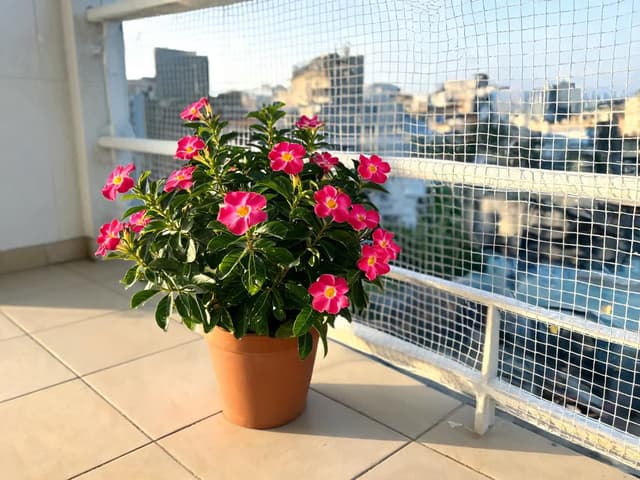
Four characteristics identify dipladenia. The leaves are simple and grow in pairs, opposite each other along the stem, dark green and glossy, according to NC State. The flower is funnel-shaped, with 5 rounded petals and a center that is usually yellow. A cut stem secretes milky white sap (UF/IFAS).
The fourth sign is on the climbing stems: the stem twines around the support on its own, without tendrils (the thin thread other climbers use to attach themselves). Trumpet vine (Campsis radicans) also has an orange, trumpet-shaped flower and is confused with dipladenia. Trumpet vine is distinguished by its compound leaf, divided into 7 to 11 leaflets with serrated edges (leaflets are the smaller parts of a compound leaf). It also clings to walls instead of twining its stem, according to NC State. When in doubt, Bloom (available for iOS) identifies the plant from a photo, and the free version allows 2 identifications per month.
How much sun dipladenia needs
Dipladenia needs direct sun to flower well, according to UF/IFAS. NC State accepts full sun (6 or more hours of direct sun per day) or partial shade (2 to 6 hours). In hot, humid climates, NC State recommends afternoon shade.
In the humid heat found across much of Brazil, the best spot receives morning sun and stays in the shade during the hottest afternoon hours. Where summers are mild, the plant tolerates sun all day long. In full shade all day, dipladenia stays alive, but produces few flowers. Clemson recommends partial shade for outdoor plants. This guide follows NC State, because it is the only one of the three sources that specifies daily sun hours and addresses hot, humid climates.
Indoors, dipladenia needs bright light filtered by a curtain, according to Clemson. In Brazil, the window that receives the most hours of sun faces north. Keep the pot at this window, behind a sheer curtain.
How to water dipladenia
Stick your finger into the soil: if the top layer is dry, water the dipladenia until water drains from the bottom of the pot. Right after, empty any water collected in the saucer. NC State advises moist, never soggy soil, and plenty of water in summer. During that season, water every time the top layer dries out.
In the heat, potting soil dries out faster, so waterings become more frequent. Check the soil daily during hot weeks. When nights cool down, the plant slows its growth and uses less water. During this phase, Clemson recommends spacing out waterings, and NC State recommends letting the soil dry out during winter.
A fixed watering schedule does not work for dipladenia year-round. The care calendar for dipladenia brings together the plant's schedule. The three extension services do not give a fixed watering frequency, so always check by testing the soil, both in summer and in cold weather.
Soil, pots, and garden beds for dipladenia
Dipladenia tolerates various soil types as long as water drains freely, according to UF/IFAS. NC State indicates soil with a pH between 6.0 and 8.0 (pH measures whether soil is acidic or alkaline). For containers, Clemson suggests equal parts peat moss (dark organic material sold in bags), potting soil, and coarse sand. The pot must have drainage holes at the bottom.
In garden beds, dipladenia lives for years where night temperatures stay above 50°F (10°C). UF/IFAS notes that it stays evergreen in tropical climates and dies back to the ground when it freezes. NC State notes that it tolerates coastal conditions near the sea well. Where winters bring frost, grow it in a pot: that way, you can move the plant to a protected spot.
How to fertilize dipladenia
Fertilize dipladenia every 2 weeks in spring and summer (from September to March in Brazil). Clemson recommends a fertilizer with more phosphorus, like 10-20-10. The three numbers are the percentages of nitrogen, phosphorus, and potassium. Follow the package dosage and water the soil before fertilizing.
German gardening guides disagree on frequency: weekly, every 2 to 3 weeks, or every 4 to 6 weeks. This guide follows Clemson, because it is the only university extension source that specifies numbers and ratios. When nights drop below 50°F (10°C) and the plant stops growing, do not fertilize.
None of the three extension services recommends coffee grounds for dipladenia, and no reviewed source provides a tested application rate. Because no one has measured the effect, stick with Clemson's phosphorus-rich fertilizer, like 10-20-10.
How to prune dipladenia
Prune dipladenia in late winter or early spring, before new growth begins. In Brazil, this falls in August or September. Clemson recommends removing old, crowded stems and shortening the others. NC State recommends pruning before moving the plant back outdoors in spring.
Pruning does not remove the season's flowers. According to Clemson, even when cut nearly to the ground, dipladenia blooms the same summer on new shoots. One retail guide claims pruning does more harm than good precisely because flowers form on new wood. This guide follows Clemson: it is an extension source, and pruning actively encourages those new flowering shoots to grow.
Step-by-step late winter pruning:
Put on gloves. The white sap can irritate skin, UF/IFAS warns.
Cut dead, broken, and crossing stems flush at the base.
Shorten the remaining stems to your desired height. Make each cut just above a pair of leaves. Clemson notes that the plant will bloom the same summer even if pruned nearly to the ground.
On vining types, leave several sturdy, long stems to climb back up the trellis.
Water after pruning. Resume fertilizing once new growth appears.
Throughout spring and summer, pinch back new dipladenia tips. Pinching means removing the soft tip of a new shoot with your fingers. Clemson, UF/IFAS, and NC State all recommend this practice to create a bushier plant. On compact dipladenia, pinching keeps the plant low and full without requiring heavy pruning.
Supports and trellises for vining mandevilla
Vining mandevilla requires support: a frame, trellis, or stake, according to Clemson. The stem twines around the support on its own without needing twine. UF/IFAS notes that the plant twines in only one direction. According to gardeners consulted by UF/IFAS, forcing it in the opposite direction appears useless.
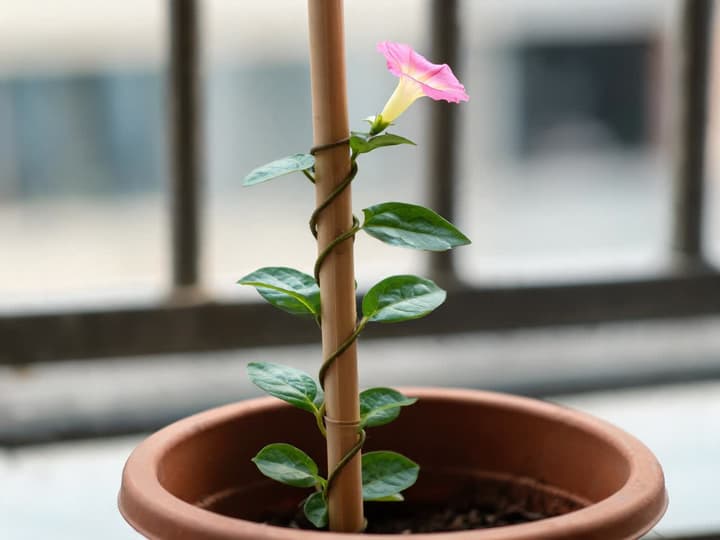
To train the plant, place the tip of a new shoot against the support and let the stem wind around it on its own. If the stem slips off, secure it with a loose loop of twine just until it completes its first turn. NC State records heights of 3 to 10 ft (0.9 to 3 m) for the genus, so choose a support tall enough for the height you want to cover. Compact dipladenia grows upright and twines very little. If stems begin to flop, support them with a short stake.
When dipladenia blooms
Dipladenia blooms most heavily in the summer, according to UF/IFAS. In warmer winter regions of the United States (zones 10 and 11 on the country's climate map), some flowers appear year-round. The flowers attract hummingbirds and butterflies, NC State notes.
A dipladenia that fails to bloom usually suffers from one of three issues:
Not enough sun: UF/IFAS notes that dipladenia needs full sun to bloom well. Move the pot to a spot with at least 2 hours of direct sun, preferably in the morning.
Cold: low temperatures and lower light levels push the plant into dormancy, according to Clemson. It resumes blooming when nights warm up.
Lack of fertilizer: UF/IFAS states that dipladenia requires regular fertilizing. Feed every 2 weeks throughout spring and summer.
Do not trim new shoots that already carry buds: the flowers develop directly on them. Pinch shoot tips only before buds form.
Cold and frost: when to protect dipladenia
According to Clemson, the lowest temperature dipladenia tolerates is between 45 and 50°F (7 and 10°C). This guide uses 50°F (10°C), the safer threshold for the plant. Below that, Clemson recommends bringing the plant into a bright, protected space. Frost kills the plant's top growth, according to UF/IFAS.
Where winter nights stay above 50°F (10°C), dipladenia stays outside year-round. Where they drop below that, such as in the South and in the mountains of the Southeast of Brazil, move the pot near a bright window. Another option is to cover garden bed plants with garden fleece (a thin, lightweight fabric sold to protect plants) on frosty nights.
Before bringing the pot indoors, inspect the leaves and stems for pests, Clemson recommends. In its protected spot, water less frequently and stop fertilizing until the plant resumes active growth.
Dipladenia with yellow leaves
Yellow leaves on a dipladenia stem from three main causes, and you can tell them apart by what you see:
Soggy soil: the soil stays wet a day after watering, or standing water sits in the saucer. Space out waterings and let the top layer dry out.
Pests: the underside of the leaf shows tiny light specks, fine webbing, or white cottony puffs. See the pests section below.
Cold: leaves turn yellow after nights below 50°F (10°C). Clemson lists 45 to 50°F (7 to 10°C) as the minimum the plant can handle. Protect the dipladenia and wait for new growth to emerge.
The page on yellow leaves on dipladenia lists other potential causes with photos.
Dipladenia pests
The most common dipladenia pests are mealybugs (the cottony ones), scale, whiteflies, and spider mites, according to Clemson. NC State adds aphids and thrips (tiny insects that rasp leaf surfaces). UF/IFAS notes that dipladenia has no severe pest problems and suggests insecticidal soap against scale insects.
Mealybugs form white cottony clusters in leaf axils (where the leaf meets the stem) and leave the plant sticky. Isolate the plant from others as soon as you spot these clusters. Step-by-step treatment is covered in the guide on mealybugs.
Spider mites leave pale stippling on leaves and, as the infestation grows, fine webbing on the undersides. Signs and control methods are in the guide on spider mites. Aphids cluster on tender new shoots, and their control is detailed in the guide on aphids on plants.
Is dipladenia toxic to cats and dogs?
The ASPCA, the American organization maintaining the primary toxic plants list for animals, lists dipladenia neither as toxic nor as non-toxic. UF/IFAS warns that the milky sap can irritate skin and may be toxic if ingested. Because the ASPCA does not list the plant and UF/IFAS warns about the sap, treat dipladenia as a potential hazard for cats and dogs.
If your cat or dog chews on foliage, keep your dipladenia out of reach. If an animal chews the plant, call your veterinarian. Other common plants hazardous to pets can be found in our guide on toxic plants for pets.
Frequently asked questions about dipladenia
When should I prune dipladenia?
Prune dipladenia in late winter or early spring, before new growth begins. In Brazil, this falls in August or September. Remove old, crowded stems and shorten the others, as Clemson recommends. Even a hard prune does not remove the year's flowers: the plant blooms that same summer on new growth.
Can I fertilize dipladenia with coffee grounds?
None of the three extension services consulted recommends coffee grounds for dipladenia, and no source found gives a tested dosage. The safe option is Clemson's: fertilizer higher in phosphorus, such as 10-20-10, every 2 weeks in spring and summer. In Brazil, this period runs from September to March. In cold weather, do not fertilize.
What conditions does dipladenia dislike?
Dipladenia dislikes soggy soil, cold temperatures, and all-day shade. NC State advises moist but never waterlogged soil. According to Clemson, the minimum temperature the plant tolerates is between 45 and 50°F (7 and 10°C). Without direct sun for part of the day, it produces few flowers.
Does dipladenia attract bees and hummingbirds?
The funnel-shaped flowers of dipladenia attract hummingbirds and butterflies when grown outdoors, according to NC State. None of the three extension services mentions bees, so we cannot claim the plant attracts them. To welcome hummingbirds, place the plant in a sunny location where flowering is heaviest.
Summary of dipladenia care
Dipladenia needs direct sun for part of the day and watering whenever the top layer of soil dries out. Fertilize every 2 weeks in spring and summer. Prune in late winter, pinch stem tips to encourage bushiness, and provide a support for climbing types. Protect the plant whenever nighttime temperatures drop below 50°F (10°C).
Related articles
How to Water Cyclamen: Bottom Watering, Edge Watering, and the Wilt Test
How to water cyclamen without rotting the tuber: when the soil surface dries out, from below for 15 minutes or around the edge, never in the center. Plus the test to tell wilting from thirst apart from rot.
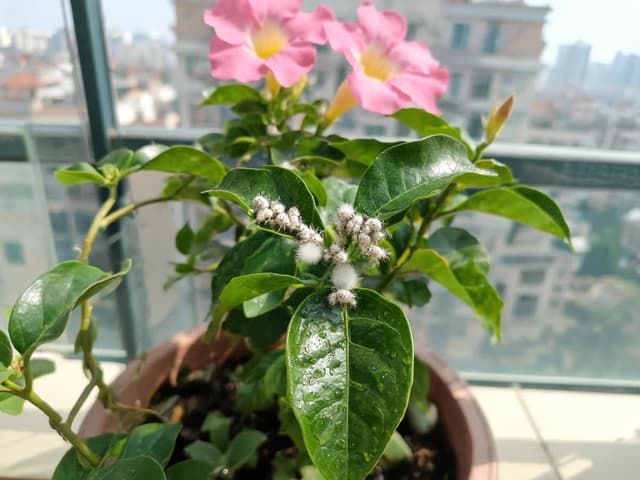
Dipladenia with Sticky White Dots: Which Pest Is It?
A sticky white dot on a dipladenia is almost always a mealybug, but whiteflies, aphids, spider mites, and the plant's own sap leave similar marks. See the test that separates each one and the source-backed treatment.
Does Dipladenia Like Sun or Shade? Sunlight Hours and Placement
Dipladenia likes sun: at least 6 hours of direct sunlight per day to bloom well. In intense heat, afternoon shade prevents scorched leaves. See which balcony exposure to choose, how to read the foliage, and what to expect indoors.