How to Water Cyclamen: Bottom Watering, Edge Watering, and the Wilt Test
How to water cyclamen without rotting the tuber: when the soil surface dries out, from below for 15 minutes or around the edge, never in the center. Plus the test to tell wilting from thirst apart from rot.
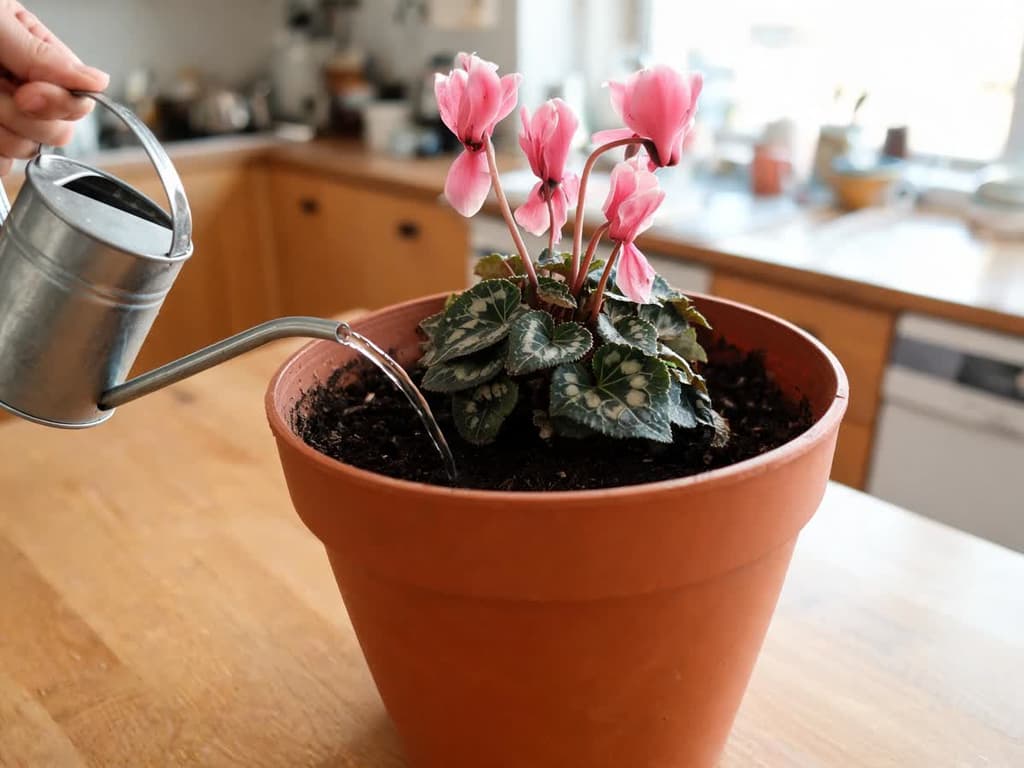
How to water cyclamen (Cyclamen persicum): wait until the soil surface is dry to the touch and water from below or around the rim of the pot. From below, leave the pot for 15 minutes in a saucer of water. Around the rim, pour water next to the pot wall until it drains from the bottom hole. Either way, water never falls into the center of the plant, and the pot never sits in water.
Cyclamen does not have a set watering day. Touch the soil every day and water only when the surface is dry, without waiting for the plant to wilt. If the cyclamen has already wilted, the first step is to find out whether it was thirst or rot, because the answer changes what to do.
Question | Answer |
|---|---|
When to water | When the surface of the soil is dry to the touch |
How to water | From below, 15 minutes in the saucer with water; or around the rim, until it drains out of the hole |
Where the water must not fall | In the center of the plant, where leaves and stems emerge from the tuber (the round, hard base) |
Standing water in the saucer | Discard it after the pot drains |
Water temperature | Room temperature |
During blooming (June to September) | Touch the soil every day and water when the surface dries out |
During dormancy (December to February) | Almost without water, just to keep the tuber from shriveling |
The tuber is the round, hard, brown base where all the cyclamen's leaves and flowers sprout from. It stores water and reserves, and it is the part that rots when watering goes wrong. The guide on how to care for cyclamen shows the rest of the care routine, from light to dormancy.
Wilted cyclamen: thirst or rot?
Cyclamen wilts for two opposite reasons: lack of water or excess water that rotted root and tuber. Both leave leaves and stems drooping, and watering incorrectly makes the problem worse. The Cyclamen Society, a British society dedicated to the genus, warns that soft leaves from excess water are often misread as thirst. The plant gets more water, the problem worsens, and the plant often dies.
The test to tell the two apart has three steps:
Touch the soil and lift the pot. Dry, light-colored soil and a light pot point to thirst. Moist or waterlogged soil and a heavy pot point to excess water.
If the soil is dry, water from below and wait until the next day. The University of Wisconsin Extension says that soft leaves on cyclamen generally mean it needs water. Leaves and stems that become firm again confirm thirst.
If the soil is wet, do not water: squeeze the tuber. If it is firm, do not water until the surface dries and check the leaves every day. If it is soft, smells bad, or is falling apart, rot has reached it and the plant should be discarded.
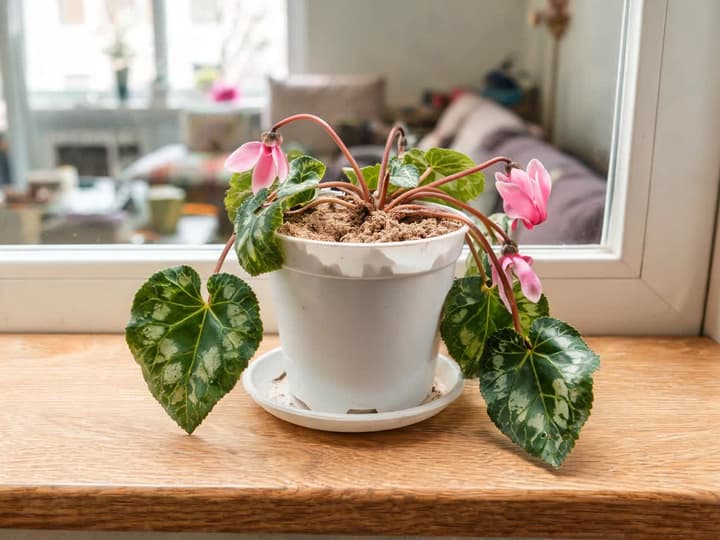
No source has measured how quickly a cyclamen wilted from thirst recovers after watering. That is why step 2 waits until the next day. If the leaves remain soft while the soil is already moist, the cause was not just thirst: go to step 3.
Wilting with wet soil is the typical sign of excess water. The New York Botanical Garden (NYBG) writes that drooping stems and leaves on cyclamen generally indicate soil kept too wet. The University of California Integrated Pest Management program (UC IPM) describes two scenarios. In root rot, the lower leaves wilt and can turn yellow, and poor drainage and overwatering favor the problem. In soft rot, a disease caused by bacteria, the plant suddenly collapses and the tuber turns soft.
A soft tuber cannot be fixed. The Montreal Botanical Garden (Espace pour la vie) instructs discarding cyclamen with soft rot. A firm tuber also does not guarantee health. In Fusarium wilt, another root disease, it remains firm, according to the UC IPM. Cornell University notes that, when cut, it appears brown or purplish inside, and directs discarding it. The cyclamen care guide explains what to do with gray mold and rot, step by step.
If the cyclamen stems collapsed while you were away, the plant may have gone thirsty or received too much water. Start with step 1 of the test: the soil tells you whether it went thirsty in your absence or received too much water from whoever took care of it.
How to water cyclamen from below
To water cyclamen from below, place the pot in a shallow bowl or saucer with water and leave it for 15 minutes. The soil draws the water up through the bottom hole. The 15 minutes comes from the Wisconsin Extension and Washington State University (WSU). The University of Maryland Extension indicates 10 to 15 minutes.
The time is only a guideline. The sign that soaking was enough is when the surface of the soil becomes moist. The Montreal Botanical Garden and the NYBG instruct you to remove the pot from the water when the top of the soil gets wet. At 15 minutes, touch the surface: if it is still dry, leave the pot in the water a little longer, up to 30 minutes in total.
After soaking, do this:
Take the pot off the saucer.
Let it drain in the sink until it stops dripping.
Discard any leftover water from the saucer.
Return the pot to its place, on a dry saucer.
The RHS (Royal Horticultural Society), the horticultural society of the United Kingdom, directs leaving the pot in water for half an hour. It also says that if the water level in the saucer does not drop, the plant did not need watering. The article follows the 15 minutes recommended by university extensions, which are the majority. No source compared the two times, and the moist surface criterion applies in both cases.
How to water cyclamen around the rim
To water around the rim, pour the water slowly next to the inner wall of the pot, away from the center of the plant. Stop when water starts coming out of the bottom hole. NC State Extension, Clemson University, and the University of Maryland Extension recommend this method.
Watering around the rim works for pots without a saucer or pots that are too large for a bowl. A narrow-spout watering can helps pour the water against the pot wall without wetting the leaves. Afterward, let the pot drain and empty the saucer.
Watering from above also serves a purpose that watering from below does not. According to the Montreal Botanical Garden, watering from above once in a while washes away mineral salts accumulated on the surface of the soil. These salts come from fertilizer and water, and the source does not say how often to do this watering. Water around the rim, always without wetting the tuber, and let the water drain through the hole.
Why not water the center of the cyclamen
The center of the cyclamen rots when it stays wet. That is where leaves and flower stems sprout from the tuber, crowded together. The Wisconsin Extension, NC State, and Iowa State University warn that water in the center can rot the tuber.
Water in the center encourages three different problems:
Tuber rot: the Cyclamen Society says that rot usually begins where the leaf and flower stems meet.
Gray mold (*Botrytis* fungus): according to the Montreal Botanical Garden, it grows with an overly wet plant center, still air, and cool temperatures.
Soft rot: UC IPM notes that the bacteria that cause it spread by splashing water.
Water on the leaves and flowers also causes harm. The RHS warns that wetting cyclamen leaves can lead to gray mold. Therefore, do not mist or spray water on the plant.
How often to water cyclamen
There is no set number of days between waterings for cyclamen. None of the university extensions consulted gives this number: they all use the soil as the criterion. Iowa State University recommends touching the soil every day. If the surface is dry, water thoroughly; if it is still moist, wait and check again the next day.
A French florist suggests watering 2 to 3 times a week. But the soil in the same pot dries faster in a warm room than in a cold room. That is why the article follows touching the soil, not a calendar.
Heat speeds up drying. Clemson warns that cyclamen near a heating vent ends up with soil that dries out too quickly. Away from the stove and afternoon sun, in a cool room, the soil takes longer to dry and waterings become more spaced out.
Do not wait for the plant to wilt before watering. The University of Maryland Extension advises waiting until the soil is dry to the touch, but not letting the plant wilt. The University of Missouri notes that cyclamen should never wilt and that consistent watering, without alternating between dry and waterlogged soil, is essential for the plant to thrive.
Decorative pots, wrapping paper, and pots without drainage holes
Cyclamen bought at the florist often comes inside a cachepot (a second, decorative pot that the plant's pot fits into) or wrapped in gift paper. The University of Illinois Extension advises removing the wrapping or poking holes in the paper so the water drains freely. Water trapped at the bottom of the cachepot leaves the soil waterlogged without you seeing it.
If you want to keep the decorative pot, take the inner pot out to water it. Return the pot only after it stops draining. The University of Missouri says to never leave cyclamen sitting in water. The reason is root rot caused by overwatering.
The pot needs a hole at the bottom. Without a hole, excess water sits under the tuber and there is no way to water from below. Move the plant to a pot with drainage holes, with the top half of the tuber above the soil, as the care guide explains.
What water to use on cyclamen
Water cyclamen with room-temperature water. Iowa State University says that water at room temperature, neither cold nor hot, prevents damage to the leaves. WSU and the Montreal Botanical Garden give the same guidance.
No extension source has measured cold water damage to the tuber. To get the water to the right temperature, fill the watering can the day before and leave it in the same room as the plant.
Is the cyclamen overwatered or underwatered?
Cyclamen lacking water has soft leaves and dry soil. Cyclamen with excess water has drooping or yellow leaves and moist soil. A yellow leaf alone does not settle it: the NYBG notes that both overly wet soil and overly dry soil turn cyclamen leaves yellow. Look at the soil and the plant together:
Sign | Lack of water | Excess water |
|---|---|---|
Soil | Dry and light-colored | Moist or waterlogged for days |
Pot weight | Light | Heavy |
Leaves | Soft, then yellow | Yellow, drooping, sometimes soft |
Flowers and buds | The buds in the center dry out and fall off | Stems collapse |
Tuber | Firm | It can become soft and smell bad |
After watering | Leaves firm up again | Nothing improves |
The sequence of lack of water comes from the University of Missouri. First the leaf wilts; then yellow leaves appear; finally, small flowers and buds in the center collapse. The Montreal Botanical Garden adds that, with soil that is too dry, flower buds drop quickly.
Yellow leaves also have causes unrelated to watering. Heat, low light, and the onset of dormancy turn cyclamen leaves yellow even with proper watering, according to the NYBG. Remove each yellow leaf by pulling the stem from the base with a twist, as explained in the cyclamen care guide.
Watering cyclamen in each season of the year in Brazil
Cyclamen needs more water during flowering and almost none during summer dormancy. The sources describe this rhythm for the Northern Hemisphere; the months below are already set to the calendar for Brazil and follow the same table as the cyclamen care guide.
Months in Brazil | Phase | Watering |
|---|---|---|
March to May | New leaves and buds | Resume watering gradually, increasing with each new leaf |
June to September | Flowering | Touch the soil every day; water when the surface dries |
October and November | End of blooming, leaves turn yellow | Space out waterings gradually |
December to February | Dormancy | Almost no water, just enough so the tuber does not wrinkle |
Blooming. The Wisconsin Extension says cyclamen needs moist soil to keep blooming. In a cool room, the soil takes longer to dry, and watering becomes more spaced out. Potted cyclamen cannot handle frost: on frosty nights in the South, it must stay indoors, as the guide on cyclamen winter care explains.
Heat. The University of Maryland Extension states that high temperatures shorten blooming and signal to the cyclamen that it is time to go dormant. In a warm spring, the leaves may turn yellow before November. If the tuber is firm and the soil is not dry, this is the beginning of dormancy: reduce water instead of watering more. If the soil is dry, water around the rim.
Dormancy. Sources disagree on how much water to give:
University of Maryland Extension and the University of Missouri recommend stopping watering for 6 to 8 weeks.
Iowa State University advises reducing watering gradually and says dormancy lasts 6 to 8 weeks.
Clemson recommends not letting the soil dry out completely during dormancy.
The Montreal Botanical Garden takes the middle ground: no watering, but the tuber cannot dehydrate or shrivel.
No source has measured which of these paths works better. The article follows the Montreal middle ground, the same as the care guide, because it avoids two risks. Wet soil without leaves rots the tuber, and soil that stays dry for weeks can shrivel it. Water only around the rim, only when the soil is dry, and only until the surface darkens slightly. A shriveled tuber needs a little more water. The Wisconsin Extension warns that the soil cannot stay wet while the plant is leafless.
Resuming watering. When the first new leaves appear, usually in March or April, start watering gradually again. The Montreal Botanical Garden directs gardeners to increase the frequency as the foliage develops. The NYBG calls for little water until the plant has enough leaves.
How to confirm that your plant is a cyclamen
These rules apply to florist's cyclamen. Its leaves are heart-shaped, almost always with silver patterns, and the flowers face downward, with petals bent upward. Kalanchoe, another common flowering gift plant, has thick, fleshy leaves without silver patterns, and small flowers in clusters.
If you got the plant without a name, the Bloom app (available for iOS) identifies the species from a photo. The free plan includes 2 identifications per month.
Frequently asked questions
How to tell if the cyclamen is thirsty?
A thirsty cyclamen has soft leaves and soil that is dry to the touch, and the pot feels light when you lift it. University of Wisconsin Extension says that cyclamen leaves should stay firm and upright. Soft leaves, according to the extension, generally indicate a lack of water. Water from below and check the leaves the next day.
Why do cyclamen flowers drop?
Cyclamen flowers and buds drop from lack of water, heat, or drafts. The University of Missouri notes that with little water, small buds and flowers in the center collapse. University of Illinois Extension links flower drop to hot or cold drafts. Check the soil before moving the plant.
Yellow leaf on cyclamen: should I cut it or stop watering?
Remove the yellow leaf and check the soil before changing watering. Pull the stem from the base with a twist, without leaving a stub. If the soil is always moist, space out waterings until the surface dries. If it is dry, water. Leaves yellowing one by one after flowering, with a firm tuber, mean dormancy is arriving.
Can you mist cyclamen with water?
Do not mist cyclamen with water. The RHS warns that wetting the leaves can lead to grey mould, and a wet center encourages tuber rot. If the air in the house is dry, place the pot on a tray of wet pebbles. The bottom of the pot must not touch the water.
Summary: how to water cyclamen
Water cyclamen when the surface of the soil dries, from below for 15 minutes or around the rim. Do not wet the center and do not let the pot sit in water. Use room-temperature water. A wilted cyclamen with dry soil needs water; one wilted with wet soil needs you to stop watering and check the tuber.
Bloom sets up a watering schedule for each plant in your home, and this schedule is part of the free plan.
Related articles
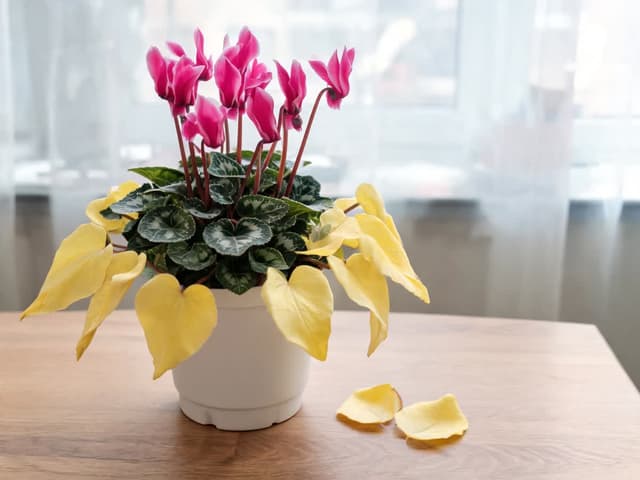
Cyclamen with Yellow Leaves: Causes and What to Do
A cyclamen with yellow leaves might just be going dormant. Learn how the tuber and the time of year tell dormancy apart from rot, heat, thirst, and mites, and what to do in each case.
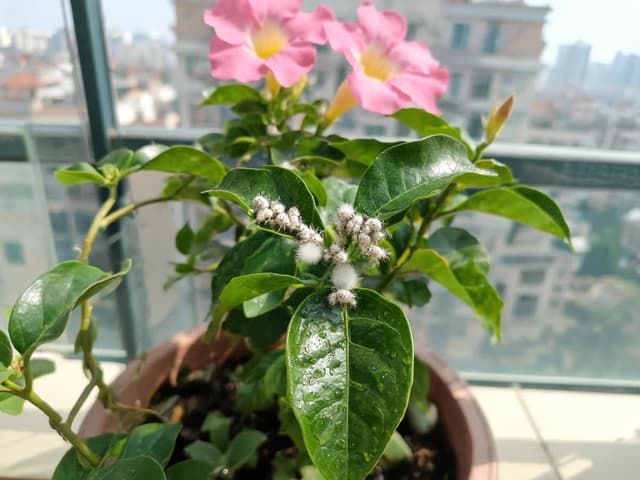
Dipladenia with Sticky White Dots: Which Pest Is It?
A sticky white dot on a dipladenia is almost always a mealybug, but whiteflies, aphids, spider mites, and the plant's own sap leave similar marks. See the test that separates each one and the source-backed treatment.
Does Dipladenia Like Sun or Shade? Sunlight Hours and Placement
Dipladenia likes sun: at least 6 hours of direct sunlight per day to bloom well. In intense heat, afternoon shade prevents scorched leaves. See which balcony exposure to choose, how to read the foliage, and what to expect indoors.