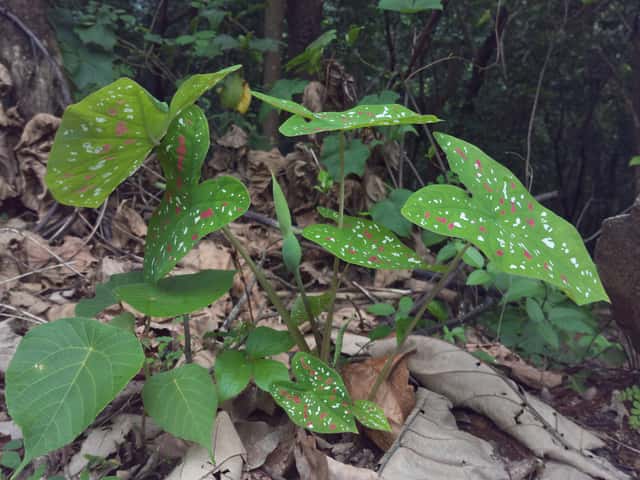
Araceae
Angel Wings: How to Care for Caladium
Caladium bicolor
Partial shade plant needing rich, moist soil, high humidity, and temperatures above 60°F. Water frequently keeping soil moist but not soggy. Goes dormant in winter losing all foliage.
Every 3 days
Partial shade
15° - 30°C
60% - 80%
Categories
What is Angel Wings?
Angel Wings (Caladium bicolor) is a medium-care plant from the Araceae family. Caladium bicolor is a tropical tuberous plant native to South America, prized for its large, heart-shaped leaves in striking combinations of red, pink, white, and green. A deciduous perennial that goes dormant in winter, it is one of the most popular foliage plants for adding color to shaded gardens...
Angel Wings grows up to 60cm, spread of 60cm, watering every 3 days, 15°C – 30°C, 60–80% humidity. It is suitable for indoor environments and not safe for pets.
Without precautions, ingestion can cause irritation in pets. Keep out of reach of cats and dogs. Without adequate drainage, root rot can develop within 7 days.
How to Care for Angel Wings?
TLDR: Angel Wings needs Partial shade, watering every 3 days, and temperatures between 15-30°C with 60-80% humidity.
How Often Should You Water Angel Wings?
Water every 2-3 days in summer, keeping soil evenly moist. Check if the top inch is dry before watering again. Drastically reduce watering in winter during dormancy.
How Much Light Does Angel Wings Need?
Prefers bright indirect light. Avoid intense direct sunlight which can scorch the delicate leaves. Tolerates partial shade, ideal near windows with filtered light.
What Is the Best Soil for Angel Wings?
Use rich, well-draining, slightly acidic soil (pH 5.5-6.5). Mix potting soil with compost and perlite for good drainage and organic matter.
What Pot Should You Use for Angel Wings?
Plastic or ceramic pots with drainage holes. Avoid terracotta pots that dry out too quickly for this moisture-loving plant.
Care Schedule
Fertilize
Every 30 days
Misting
Every 3 days
Rotate
Every 14 days
Repot
Every 365 days
What Is Angel Wings and Where Does It Come From?
Caladium bicolor is a tropical tuberous plant native to South America, prized for its large, heart-shaped leaves in striking combinations of red, pink, white, and green. A deciduous perennial that goes dormant in winter, it is one of the most popular foliage plants for adding color to shaded gardens and indoor spaces.
How to Propagate Angel Wings?
Tuber division
Use a clean, sharp knife to divide. Apply cinnamon powder to cuts to prevent fungal infection. Plant with the eye facing up.
- 1 Remove the tuber from the pot in spring before sprouting
- 2 Divide the tuber into pieces with at least one eye (bud) each
- 3 Let the cuts dry for 24 hours
- 4 Plant each piece 2 inches deep in moist potting mix
- 5 Keep warm (above 70°F) and moist until sprouting
Materials needed:
How Big Does Angel Wings Grow?
TLDR: Angel Wings can reach up to 60cm tall with Medium growth rate.
Max height
60cm
Spread
60cm
Growth rate
Medium
Foliage
Deciduous
Warning: Toxic Plant
This plant can be toxic if ingested. Keep out of reach of:
Plant Uses
Ornamental
Great for decoration
Is your plant showing symptoms?
Click on the symptom to discover possible causes:
What Diseases Commonly Affect Angel Wings?
TLDR: Angel Wings is susceptible to 16 known diseases. Monitor regularly for early detection.
Root Rot
Root rot is a serious fungal disease that affects the root system of plants, causing them to decay and die. It is primarily caused by overwatering, poor drainage, or soil-borne fungi such as Pythium, Phytophthora, Rhizoctonia, and Fusarium. The disease thrives in waterlogged conditions where roots are deprived of oxygen, making them susceptible to fungal infection.
Pythium Root Rot
Pythium root rot is a serious fungal disease caused by various Pythium species including P. aphanidermatum, P. ultimum, and P. irregulare. These water molds are present in practically all cultivated soils and attack plant roots under wet conditions, causing rapid wet rot that can extend into the stem. The disease is favored by poor drainage, overwatering, and specific temperatures depending on the species.
Fusarium Wilt
Fusarium wilt is a serious fungal disease caused by the soil-borne fungus Fusarium oxysporum. The fungus invades roots and blocks the water-conducting vessels (xylem) of the plant, causing progressive wilting and eventual death. Host-specific forms of the pathogen exist that attack different plant species.
Bacterial Leaf Spot
Bacterial leaf spot is a plant disease caused by bacteria in the Xanthomonas and Pseudomonas genera that affects various ornamental and edible plants. The bacteria infect leaves through wounds or natural openings, causing characteristic lesions that can lead to premature leaf drop and plant weakening.
Meaning & Symbolism
Represents beauty, passion, and the duality of nature with its vibrant two-toned leaves.
Fun Facts
Caladium loses all its leaves in winter and regrows from the tuber in spring, as if resurrecting
There are over 1000 registered Caladium cultivars with different color patterns
Caladium flowers are insignificant - all the beauty is in the leaves
Caladium tubers were used by indigenous peoples of South America as a starch source after processing to remove toxins
Frequently asked questions
How do I care for Caladium in winter?
Is Caladium toxic to pets?
Why are my Caladium leaves burning?
How do I make my Caladium look fuller?
Compare with similar plants
| Attribute | Difficulty | Light | Watering | Pet Safe |
|---|---|---|---|---|
| Dark Fieldcap | Medium | Low light | 2d | ⚠️ |
| Azalea | Medium | Partial shade | 3d | ⚠️ |
| Muriel's Bamboo | Medium | Partial shade | 3d | ✓ |
| Bougainvillea | Medium | Direct sun | 7d | ⚠️ |




