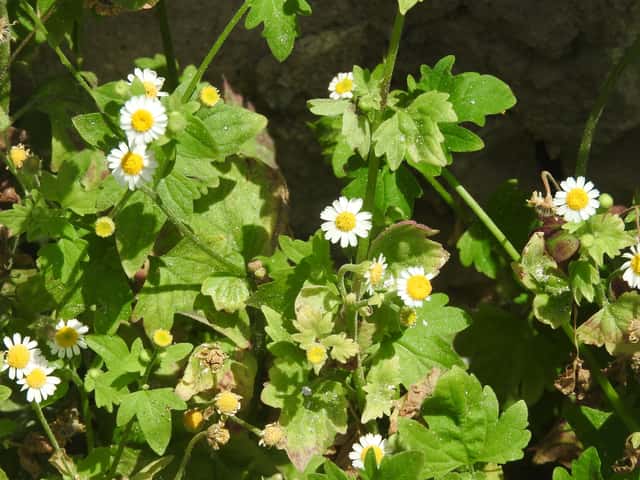
Asteraceae
Small-tongue Rock Daisy: Aromatic Plant
Perityle microglossa
Requires full sun exposure and soil with excellent drainage. It is highly drought-tolerant and prefers dry climates.
Every 10 days
Bright indirect
10° - 38°C
20% - 50%
Categories
What is Small-tongue Rock Daisy?
Small-tongue Rock Daisy (Perityle microglossa) is a medium-care plant from the Asteraceae family. Perityle microglossa, commonly known as the small-tongue rock daisy, is a herbaceous plant in the Asteraceae family native to the arid regions of Mexico and the southwestern United States. It is distinguished by its branched stems and small flower heads featuring white ray florets and a yellow centr...
Small-tongue Rock Daisy grows up to 80cm, spread of 60cm, watering every 10 days, 10°C – 38°C, 20–50% humidity. It is not suitable for indoor environments and not safe for pets.
Without precautions, ingestion can cause irritation in pets. Keep out of reach of cats and dogs.
How to Care for Small-tongue Rock Daisy?
TLDR: Small-tongue Rock Daisy needs Bright indirect, watering every 10 days, and temperatures between 10-38°C with 20-50% humidity.
How Often Should You Water Small-tongue Rock Daisy?
Water only when the substrate is completely dry. In winter, reduce watering to a minimum.
How Much Light Does Small-tongue Rock Daisy Need?
Needs direct sunlight for most of the day to bloom profusely and maintain a compact structure.
What Is the Best Soil for Small-tongue Rock Daisy?
Thrives in poor, stony soils; avoid clay soils that retain water at all costs.
What Pot Should You Use for Small-tongue Rock Daisy?
Clay or terracotta pots with large drainage holes to prevent moisture buildup.
Care Schedule
Fertilize
Every 45 days
What Is Small-tongue Rock Daisy and Where Does It Come From?
Perityle microglossa, commonly known as the small-tongue rock daisy, is a herbaceous plant in the Asteraceae family native to the arid regions of Mexico and the southwestern United States. It is distinguished by its branched stems and small flower heads featuring white ray florets and a yellow central disk. It is an extremely hardy species that thrives in rocky terrain and hot climates, contributing a characteristic aroma to its environment.
How to Propagate Small-tongue Rock Daisy?
Sowing by seeds
- Do not bury the seeds too deep; they need some light to germinate.
- Avoid waterlogging during germination.
- 1 Substrate preparation
Use a mixture of equal parts sand and garden soil.
- 2 Sowing
Scatter the seeds over the surface and cover with a very thin layer of sand.
- 3 Initial watering
Moisten with a spray bottle to avoid displacing the seeds and keep in a warm place.
Materials needed:
Stem cuttings
- Using rooting hormones can speed up the process.
- Ensure the cutting has at least two nodes below the soil surface.
- 1 Taking the cutting
Cut a healthy stem about 10 cm long that does not have flowers.
- 2 Preparation
Remove the leaves from the bottom half of the stem.
- 3 Planting
Insert the cutting into a very porous substrate and keep slightly moist in the shade.
Materials needed:
How Big Does Small-tongue Rock Daisy Grow?
TLDR: Small-tongue Rock Daisy can reach up to 80cm tall with Medium growth rate.
Max height
80cm
Spread
60cm
Growth rate
Medium
Foliage
Evergreen
Warning: Toxic Plant
This plant can be toxic if ingested. Keep out of reach of:
Plant Uses
Ornamental
Great for decoration
Medicinal
Medicinal properties
Aromatic
Pleasant fragrance
Medicinal Uses
- Relief of stomach cramps in traditional medicine
- Used in infusions for mild digestive disorders
- Topical anti-inflammatory properties
Is your plant showing symptoms?
Click on the symptom to discover possible causes:
Meaning & Symbolism
Represents tenacity and the ability to bloom in inhospitable conditions.
Compare with similar plants
| Attribute | Difficulty | Light | Watering | Pet Safe |
|---|---|---|---|---|
| Field Maple | Easy | Bright indirect | 14d | ✓ |
| Silver Birch | Easy | Direct sun | 14d | ✓ |
| Cushion Bush | Easy | Direct sun | 14d | ✓ |
| Wild Lettuce | Medium | Direct sun | 7d | ⚠️ |





