Boraginaceae
Siberian Bugloss — Blue Spring Flowers for Shaded Gardens
Brunnera macrophylla
An easy-care perennial that thrives in partial to full shade. Keep soil consistently moist — water every 7 days or as the top inch dries. Shield from hot afternoon sun. Amend with compost annually. Grows slowly but forms handsome clumps over time.
Every 7 days
Low light
-35° - 30°C
50% - 80%
Categories
What is Siberian Bugloss?
Siberian Bugloss (Brunnera macrophylla) is a easy-care plant from the Boraginaceae family. Brunnera macrophylla, commonly called Siberian Bugloss or False Forget-Me-Not, is a shade-loving herbaceous perennial native to the forests of the Caucasus region and Turkey. It produces sprays of tiny, brilliant blue flowers above large heart-shaped leaves every spring, making it a beloved choice f...
Siberian Bugloss grows up to 45cm, spread of 75cm, watering every 7 days, -35°C – 30°C, 50–80% humidity. It is not suitable for indoor environments and safe for pets.
Unlike many tropical plants, Siberian Bugloss tolerates watering mistakes. Best for beginners. Unlike many popular species, Siberian Bugloss is safe to keep around pets.
How to Care for Siberian Bugloss?
TLDR: Siberian Bugloss needs Low light, watering every 7 days, and temperatures between -35-30°C with 50-80% humidity.
How Often Should You Water Siberian Bugloss?
Water when the top inch of soil begins to dry, roughly every 7 days. Never allow the soil to dry out completely. Increase frequency during hot spells. Mulching helps retain moisture between waterings.
How Much Light Does Siberian Bugloss Need?
Thrives in partial to full shade. Tolerates a few hours of gentle morning sun but afternoon sun causes leaf scorch. Indoors, place near a filtered-light window. Variegated cultivars need slightly more light to maintain their markings.
What Is the Best Soil for Siberian Bugloss?
Prefers fertile, moist, well-draining loamy soil. Amend with compost before planting. Tolerates a wide pH range (5.5–8.0). Avoid compacted or waterlogged conditions. Apply mulch to conserve moisture and regulate soil temperature.
What Pot Should You Use for Siberian Bugloss?
Terra cotta or glazed ceramic pot with drainage holes. Choose a medium-to-large container to accommodate clump spread.
Care Schedule
Fertilize
Every 90 days
What Is Siberian Bugloss and Where Does It Come From?
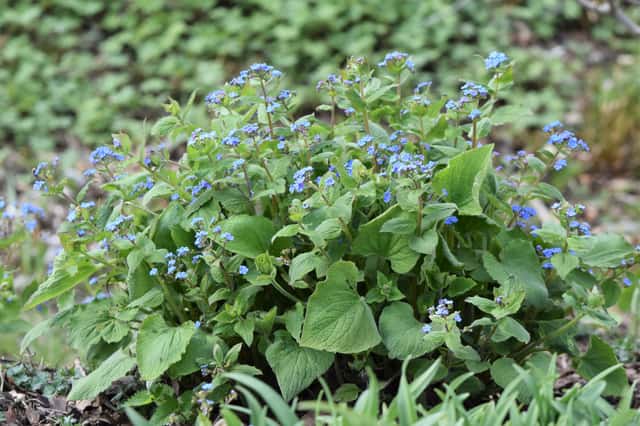
Brunnera macrophylla, commonly called Siberian Bugloss or False Forget-Me-Not, is a shade-loving herbaceous perennial native to the forests of the Caucasus region and Turkey. It produces sprays of tiny, brilliant blue flowers above large heart-shaped leaves every spring, making it a beloved choice for woodland gardens and shaded borders.
How Big Does Siberian Bugloss Grow?
TLDR: Siberian Bugloss can reach up to 45cm tall with Slow growth rate.
Max height
45cm
Spread
75cm
Growth rate
Slow
Foliage
Semi-evergreen
Plant Uses
Ornamental
Great for decoration
Ground Cover
Soil coverage
Is your plant showing symptoms?
Click on the symptom to discover possible causes:
What Diseases Commonly Affect Siberian Bugloss?
TLDR: Siberian Bugloss is susceptible to 5 known diseases. Monitor regularly for early detection.
Root Rot
Root rot is a serious fungal disease that affects the root system of plants, causing them to decay and die. It is primarily caused by overwatering, poor drainage, or soil-borne fungi such as Pythium, Phytophthora, Rhizoctonia, and Fusarium. The disease thrives in waterlogged conditions where roots are deprived of oxygen, making them susceptible to fungal infection.
Powdery Mildew
Powdery mildew is a common fungal disease caused by various fungi species including Erysiphe, Podosphaera, Oïdium, and Leveillula. It affects over 10,000 plant species worldwide. The disease thrives in warm, dry climates with high humidity and appears as a distinctive white powdery coating on plant surfaces.
Slugs and Snails
Slugs and snails are mollusks that feed on plant tissue, causing irregular holes in leaves and damage to young seedlings. They are most active at night and in moist conditions, leaving characteristic silvery slime trails. These pests can quickly devastate gardens, especially during wet seasons.
Botrytis
Meaning & Symbolism
Represents remembrance, loyalty, and enduring love — echoing the forget-me-not symbolism it closely resembles.
Fun Facts
The blue flowers of Brunnera are often mistaken for forget-me-nots, yet they belong to a completely different genus within the same Boraginaceae family.
Native to mountainous forests of the Caucasus and Turkey, it is extremely cold-hardy, surviving down to USDA zone 3 (−40 °C).
The popular cultivar 'Jack Frost' is celebrated for its silver-frosted foliage that remains ornamental throughout the entire growing season.
Frequently asked questions
Is Brunnera toxic to cats and dogs?
Does Brunnera spread invasively?
Compare with similar plants
| Attribute | Difficulty | Light | Watering | Pet Safe |
|---|---|---|---|---|
| Field Maple | Easy | Bright indirect | 14d | ✓ |
| Silver Birch | Easy | Direct sun | 14d | ✓ |
| Cushion Bush | Easy | Direct sun | 14d | ✓ |
| Peruvian peppertree | Easy | Direct sun | 14d | ⚠️ |