Cactaceae
Easter Cactus (Rhipsalidopsis gaertneri): Complete Care Guide
Rhipsalidopsis gaertneri
Keep in bright indirect light, water moderately and boost surrounding humidity. Reduce watering in winter to encourage blooming. Fertilize monthly during active growth.
Every 7 days
Partial shade
7° - 27°C
50% - 70%
Categories
What is Easter Cactus?
Easter Cactus (Rhipsalidopsis gaertneri) is a medium-care plant from the Cactaceae family. The Easter Cactus (Rhipsalidopsis gaertneri) is an epiphytic cactus native to the Atlantic Forest of Brazil, particularly Paraná and Santa Catarina states. Unlike desert cacti, it thrives in humid conditions with indirect light, producing stunning star-shaped flowers in shades of red, pink, and whit...
Easter Cactus grows up to 60cm, spread of 60cm, watering every 7 days, 7°C – 27°C, 50–70% humidity. It is suitable for indoor environments and safe for pets.
Unlike many popular species, Easter Cactus is safe to keep around pets. Without adequate drainage, root rot can develop within 14 days.
How to Care for Easter Cactus?
TLDR: Easter Cactus needs Partial shade, watering every 7 days, and temperatures between 7-27°C with 50-70% humidity.
How Often Should You Water Easter Cactus?
Water every 7 days or when the top inch of soil feels dry. Avoid waterlogging and never let water sit in the saucer. Reduce watering in winter to trigger bud formation.
How Much Light Does Easter Cactus Need?
Prefers bright indirect light from an east- or south-facing window. Avoid direct sun exposure as the fleshy stem segments burn easily.
What Is the Best Soil for Easter Cactus?
Use well-draining soil with pH 5.5–6.5. A mix of peat moss, perlite, and orchid bark works excellently. Avoid compacted or clay-heavy soils.
What Pot Should You Use for Easter Cactus?
Terra cotta or ceramic pot with drainage holes. Hanging baskets also work beautifully to showcase the arching stem growth.
Care Schedule
Fertilize
Every 30 days
Misting
Every 2 days
Rotate
Every 30 days
Repot
Every 730 days
What Is Easter Cactus and Where Does It Come From?
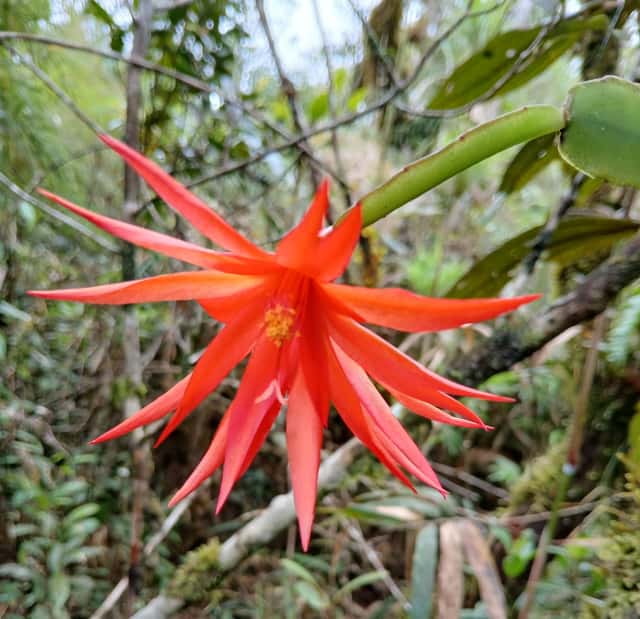
The Easter Cactus (Rhipsalidopsis gaertneri) is an epiphytic cactus native to the Atlantic Forest of Brazil, particularly Paraná and Santa Catarina states. Unlike desert cacti, it thrives in humid conditions with indirect light, producing stunning star-shaped flowers in shades of red, pink, and white during spring.
How to Propagate Easter Cactus?
Stem Segment Cutting
Best time to propagate is 2-3 months after flowering ends. Use clean tools to prevent disease transmission.
- 1 Gently twist off 2-3 stem segments from the mother plant
- 2 Allow cut ends to callus for 1-2 days
- 3 Plant in slightly moist, well-draining cactus mix
- 4 Keep in indirect light and avoid overwatering until roots develop
Materials needed:
How Big Does Easter Cactus Grow?
TLDR: Easter Cactus can reach up to 60cm tall with Slow growth rate.
Max height
60cm
Spread
60cm
Growth rate
Slow
Foliage
Evergreen
Plant Uses
Ornamental
Great for decoration
Is your plant showing symptoms?
Click on the symptom to discover possible causes:
What Diseases Commonly Affect Easter Cactus?
TLDR: Easter Cactus is susceptible to 8 known diseases. Monitor regularly for early detection.
Root Rot
Root rot is a serious fungal disease that affects the root system of plants, causing them to decay and die. It is primarily caused by overwatering, poor drainage, or soil-borne fungi such as Pythium, Phytophthora, Rhizoctonia, and Fusarium. The disease thrives in waterlogged conditions where roots are deprived of oxygen, making them susceptible to fungal infection.
Powdery Mildew
Powdery mildew is a common fungal disease caused by various fungi species including Erysiphe, Podosphaera, Oïdium, and Leveillula. It affects over 10,000 plant species worldwide. The disease thrives in warm, dry climates with high humidity and appears as a distinctive white powdery coating on plant surfaces.
Gray Mold (Botrytis Blight)
Gray mold, caused by the fungus Botrytis cinerea, is a widespread necrotrophic pathogen affecting over 1,400 plant species. It thrives in cool, humid conditions and attacks weakened or aging plant tissues, causing soft rot and characteristic gray fuzzy growth.
Spider Mites
Spider mites are tiny arachnids (less than 1/20 inch long) related to spiders and ticks that feed on plant sap. They thrive in hot, dry conditions and can cause significant damage to ornamental and vegetable plants. During severe infestations, crop losses can reach 14% or higher as these pests disrupt vital plant processes including photosynthesis, carbon dioxide absorption, and transpiration.
Meaning & Symbolism
Symbolizes renewal and hope, associated with Easter and the arrival of spring.
Fun Facts
Native to the Brazilian Atlantic Forest, one of the most biodiverse biomes on Earth
Unlike desert cacti, it needs humidity and indirect light to thrive
Its multi-petaled star-shaped flowers distinguish it from its close relative Schlumbergera (Christmas Cactus)
With proper care, it can live for decades and become a cherished heirloom plant
Frequently asked questions
How often should I water my Easter Cactus?
Is Easter Cactus toxic to cats and dogs?
Why is my Easter Cactus not blooming?
What light does Easter Cactus need?
How do I propagate Easter Cactus?
Compare with similar plants
| Attribute | Difficulty | Light | Watering | Pet Safe |
|---|---|---|---|---|
| Dark Fieldcap | Medium | Low light | 2d | ⚠️ |
| Azalea | Medium | Partial shade | 3d | ⚠️ |
| Muriel's Bamboo | Medium | Partial shade | 3d | ✓ |
| Bougainvillea | Medium | Direct sun | 7d | ⚠️ |




