Araceae
Purple Sword: Complete Care Guide
Alocasia lauterbachiana
Bright, indirect light, evenly moist (never soggy) well-draining soil, and humidity above 60% keep this plant thriving. Feed monthly in the growing season and watch for spider mites in dry indoor air.
Every 7 days
Partial shade
18° - 27°C
60% - 80%
Categories
What is Purple Sword?
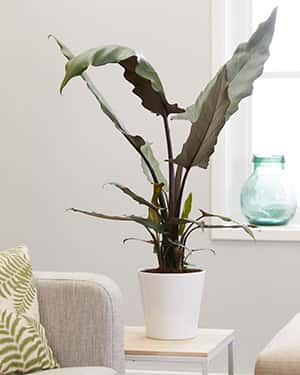
Purple Sword (Alocasia lauterbachiana) is a medium-care plant from the Araceae family. Alocasia lauterbachiana, better known as the Purple Sword, is a striking aroid prized for its long, narrow, sword-shaped leaves. The glossy dark green upper surface contrasts dramatically with a deep purple-maroon underside, and new growth often emerges with a metallic sheen. Native to the humid und...
Purple Sword grows up to 1.5m, spread of 90cm, watering every 7 days, 18°C – 27°C, 60–80% humidity. It is suitable for indoor environments and not safe for pets.
Without precautions, ingestion can cause irritation in pets. Keep out of reach of cats and dogs. Without adequate drainage, root rot can develop within 14 days.
How to Care for Purple Sword?
TLDR: Purple Sword needs Partial shade, watering every 7 days, and temperatures between 18-27°C with 60-80% humidity.
How Often Should You Water Purple Sword?
Water when the top 2-3 cm of soil has dried out, roughly every 7-10 days; reduce frequency in winter and never let the pot sit in standing water.
How Much Light Does Purple Sword Need?
Give it bright, indirect light near an east or filtered south/west window; direct midday sun will scorch the thin leaves, while deep shade causes leggy, weak growth.
What Is the Best Soil for Purple Sword?
Use a chunky, fast-draining aroid mix (potting soil, perlite or pumice, and orchid bark) so roots get air and excess water escapes quickly.
What Pot Should You Use for Purple Sword?
A terracotta pot with generous drainage holes suits it best, helping wick away excess moisture between waterings.
Care Schedule
Fertilize
Every 30 days
Misting
Every 4 days
Rotate
Every 14 days
Repot
Every 730 days
What Is Purple Sword and Where Does It Come From?
Alocasia lauterbachiana, better known as the Purple Sword, is a striking aroid prized for its long, narrow, sword-shaped leaves. The glossy dark green upper surface contrasts dramatically with a deep purple-maroon underside, and new growth often emerges with a metallic sheen. Native to the humid understories of New Guinea, it grows as a compact rhizomatous perennial that rarely tops 1.2-1.5 m indoors, forming an upright clump of upward-arching foliage rather than sprawling. Like most Alocasia, it prefers to be left slightly on the drier side between thorough waterings and is sensitive to both soggy roots and prolonged drought, making consistency the key to happy growth.
How to Propagate Purple Sword?
Division
- Best performed in spring during repotting
- Ensure each division has at least one growing point and healthy roots
- 1 Unpot the plant
Gently remove the plant and shake off excess soil to expose the rhizome and root clumps.
- 2 Separate divisions
Use a clean, sharp knife to divide the rhizome into sections, each with roots and at least one leaf or growing point.
- 3 Pot each division
Plant each section in a small pot with fresh, well-draining aroid mix and water lightly.
Materials needed:
Corm propagation
- Small corms often form at the base of the rhizome
- Corms can take months to sprout, so patience is required
- 1 Locate corms
During repotting, look for small brown corms attached near the base of the parent plant.
- 2 Remove and puddle
Detach corms and place them in a shallow dish with a little water, changing it every few days, until roots or a shoot appear.
- 3 Pot up
Once a shoot or roots emerge, pot the corm shallowly in a well-draining mix and keep humidity high.
Materials needed:
How Big Does Purple Sword Grow?
TLDR: Purple Sword can reach up to 1.5m tall with Medium growth rate.
Max height
1.5m
Spread
90cm
Growth rate
Medium
Foliage
Evergreen
Warning: Toxic Plant
This plant can be toxic if ingested. Keep out of reach of:
Plant Uses
Ornamental
Great for decoration
Is your plant showing symptoms?
Click on the symptom to discover possible causes:
What Diseases Commonly Affect Purple Sword?
TLDR: Purple Sword is susceptible to 12 known diseases. Monitor regularly for early detection.
Root Rot
Root rot is a serious fungal disease that affects the root system of plants, causing them to decay and die. It is primarily caused by overwatering, poor drainage, or soil-borne fungi such as Pythium, Phytophthora, Rhizoctonia, and Fusarium. The disease thrives in waterlogged conditions where roots are deprived of oxygen, making them susceptible to fungal infection.
Spider Mites
Spider mites are tiny arachnids (less than 1/20 inch long) related to spiders and ticks that feed on plant sap. They thrive in hot, dry conditions and can cause significant damage to ornamental and vegetable plants. During severe infestations, crop losses can reach 14% or higher as these pests disrupt vital plant processes including photosynthesis, carbon dioxide absorption, and transpiration.
Mealybugs
Mealybugs are small, soft-bodied insects covered with a white, waxy, cottony material. They are common pests of houseplants and outdoor plants in mild climates. These sap-sucking insects feed on plant tissue, causing damage, stunted growth, and can lead to plant death if left untreated. They produce sticky honeydew which attracts sooty mold.
Aphids
Aphids are small, soft-bodied, pear-shaped insects (1/16 to 1/8 inch long) that feed by sucking nutrient-rich sap from plants. They reproduce rapidly and can quickly weaken plants, causing distorted growth and transmitting plant viruses. Aphids come in various colors including green, black, red, yellow, brown, and gray. They secrete honeydew, a sticky substance that attracts ants and encourages sooty mold growth.
Meaning & Symbolism
Its bold two-toned foliage is often linked to hidden strength, protection, and quiet confidence, echoing the resilience of Alocasia species that thrive in dense, competitive rainforest understories.
Compare with similar plants
| Attribute | Difficulty | Light | Watering | Pet Safe |
|---|---|---|---|---|
| Dark Fieldcap | Medium | Low light | 2d | ⚠️ |
| Azalea | Medium | Partial shade | 3d | ⚠️ |
| Bougainvillea | Medium | Direct sun | 7d | ⚠️ |
| Wild Lettuce | Medium | Direct sun | 7d | ⚠️ |



