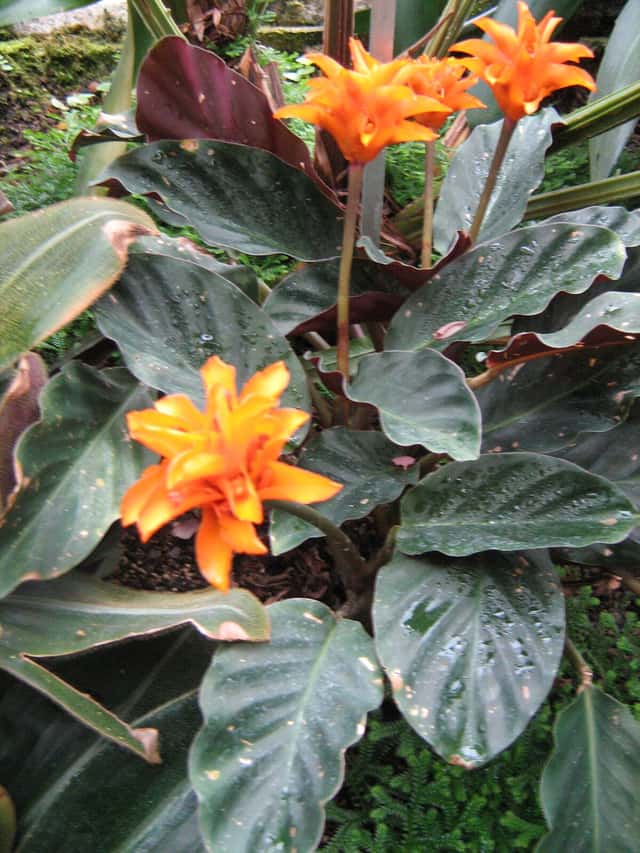
Marantaceae
Eternal Flame Plant (Goeppertia crocata)
Goeppertia crocata
Give it bright indirect light, keep the soil evenly moist but never soggy, and provide high humidity (60-80%). Keep away from cold drafts and water with filtered or rain water.
Every 7 days
Partial shade
18° - 27°C
60% - 80%
Categories
What is Eternal Flame?
Eternal Flame (Goeppertia crocata) is a medium-care plant from the Marantaceae family. The Eternal Flame plant (Goeppertia crocata) is a rhizomatous herbaceous species in the Marantaceae family, native to the tropical rainforests of Brazil (Bahia and Espírito Santo states). It is prized for its glossy dark green leaves with purple undersides and its striking saffron-orange flower spik...
Eternal Flame grows up to 85cm, spread of 40cm, watering every 7 days, 18°C – 27°C, 60–80% humidity. It is suitable for indoor environments and safe for pets.
Unlike many popular species, Eternal Flame is safe to keep around pets. Without adequate drainage, root rot can develop within 14 days.
How to Care for Eternal Flame?
TLDR: Eternal Flame needs Partial shade, watering every 7 days, and temperatures between 18-27°C with 60-80% humidity.
How Often Should You Water Eternal Flame?
Water about once a week when the top inch of soil feels dry, using filtered, distilled, or rain water — tap water chlorine and fluoride can cause leaf browning.
How Much Light Does Eternal Flame Need?
Provide bright, indirect light, such as near a sheer-curtained window. Avoid direct sun, which scorches the leaves, and deep shade, which prevents flowering.
What Is the Best Soil for Eternal Flame?
Use a light, well-draining, organically rich mix with a slightly acidic to neutral pH (6.0-6.5). Blending in coconut coir or pine bark improves aeration and drainage.
What Pot Should You Use for Eternal Flame?
A ceramic or plastic pot with drainage holes, only slightly larger than the root ball, to retain moisture without waterlogging.
Care Schedule
Fertilize
Every 30 days
Misting
Every 2 days
Rotate
Every 14 days
Repot
Every 365 days
What Is Eternal Flame and Where Does It Come From?
The Eternal Flame plant (Goeppertia crocata) is a rhizomatous herbaceous species in the Marantaceae family, native to the tropical rainforests of Brazil (Bahia and Espírito Santo states). It is prized for its glossy dark green leaves with purple undersides and its striking saffron-orange flower spikes that resemble small flames, remaining showy for weeks to months.
How to Propagate Eternal Flame?
Clump division
Use sterilized tools to avoid contamination and keep humidity high in the first weeks to reduce division stress.
- 1 Remove the plant from its pot in early spring, when growth is most vigorous
- 2 Carefully separate the clumps along the rhizomes, ensuring each division has roots and a few healthy leaves
- 3 Pot each division individually in a light, well-draining mix
- 4 Keep in a warm, humid spot with indirect light until new roots establish
Materials needed:
How Big Does Eternal Flame Grow?
TLDR: Eternal Flame can reach up to 85cm tall with Medium growth rate.
Max height
85cm
Spread
40cm
Growth rate
Medium
Foliage
Evergreen
Plant Uses
Ornamental
Great for decoration
Is your plant showing symptoms?
Click on the symptom to discover possible causes:
What Diseases Commonly Affect Eternal Flame?
TLDR: Eternal Flame is susceptible to 12 known diseases. Monitor regularly for early detection.
Root Rot
Root rot is a serious fungal disease that affects the root system of plants, causing them to decay and die. It is primarily caused by overwatering, poor drainage, or soil-borne fungi such as Pythium, Phytophthora, Rhizoctonia, and Fusarium. The disease thrives in waterlogged conditions where roots are deprived of oxygen, making them susceptible to fungal infection.
Leaf Spot
Leaf spot is a common fungal disease caused by various pathogens including Alternaria, Ascochyta, Colletotrichum, Septoria, and Venturia. It primarily affects leaves, causing discolored spots that can lead to premature leaf drop if left untreated.
Grey Mould
Rust
Rust is a common fungal disease caused by fungi in the order Pucciniales that affects a wide variety of plants. The disease gets its name from the characteristic orange, yellow, or reddish-brown pustules that appear on leaves, resembling metal rust. This obligate fungal parasite requires living plants to survive and can cause significant economic losses in agricultural crops.
Meaning & Symbolism
Known as the Eternal Flame plant, its vivid orange bracts symbolize passion, vitality, and enduring warmth, while its nightly leaf movement reflects rhythm and inner life.
Fun Facts
It is native exclusively to Brazil, found in the states of Bahia and Espírito Santo.
Its saffron-orange flowers can last up to three months, a record among calatheas.
Like other Marantaceae, its leaves move throughout the day following the light, a phenomenon called nyctinasty.
Frequently asked questions
Is the Eternal Flame plant toxic to cats and dogs?
Why won't my Eternal Flame plant bloom?
How often should I water my Eternal Flame plant?
Why are my Eternal Flame plant leaves curling?
Compare with similar plants
| Attribute | Difficulty | Light | Watering | Pet Safe |
|---|---|---|---|---|
| Dark Fieldcap | Medium | Low light | 2d | ⚠️ |
| Azalea | Medium | Partial shade | 3d | ⚠️ |
| Muriel's Bamboo | Medium | Partial shade | 3d | ✓ |
| Bougainvillea | Medium | Direct sun | 7d | ⚠️ |




