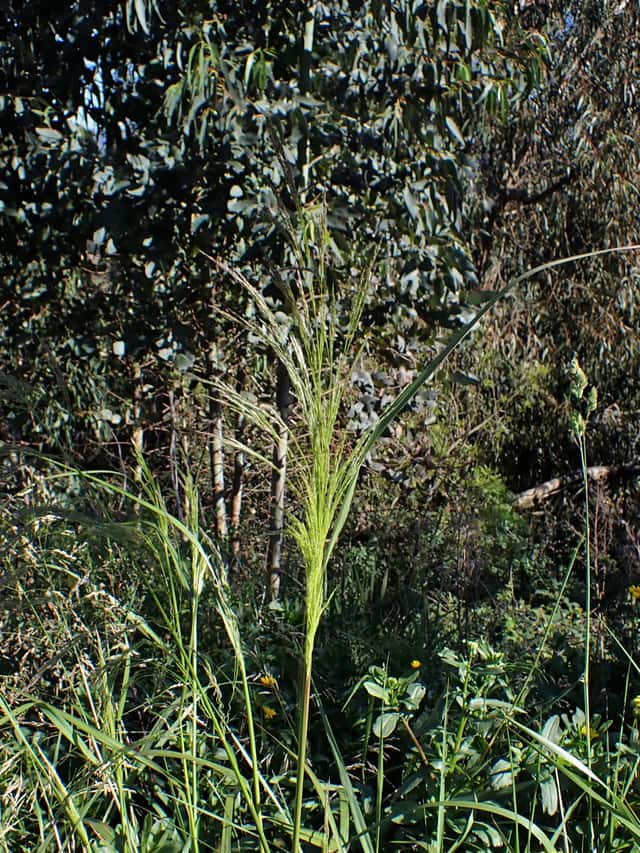
Poaceae
Johnson grass: Edible Plant
Sorghum halepense
An extremely hardy and adaptable species that requires no special care. It prefers full sun and well-drained loamy soils, although it tolerates clay, sandy, and stony soils with a pH between 5.0 and 7.5. Drought-tolerant once established. It grows actively in spring, summer, and fall with temperatures between -5 °C and 40 °C. WARNING: It is an invasive weed declared noxious in numerous countries and territories. Its control requires integrated weed management.
Every 10 days
Direct sun
-5° - 40°C
30% - 70%
Categories
What is Johnson grass?
Johnson grass (Sorghum halepense) is a easy-care plant from the Poaceae family. Johnson grass (Sorghum halepense) is an invasive perennial grass native to the eastern Mediterranean and the Middle East, naturalized in more than 50 countries. It grows upright and vigorously up to 2.4 meters tall, with lanceolate leaves up to 60 cm long featuring a characteristic white midrib. It...
Johnson grass grows up to 2.4m, spread of 150cm, watering every 10 days, -5°C – 40°C, 30–70% humidity. It is not suitable for indoor environments and not safe for pets.
Unlike many tropical plants, Johnson grass tolerates watering mistakes. Best for beginners. Without precautions, ingestion can cause irritation in pets. Keep out of reach of cats and dogs.
How to Care for Johnson grass?
TLDR: Johnson grass needs Direct sun, watering every 10 days, and temperatures between -5-40°C with 30-70% humidity.
How Often Should You Water Johnson grass?
Highly drought-tolerant species. It does not require additional watering when established outdoors. During periods of extreme drought, it may show temporary water stress but recovers quickly. Excess moisture in poorly drained soils can reduce its vigor.
How Much Light Does Johnson grass Need?
Requires full direct sun (minimum 6 hours daily). In partial shade conditions, its growth slows down significantly and rhizome production decreases. Not suitable for indoors.
What Is the Best Soil for Johnson grass?
Grows in a wide range of soils: loamy, clayey, silty, sandy, and stony. Prefers fertile, well-drained soils with a pH between 5.0 and 7.5. Tolerates compacted and occasionally flooded soils.
What Is Johnson grass and Where Does It Come From?
Johnson grass (Sorghum halepense) is an invasive perennial grass native to the eastern Mediterranean and the Middle East, naturalized in more than 50 countries. It grows upright and vigorously up to 2.4 meters tall, with lanceolate leaves up to 60 cm long featuring a characteristic white midrib. It produces purple or copper-brown panicles in summer and fall. It spreads aggressively through thick rhizomes and abundant seeds, displacing native vegetation and significantly reducing yields of crops such as corn and soybeans. It contains the cyanogenic glycoside dhurrin in all its vegetative tissues, making it SEVERELY TOXIC to livestock, especially under stress conditions.
How to Propagate Johnson grass?
Rhizome division
- 1 Identify healthy rhizomes at the base of the plant
- 2 Cut sections of at least 5-7 cm with a visible node
- 3 Bury 5-10 cm deep in moist soil
- 4 Keep moist during germination (1-2 weeks)
Seeds
- 1 Collect mature seeds in fall (September-October)
- 2 Store dry for 3-5 months to break dormancy
- 3 Sow in spring in warm soil (>15°C)
- 4 Emergence in 7-14 days
How Big Does Johnson grass Grow?
TLDR: Johnson grass can reach up to 2.4m tall with Fast growth rate.
Max height
2.4m
Spread
1.5m
Growth rate
Fast
Foliage
Deciduous
Warning: Toxic Plant
This plant can be toxic if ingested. Keep out of reach of:
Plant Uses
Edible
Can be consumed
Culinary Uses
- Mature, dried seeds are edible; they can be ground into flour used for breads and cakes, or cooked similarly to rice or millet. CAUTION: Young, stressed, or frosted plants are toxic due to the release of hydrocyanic acid; consume only fully mature and processed seeds.
Is your plant showing symptoms?
Click on the symptom to discover possible causes:
What Diseases Commonly Affect Johnson grass?
TLDR: Johnson grass is susceptible to 7 known diseases. Monitor regularly for early detection.
Rust
Rust is a common fungal disease caused by fungi in the order Pucciniales that affects a wide variety of plants. The disease gets its name from the characteristic orange, yellow, or reddish-brown pustules that appear on leaves, resembling metal rust. This obligate fungal parasite requires living plants to survive and can cause significant economic losses in agricultural crops.
Leaf Spot
Leaf spot is a common fungal disease caused by various pathogens including Alternaria, Ascochyta, Colletotrichum, Septoria, and Venturia. It primarily affects leaves, causing discolored spots that can lead to premature leaf drop if left untreated.
Anthracnose
Anthracnose is a fungal disease caused by fungi in the genus Colletotrichum that affects many plants, including vegetables, fruits, and trees. The disease thrives in cool, wet conditions, causing dark, sunken lesions on leaves, stems, flowers, and fruits.
Downy Mildew
Downy mildew is a fungal-like disease caused by oomycetes (water molds) that thrives in cool, wet conditions. It affects a wide range of plants, causing yellowing leaves with fuzzy white-gray growth underneath, leading to defoliation and reduced yields if left untreated.
Compare with similar plants
| Attribute | Difficulty | Light | Watering | Pet Safe |
|---|---|---|---|---|
| Field Maple | Easy | Bright indirect | 14d | ✓ |
| Muriel's Bamboo | Medium | Partial shade | 3d | ✓ |
| Silver Birch | Easy | Direct sun | 14d | ✓ |
| Common Blanketflower | Easy | Direct sun | 10d | ✓ |





