Crassulaceae
Lau's Echeveria: Low Water Needs
Echeveria laui
A low-maintenance succulent that thrives in bright light and dry conditions. Water deeply only when the soil is completely dry, avoid wetting the leaves, and never touch the farina, as it is fragile and does not regenerate.
Every 14 days
Bright indirect
5° - 27°C
20% - 40%
Categories
What is Lau's Echeveria?
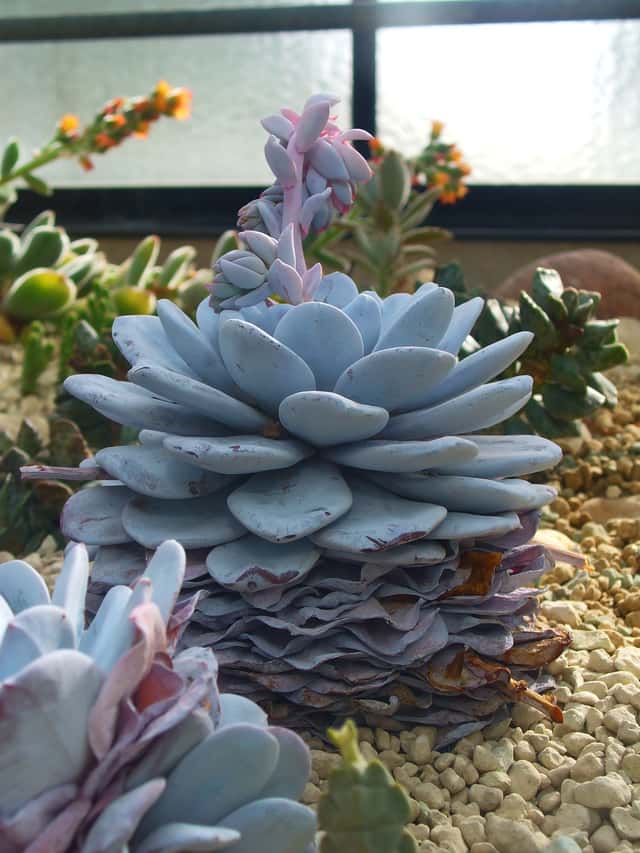
Lau's Echeveria (Echeveria laui) is a medium-care plant from the Crassulaceae family. Echeveria laui is a slow-growing succulent native to Oaxaca, Mexico, prized for its compact rosettes covered in a thick, powdery blue-white farina that gives the leaves a frosted, icing-sugar appearance. The plump, spoon-shaped leaves form a tight rosette rarely taller than a few centimeters, and ma...
Lau's Echeveria grows up to 8cm, spread of 15cm, watering every 14 days, 5°C – 27°C, 20–40% humidity. It is suitable for indoor environments and safe for pets.
Unlike many popular species, Lau's Echeveria is safe to keep around pets. Without adequate drainage, root rot can develop within 28 days.
How to Care for Lau's Echeveria?
TLDR: Lau's Echeveria needs Bright indirect, watering every 14 days, and temperatures between 5-27°C with 20-40% humidity.
How Often Should You Water Lau's Echeveria?
Use the soak-and-dry method: water thoroughly, then let the soil dry out completely before watering again, roughly every two weeks. Reduce watering further in winter.
How Much Light Does Lau's Echeveria Need?
Provide bright, indirect to direct light for at least 4-6 hours a day. Acclimate gradually to full sun to avoid sunburn on the leaves.
What Is the Best Soil for Lau's Echeveria?
Plant in a fast-draining cactus/succulent mix amended with perlite or pumice to prevent waterlogged roots.
What Pot Should You Use for Lau's Echeveria?
Use a shallow, unglazed terracotta pot with drainage holes to wick away excess moisture.
Care Schedule
Fertilize
Every 60 days
Repot
Every 730 days
What Is Lau's Echeveria and Where Does It Come From?
Echeveria laui is a slow-growing succulent native to Oaxaca, Mexico, prized for its compact rosettes covered in a thick, powdery blue-white farina that gives the leaves a frosted, icing-sugar appearance. The plump, spoon-shaped leaves form a tight rosette rarely taller than a few centimeters, and mature plants produce coral-pink, bell-shaped flowers on tall stalks in summer.
How to Propagate Lau's Echeveria?
Leaf cutting
Handle leaves by the edges to avoid smudging the delicate farina, which does not regrow once rubbed off.
- 1 Gently twist off a healthy, plump leaf close to the stem, keeping the base intact
- 2 Let the leaf callus over for 2-3 days in a dry, shaded spot
- 3 Lay the leaf on top of well-draining succulent soil without burying it
- 4 Mist lightly once roots and a tiny rosette begin to form
Materials needed:
Offset division
Wait until offsets have their own small roots for the best survival rate.
- 1 Remove small offsets (pups) that form at the base of the mother rosette
- 2 Let the cut ends callus for 1-2 days
- 3 Plant in dry succulent soil and withhold water until roots establish
Materials needed:
How Big Does Lau's Echeveria Grow?
TLDR: Lau's Echeveria can reach up to 8cm tall with Slow growth rate.
Max height
8cm
Spread
15cm
Growth rate
Slow
Foliage
Evergreen
Plant Uses
Ornamental
Great for decoration
Is your plant showing symptoms?
Click on the symptom to discover possible causes:
What Diseases Commonly Affect Lau's Echeveria?
TLDR: Lau's Echeveria is susceptible to 10 known diseases. Monitor regularly for early detection.
Root Rot
Root rot is a serious fungal disease that affects the root system of plants, causing them to decay and die. It is primarily caused by overwatering, poor drainage, or soil-borne fungi such as Pythium, Phytophthora, Rhizoctonia, and Fusarium. The disease thrives in waterlogged conditions where roots are deprived of oxygen, making them susceptible to fungal infection.
Overwatering
Overwatering occurs when plants receive too much water, depriving roots of oxygen and causing root rot. This environmental stress is one of the most common causes of houseplant death, as waterlogged soil prevents roots from breathing and functioning properly.
Powdery Mildew
Powdery mildew is a common fungal disease caused by various fungi species including Erysiphe, Podosphaera, Oïdium, and Leveillula. It affects over 10,000 plant species worldwide. The disease thrives in warm, dry climates with high humidity and appears as a distinctive white powdery coating on plant surfaces.
Leaf Spot
Leaf spot is a common fungal disease caused by various pathogens including Alternaria, Ascochyta, Colletotrichum, Septoria, and Venturia. It primarily affects leaves, causing discolored spots that can lead to premature leaf drop if left untreated.
Meaning & Symbolism
Represents delicate beauty and resilience, admired for its rare, untouchable frosted coating.
Compare with similar plants
| Attribute | Difficulty | Light | Watering | Pet Safe |
|---|---|---|---|---|
| Dark Fieldcap | Medium | Low light | 2d | ⚠️ |
| Azalea | Medium | Partial shade | 3d | ⚠️ |
| Muriel's Bamboo | Medium | Partial shade | 3d | ✓ |
| Bougainvillea | Medium | Direct sun | 7d | ⚠️ |




