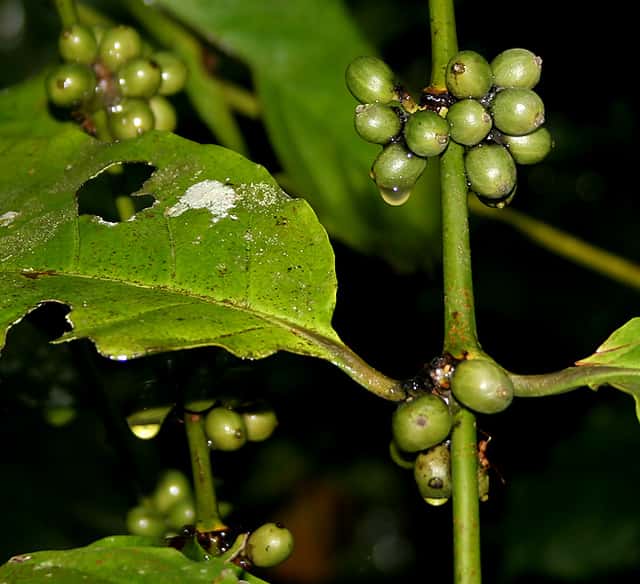
Rubiaceae
Robusta Coffee (Coffea canephora): Complete Care Guide
Coffea canephora
Robusta coffee thrives in bright indirect light, rich well-drained soil with pH 5–6.5, and regular watering without waterlogging. It tolerates drought and heat better than Arabica. Fertilize every 30 days during the growing season and perform annual maintenance pruning.
Every 7 days
Bright indirect
15° - 30°C
60% - 85%
Categories
What is Robusta Coffee?
Robusta Coffee (Coffea canephora) is a medium-care plant from the Rubiaceae family. Coffea canephora, commonly known as Robusta coffee, is an evergreen shrub or small tree native to Western and Central Africa (Congo basin). It is the second most widely grown coffee species in the world, accounting for 40–45% of global coffee production. Robusta is prized for its higher caffeine con...
Robusta Coffee grows up to 10.0m, spread of 300cm, watering every 7 days, 15°C – 30°C, 60–85% humidity. It is suitable for indoor environments and not safe for pets.
Without precautions, ingestion can cause irritation in pets. Keep out of reach of cats and dogs. Without adequate drainage, root rot can develop within 14 days.
How to Care for Robusta Coffee?
TLDR: Robusta Coffee needs Bright indirect, watering every 7 days, and temperatures between 15-30°C with 60-85% humidity.
How Often Should You Water Robusta Coffee?
Water every 5–7 days, keeping the soil slightly moist but never waterlogged. During hot periods increase frequency as needed. Reduce watering in winter to stimulate flowering.
How Much Light Does Robusta Coffee Need?
Place in bright indirect light near an east- or west-facing window. Robusta tolerates gentle full sun but avoid harsh afternoon sun that may scorch leaves. Outdoors, a lightly shaded position is ideal.
What Is the Best Soil for Robusta Coffee?
Use rich, well-draining organic soil with a pH of 5.0–6.5. A mix of potting soil, compost, and perlite (3:2:1) works well. Avoid compacted or waterlogged soils.
What Pot Should You Use for Robusta Coffee?
Clay or ceramic pot with drainage holes, sized proportionally to the plant. For indoor growing, 20–30 cm pots work well for young plants. Mature plants may need large containers or ground planting.
Care Schedule
Fertilize
Every 30 days
Repot
Every 730 days
What Is Robusta Coffee and Where Does It Come From?
Coffea canephora, commonly known as Robusta coffee, is an evergreen shrub or small tree native to Western and Central Africa (Congo basin). It is the second most widely grown coffee species in the world, accounting for 40–45% of global coffee production. Robusta is prized for its higher caffeine content (2.7%), superior disease resistance, and drought tolerance compared to Arabica. It produces a full-bodied, strong-flavored coffee widely used in espresso blends and instant coffee. Vietnam and Brazil are the world's largest Robusta producers.
How to Propagate Robusta Coffee?
Seeds
Use fresh seeds as they lose viability quickly. Maintain consistent moisture throughout germination.
- 1 Select fresh seeds from ripe, healthy fruits
- 2 Remove the pulp and wash seeds thoroughly
- 3 Sow in moist, well-draining germination mix at 1 cm depth
- 4 Keep in a warm (25–28°C) and humid environment until germination
- 5 Transplant seedlings once they reach 15 cm tall
Materials needed:
Stem Cuttings
Use semi-hardwood stems — not too woody, not too tender. Ventilate the bag daily to prevent fungal issues.
- 1 Take a healthy semi-hardwood cutting with 2–3 pairs of leaves
- 2 Remove lower leaves and dip base in rooting hormone
- 3 Plant in moist perlite-enriched substrate
- 4 Cover with a clear plastic bag to maintain humidity
- 5 Keep in indirect light at 25–28°C
Materials needed:
How Big Does Robusta Coffee Grow?
TLDR: Robusta Coffee can reach up to 10.0m tall with Medium growth rate.
Max height
10.0m
Spread
3.0m
Growth rate
Medium
Foliage
Evergreen
Warning: Toxic Plant
This plant can be toxic if ingested. Keep out of reach of:
Plant Uses
Edible
Can be consumed
Ornamental
Great for decoration
Medicinal
Medicinal properties
Medicinal Uses
- Natural stimulant rich in caffeine used in beverages and dietary supplements
- Caffeine extract used in pharmaceuticals and cosmetics
Culinary Uses
- Primary ingredient for instant (soluble) coffee
- Widely used in espresso blends for body and crema
- Roasted beans for brewed beverages
- Used in the production of coffelite bioplastic
Is your plant showing symptoms?
Click on the symptom to discover possible causes:
What Diseases Commonly Affect Robusta Coffee?
TLDR: Robusta Coffee is susceptible to 7 known diseases. Monitor regularly for early detection.
Rust
Rust is a common fungal disease caused by fungi in the order Pucciniales that affects a wide variety of plants. The disease gets its name from the characteristic orange, yellow, or reddish-brown pustules that appear on leaves, resembling metal rust. This obligate fungal parasite requires living plants to survive and can cause significant economic losses in agricultural crops.
Root-Knot Nematodes
Root-knot nematodes (Meloidogyne species) are microscopic roundworms that parasitize plant roots, causing characteristic galls or knots. These soil-borne pests are among the most economically damaging plant pathogens worldwide, affecting a wide range of ornamental and edible plants. The nematodes inject enzymes into root cells, causing abnormal swelling and disrupting water and nutrient uptake.
Leafminers
Leafminers are the larvae of various insects including flies, moths, sawflies, and beetles that tunnel between leaf surfaces, creating distinctive serpentine trails or blotchy patches. While primarily cosmetic, severe infestations can weaken plants by reducing photosynthesis capacity and making them susceptible to secondary infections.
Aphids
Aphids are small, soft-bodied, pear-shaped insects (1/16 to 1/8 inch long) that feed by sucking nutrient-rich sap from plants. They reproduce rapidly and can quickly weaken plants, causing distorted growth and transmitting plant viruses. Aphids come in various colors including green, black, red, yellow, brown, and gray. They secrete honeydew, a sticky substance that attracts ants and encourages sooty mold growth.
Meaning & Symbolism
Robusta coffee symbolizes resilience, energy, and the economic backbone of tropical coffee-growing regions.
Fun Facts
Robusta contains nearly twice the caffeine of Arabica — about 2.7% vs 1.5%.
The species can take 3–4 years from seed before producing its first fruits.
Robusta accounts for 40–45% of all coffee produced globally.
It is naturally more resistant to the devastating coffee leaf rust fungus than Arabica.
Frequently asked questions
How often should I water a Robusta coffee plant?
Can Robusta coffee be grown indoors?
Is Robusta coffee toxic to pets?
What is the difference between Robusta and Arabica coffee?
When does Robusta coffee flower?
Compare with similar plants
| Attribute | Difficulty | Light | Watering | Pet Safe |
|---|---|---|---|---|
| Dark Fieldcap | Medium | Low light | 2d | ⚠️ |
| Azalea | Medium | Partial shade | 3d | ⚠️ |
| Muriel's Bamboo | Medium | Partial shade | 3d | ✓ |
| Bougainvillea | Medium | Direct sun | 7d | ⚠️ |




