Orchidaceae
How to Grow and Care for Rock Orchid (Dendrobium speciosum)
Dendrobium speciosum
Thrives in bright indirect light, moderate watering with a dry winter rest period, and a coarse bark-based orchid mix. Slow-growing but extremely tough, tolerating temperatures from 10°C to 30°C. Non-toxic to pets and humans.
Every 7 days
Bright indirect
10° - 30°C
50% - 70%
Categories
What is Rock Orchid?
Rock Orchid (Dendrobium speciosum) is a medium-care plant from the Orchidaceae family. Dendrobium speciosum, commonly known as the Rock Orchid or King Orchid, is a large epiphytic and lithophytic orchid native to eastern Australia. It grows naturally on rocks and tree trunks, producing robust pseudobulbs up to 45 cm long. In late winter to early spring, it produces spectacular arching...
Rock Orchid grows up to 60cm, spread of 100cm, watering every 7 days, 10°C – 30°C, 50–70% humidity. It is suitable for indoor environments and safe for pets.
Unlike many popular species, Rock Orchid is safe to keep around pets. Without adequate drainage, root rot can develop within 14 days.
How to Care for Rock Orchid?
TLDR: Rock Orchid needs Bright indirect, watering every 7 days, and temperatures between 10-30°C with 50-70% humidity.
How Often Should You Water Rock Orchid?
Water every 7 days during the growing season (spring/summer). In winter, reduce to every 2 weeks or less, allowing the medium to dry out completely between waterings. Always water in the morning and never let the plant sit in water.
How Much Light Does Rock Orchid Need?
Requires bright, indirect light — near a north- or east-facing window, or under 30-50% shade cloth. Protect from intense direct sun which can scorch leaves. Without sufficient light, the plant will not flower.
What Is the Best Soil for Rock Orchid?
Use a coarse orchid mix: medium to large pine bark chips mixed with perlite. Never use regular potting soil. Terracotta pots or wooden slatted baskets with excellent drainage are ideal.
What Pot Should You Use for Rock Orchid?
Terracotta pots or wooden slatted baskets with ample drainage holes. Avoid plastic pots that retain excessive moisture. For rock mounting, attach with wire or silicone glue with minimal substrate.
Care Schedule
Fertilize
Every 21 days
Misting
Every 3 days
Repot
Every 730 days
What Is Rock Orchid and Where Does It Come From?
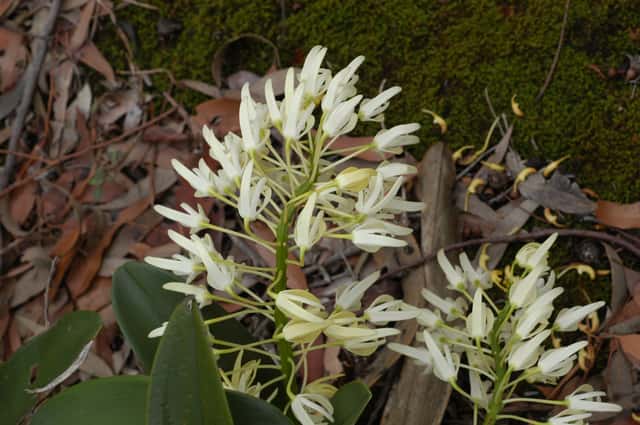
Dendrobium speciosum, commonly known as the Rock Orchid or King Orchid, is a large epiphytic and lithophytic orchid native to eastern Australia. It grows naturally on rocks and tree trunks, producing robust pseudobulbs up to 45 cm long. In late winter to early spring, it produces spectacular arching sprays of white to creamy-yellow flowers with purple-spotted labellums and a soft honey fragrance.
How to Propagate Rock Orchid?
Clump Division
Only divide healthy, large clumps. Avoid very small divisions as they take longer to rebloom.
- 1 Remove the plant from its pot or mount after flowering
- 2 Divide the clump with a sterilized knife, ensuring each division has at least 3-4 pseudobulbs
- 3 Allow cut surfaces to dry for a few hours before replanting
- 4 Secure each division in fresh bark medium or on a rock/mount
- 5 Keep slightly moist until new roots establish
Materials needed:
Seed Propagation
Seed propagation is not recommended for hobbyists. Division is far more practical and reliable.
- 1 Requires specialized laboratory with sterile culture medium (protocorms)
- 2 Seeds are microscopic and need mycorrhizal fungi or Knudson medium to germinate
- 3 Process carried out under aseptic conditions
- 4 Transplant seedlings only when they have developed leaves and roots
Materials needed:
How Big Does Rock Orchid Grow?
TLDR: Rock Orchid can reach up to 60cm tall with Slow growth rate.
Max height
60cm
Spread
1.0m
Growth rate
Slow
Foliage
Evergreen
Plant Uses
Ornamental
Great for decoration
Is your plant showing symptoms?
Click on the symptom to discover possible causes:
What Diseases Commonly Affect Rock Orchid?
TLDR: Rock Orchid is susceptible to 13 known diseases. Monitor regularly for early detection.
Root Rot
Root rot is a serious fungal disease that affects the root system of plants, causing them to decay and die. It is primarily caused by overwatering, poor drainage, or soil-borne fungi such as Pythium, Phytophthora, Rhizoctonia, and Fusarium. The disease thrives in waterlogged conditions where roots are deprived of oxygen, making them susceptible to fungal infection.
Phytophthora Blight
Devastating fungal disease caused by Phytophthora species (primarily P. capsici and P. infestans), famously responsible for the Irish Potato Famine in the 1840s. Affects all plant parts including roots, stems, leaves, and fruits in warm, wet conditions. The pathogen is technically an oomycete (water mold) that thrives in saturated soils and can survive in soil for 5+ years.
Anthracnose
Anthracnose is a fungal disease caused by fungi in the genus Colletotrichum that affects many plants, including vegetables, fruits, and trees. The disease thrives in cool, wet conditions, causing dark, sunken lesions on leaves, stems, flowers, and fruits.
Gray Mold (Botrytis Blight)
Gray mold, caused by the fungus Botrytis cinerea, is one of the most common fungal diseases in plants. It affects over 200 plant species, including ornamentals, vegetables, fruits, and houseplants. The disease thrives in cool, humid conditions with poor air circulation, causing grayish spots and soft rot on infected tissues.
Fun Facts
Can live for over 100 years in its natural habitat, growing on the same rocks for generations
A single flower spike can carry more than 50 individual blooms with a soft honey fragrance
It is the largest native orchid in Australia, with pseudobulbs reaching up to 45 cm in length
Tolerates summer temperatures up to 45°C and light winter frosts, making it exceptionally hardy
Frequently asked questions
How often should I water my Rock Orchid?
Why is my Rock Orchid not flowering?
Is Rock Orchid toxic to cats and dogs?
What potting mix should I use for Rock Orchid?
How long until the Rock Orchid flowers for the first time?
Compare with similar plants
| Attribute | Difficulty | Light | Watering | Pet Safe |
|---|---|---|---|---|
| Dark Fieldcap | Medium | Low light | 2d | ⚠️ |
| Azalea | Medium | Partial shade | 3d | ⚠️ |
| Muriel's Bamboo | Medium | Partial shade | 3d | ✓ |
| Bougainvillea | Medium | Direct sun | 7d | ⚠️ |




