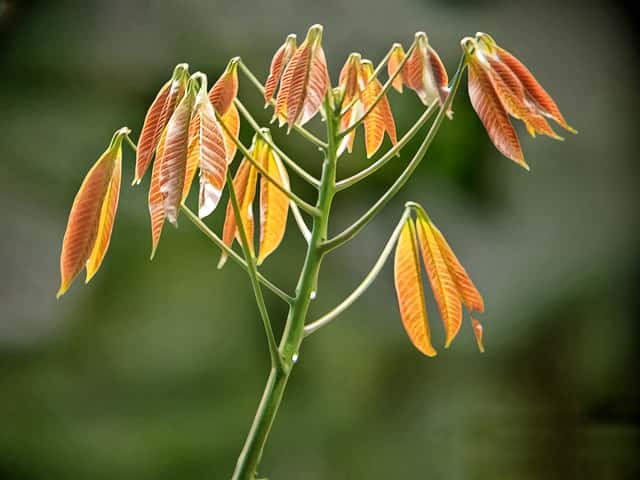
Euphorbiaceae
Rubber tree: Air Purifying Plant
Hevea brasiliensis
Prefers bright light, ideally several hours of filtered sunlight per day, moderate watering allowing the soil surface to dry out, and high humidity. Sensitive to overwatering (root rot) and lime content in tap water.
Every 7 days
Bright indirect
18° - 32°C
50% - 80%
Categories
What is Rubber tree?
Rubber tree (Hevea brasiliensis) is a medium-care plant from the Euphorbiaceae family. Hevea brasiliensis, commonly known as the rubber tree, is a species native to the Amazon rainforests (Amazon and Orinoco basins), where it can reach heights of 130 feet along riverbanks. It is the primary source of the world's natural rubber: an incision in its bark releases a white latex harvested...
Rubber tree grows up to 40.0m, spread of 2000cm, watering every 7 days, 18°C – 32°C, 50–80% humidity. It is suitable for indoor environments and not safe for pets.
Without precautions, ingestion can cause irritation in pets. Keep out of reach of cats and dogs. Without adequate drainage, root rot can develop within 14 days.
How to Care for Rubber tree?
TLDR: Rubber tree needs Bright indirect, watering every 7 days, and temperatures between 18-32°C with 50-80% humidity.
How Often Should You Water Rubber tree?
Allow the top 1 to 1.5 inches of soil to dry out between waterings; reduce significantly in winter. Preferably use rainwater or distilled water, as this species is sensitive to chlorine and lime.
How Much Light Does Rubber tree Need?
Provide bright light and, if possible, a few hours of soft direct sunlight (east or west window); avoid harsh midday sun which can burn the foliage.
What Is the Best Soil for Rubber tree?
Use a potting mix rich in organic matter but well-draining (houseplant soil + perlite or sand), with a slightly acidic pH between 4.5 and 6.5.
What Pot Should You Use for Rubber tree?
A wide and deep pot, preferably terracotta, with excellent drainage to prevent any water stagnation around the roots.
Care Schedule
Fertilize
Every 30 days
Misting
Every 2 days
Rotate
Every 15 days
Repot
Every 730 days
What Is Rubber tree and Where Does It Come From?
Hevea brasiliensis, commonly known as the rubber tree, is a species native to the Amazon rainforests (Amazon and Orinoco basins), where it can reach heights of 130 feet along riverbanks. It is the primary source of the world's natural rubber: an incision in its bark releases a white latex harvested through tapping starting around age 7. Introduced to Asia and Africa at the turn of the 20th century, it thrives there largely protected from its main threat, the Microcyclus ulei fungus, which causes South American Leaf Blight (SALB) that once devastated Brazilian rubber production. Indoors, grown for its glossy green trifoliate foliage, it remains much smaller in size. Its latex contains proteins (hevein) known to be allergenic: handling the sap can cause skin irritation or more severe reactions in individuals with latex allergies.
How to Propagate Rubber tree?
Stem cuttings
- Wear gloves, as the latex can irritate the skin.
- Rooting hormone increases the success rate.
- 1 Taking the cutting
Cut a healthy stem section about 6 inches long with at least two nodes.
- 2 Drying the latex
Let the cut dry for a few hours until the latex flow stops.
- 3 Planting
Plant in a moist mix of potting soil and perlite, then cover to maintain humidity.
Materials needed:
Grafting (commercial method)
- Method used in plantations to ensure consistent latex yield.
- 1 Rootstock
Germinate fresh seeds (viable for only 7 to 10 days) to obtain a vigorous rootstock.
- 2 Bud grafting
Graft a bud from a selected high-yield clone onto the juvenile rootstock.
Materials needed:
How Big Does Rubber tree Grow?
TLDR: Rubber tree can reach up to 40.0m tall with Medium growth rate.
Max height
40.0m
Spread
20.0m
Growth rate
Medium
Foliage
Evergreen
Warning: Toxic Plant
This plant can be toxic if ingested. Keep out of reach of:
Plant Uses
Ornamental
Great for decoration
Air Purifying
Improves air quality
Is your plant showing symptoms?
Click on the symptom to discover possible causes:
What Diseases Commonly Affect Rubber tree?
TLDR: Rubber tree is susceptible to 7 known diseases. Monitor regularly for early detection.
Powdery Mildew
Powdery mildew is a common fungal disease caused by various fungi species including Erysiphe, Podosphaera, Oïdium, and Leveillula. It affects over 10,000 plant species worldwide. The disease thrives in warm, dry climates with high humidity and appears as a distinctive white powdery coating on plant surfaces.
Phytophthora Blight
Devastating fungal disease caused by Phytophthora species (primarily P. capsici and P. infestans), famously responsible for the Irish Potato Famine in the 1840s. Affects all plant parts including roots, stems, leaves, and fruits in warm, wet conditions. The pathogen is technically an oomycete (water mold) that thrives in saturated soils and can survive in soil for 5+ years.
Leaf Spot
Leaf spot is a common fungal disease caused by various pathogens including Alternaria, Ascochyta, Colletotrichum, Septoria, and Venturia. It primarily affects leaves, causing discolored spots that can lead to premature leaf drop if left untreated.
Anthracnose
Anthracnose is a fungal disease caused by fungi in the genus Colletotrichum that affects many plants, including vegetables, fruits, and trees. The disease thrives in cool, wet conditions, causing dark, sunken lesions on leaves, stems, flowers, and fruits.
Meaning & Symbolism
Represents resilience, flexibility, and prosperity—its continuous flow of latex evokes abundance and the ability to regenerate after an injury.
Compare with similar plants
| Attribute | Difficulty | Light | Watering | Pet Safe |
|---|---|---|---|---|
| Dark Fieldcap | Medium | Low light | 2d | ⚠️ |
| Azalea | Medium | Partial shade | 3d | ⚠️ |
| Muriel's Bamboo | Medium | Partial shade | 3d | ✓ |
| Bougainvillea | Medium | Direct sun | 7d | ⚠️ |
Choose & Compare
Sources & References
- Rubber Tree (Hevea brasiliensis) Care Guide - Forward Plant
- Hevea brasiliensis - Plants For A Future
- A Review of a Century of Studies on South American Leaf Blight of the Rubber Tree - Plant Disease (APS)
- Pseudocercospora ulei (South American leaf blight of rubber) - CABI Compendium
- Microcyclus ulei - ScienceDirect Topics




