Orchidaceae
Phalaenopsis schilleriana (Schiller's Moth Orchid)
Phalaenopsis schilleriana
Grow in bright, indirect light with high humidity (50-70%) and let the potting medium approach dryness between waterings. Feed lightly and regularly during active growth and provide a cooler night drop in autumn to encourage flowering.
Every 7 days
Partial shade
15° - 29°C
50% - 70%
Categories
What is Schiller's Moth Orchid?
Schiller's Moth Orchid (Phalaenopsis schilleriana) is a medium-care plant from the Orchidaceae family. Phalaenopsis schilleriana is an epiphytic moth orchid endemic to the Philippines, prized for its handsome foliage as much as its flowers. The leathery leaves are marked with alternating bars of silver-grey and dark green on top, with a purple flush underneath, remaining attractive year-round. In lat...
Schiller's Moth Orchid grows up to 30cm, spread of 60cm, watering every 7 days, 15°C – 29°C, 50–70% humidity. It is suitable for indoor environments and safe for pets.
Unlike many popular species, Schiller's Moth Orchid is safe to keep around pets. Without adequate drainage, root rot can develop within 14 days.
How to Care for Schiller's Moth Orchid?
TLDR: Schiller's Moth Orchid needs Partial shade, watering every 7 days, and temperatures between 15-29°C with 50-70% humidity.
How Often Should You Water Schiller's Moth Orchid?
Water thoroughly about once a week, letting roots dry out between waterings; never let the base sit in water for more than a couple of days, as roots are prone to rot.
How Much Light Does Schiller's Moth Orchid Need?
Provide bright, indirect or dappled light such as an east-facing window; avoid direct midday sun, which can scorch the barred foliage.
What Is the Best Soil for Schiller's Moth Orchid?
Pot in a coarse, well-draining orchid mix (fir bark, sphagnum, or coconut husk) or mount on cork bark to mimic its epiphytic habitat; avoid dense, water-retentive soil.
What Pot Should You Use for Schiller's Moth Orchid?
Clear plastic pot or slatted wooden basket with a coarse bark/sphagnum mix; mounting on cork bark or tree fern is also suitable in humid environments
Care Schedule
Fertilize
Every 7 days
Repot
Every 730 days
What Is Schiller's Moth Orchid and Where Does It Come From?
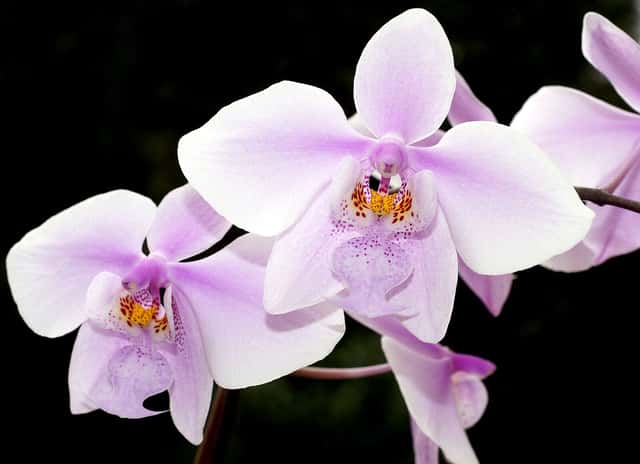
Phalaenopsis schilleriana is an epiphytic moth orchid endemic to the Philippines, prized for its handsome foliage as much as its flowers. The leathery leaves are marked with alternating bars of silver-grey and dark green on top, with a purple flush underneath, remaining attractive year-round. In late winter to spring, arching, often branching sprays carry dozens of fragrant, rose-pink flowers with a spotted lip. Cooler autumn nights help trigger the bloom spike.
How to Propagate Schiller's Moth Orchid?
Keiki (offset) propagation
Do not force removal before roots are well developed; newly separated keikis are vulnerable to rot if watered heavily too soon.
- 1 Wait for a keiki (baby plantlet) to form naturally on a spent flower spike node, or apply cytokinin-based keiki paste to a node after flowering to encourage one
- 2 Allow the keiki to develop until it has 2-3 roots roughly 2-5 cm long
- 3 Sterilize a blade and cut the keiki away from the mother spike, keeping its roots intact
- 4 Pot the keiki in a small container with fine-grade orchid bark or sphagnum moss
- 5 Keep in warm, humid conditions (75-85% humidity) and mist rather than water heavily until new roots establish
Materials needed:
How Big Does Schiller's Moth Orchid Grow?
TLDR: Schiller's Moth Orchid can reach up to 30cm tall with Slow growth rate.
Max height
30cm
Spread
60cm
Growth rate
Slow
Foliage
Evergreen
Plant Uses
Ornamental
Great for decoration
Is your plant showing symptoms?
Click on the symptom to discover possible causes:
What Diseases Commonly Affect Schiller's Moth Orchid?
TLDR: Schiller's Moth Orchid is susceptible to 7 known diseases. Monitor regularly for early detection.
Root Rot
Root rot is a serious fungal disease that affects the root system of plants, causing them to decay and die. It is primarily caused by overwatering, poor drainage, or soil-borne fungi such as Pythium, Phytophthora, Rhizoctonia, and Fusarium. The disease thrives in waterlogged conditions where roots are deprived of oxygen, making them susceptible to fungal infection.
Gray Mold (Botrytis Blight)
Gray mold, caused by the fungus Botrytis cinerea, is one of the most common fungal diseases in plants. It affects over 200 plant species, including ornamentals, vegetables, fruits, and houseplants. The disease thrives in cool, humid conditions with poor air circulation, causing grayish spots and soft rot on infected tissues.
Mealybugs
Mealybugs are small, soft-bodied insects covered with a white, waxy, cottony material. They are common pests of houseplants and outdoor plants in mild climates. These sap-sucking insects feed on plant tissue, causing damage, stunted growth, and can lead to plant death if left untreated. They produce sticky honeydew which attracts sooty mold.
Spider Mites
Spider mites are tiny arachnids (less than 1/20 inch long) related to spiders and ticks that feed on plant sap. They thrive in hot, dry conditions and can cause significant damage to ornamental and vegetable plants. During severe infestations, crop losses can reach 14% or higher as these pests disrupt vital plant processes including photosynthesis, carbon dioxide absorption, and transpiration.
Meaning & Symbolism
Phalaenopsis orchids are widely associated with love, beauty, luxury and refinement; the silver-marbled leaves of P. schilleriana are admired even outside the bloom season.
Fun Facts
The silver-and-green barred foliage of P. schilleriana is so ornamental that the plant is attractive even when not in bloom
A single inflorescence can branch and carry dozens of fragrant pink flowers at once
It was named after Consul Schiller, a 19th-century orchid collector, and formally described by H.G. Reichenbach in 1860
Frequently asked questions
How often should I water Phalaenopsis schilleriana?
Is Phalaenopsis schilleriana toxic to cats or dogs?
How much light does Schiller's moth orchid need?
How do I propagate Phalaenopsis schilleriana?
Compare with similar plants
| Attribute | Difficulty | Light | Watering | Pet Safe |
|---|---|---|---|---|
| Dark Fieldcap | Medium | Low light | 2d | ⚠️ |
| Azalea | Medium | Partial shade | 3d | ⚠️ |
| Muriel's Bamboo | Medium | Partial shade | 3d | ✓ |
| Bougainvillea | Medium | Direct sun | 7d | ⚠️ |
Choose & Compare
Sources & References
- Care instructions for Phalaenopsis schilleriana - Big Leaf Orchids
- Phalaenopsis schilleriana - NC State Extension Gardener Plant Toolbox
- Phalaenopsis schilleriana Rchb.f. - American Orchid Society
- Phalaenopsis Orchid - ASPCA Toxic and Non-Toxic Plants
- Complete guide to the Phalaenopsis schilleriana orchid
- Propagating Phalaenopsis schilleriana: The Ultimate Guide




