Poaceae
Timothy-grass: Ground Cover Plant
Phleum pratense
A hardy and easy-to-manage plant, Timothy-grass prefers full sun or partial shade, fresh, well-drained loamy soils with a pH between 5.5 and 7. It tolerates intense cold well (down to about -20°C) but suffers in hot, prolonged summers and does not tolerate drought. In meadows and pastures, it is mowed once or twice a year.
Every 5 days
Bright indirect
-20° - 30°C
40% - 90%
Categories
What is Timothy-grass?
Timothy-grass (Phleum pratense) is a easy-care plant from the Poaceae family. Phleum pratense, commonly known as Timothy-grass or Cat's Tail, is a perennial forage grass belonging to the Poaceae family, native to Europe and temperate Asia, and now naturalized in much of the temperate world. It forms erect clumps up to 100-115 cm tall, with linear leaves and a distinctive comp...
Timothy-grass grows up to 1.1m, spread of 50cm, watering every 5 days, -20°C – 30°C, 40–90% humidity. It is not suitable for indoor environments and safe for pets.
Unlike many tropical plants, Timothy-grass tolerates watering mistakes. Best for beginners. Unlike many popular species, Timothy-grass is safe to keep around pets.
How to Care for Timothy-grass?
TLDR: Timothy-grass needs Bright indirect, watering every 5 days, and temperatures between -20-30°C with 40-90% humidity.
How Often Should You Water Timothy-grass?
Keep the soil consistently moist during the establishment of young plants; once well-rooted, Timothy-grass tolerates short dry spells but not prolonged drought, so it should be watered regularly during rainless periods in summer.
How Much Light Does Timothy-grass Need?
It grows best in full sun but also tolerates partial shade.
What Is the Best Soil for Timothy-grass?
It prefers deep, fresh, fertile loamy soils with a pH of 5.5 to 7; it develops poorly in sandy and arid soils. It also tolerates clay and moderately moist soils but not prolonged waterlogging.
What Pot Should You Use for Timothy-grass?
Not suitable for pot cultivation: it is a field grass, intended for meadows, pastures, and hay crops in open ground.
Care Schedule
Fertilize
Every 180 days
What Is Timothy-grass and Where Does It Come From?
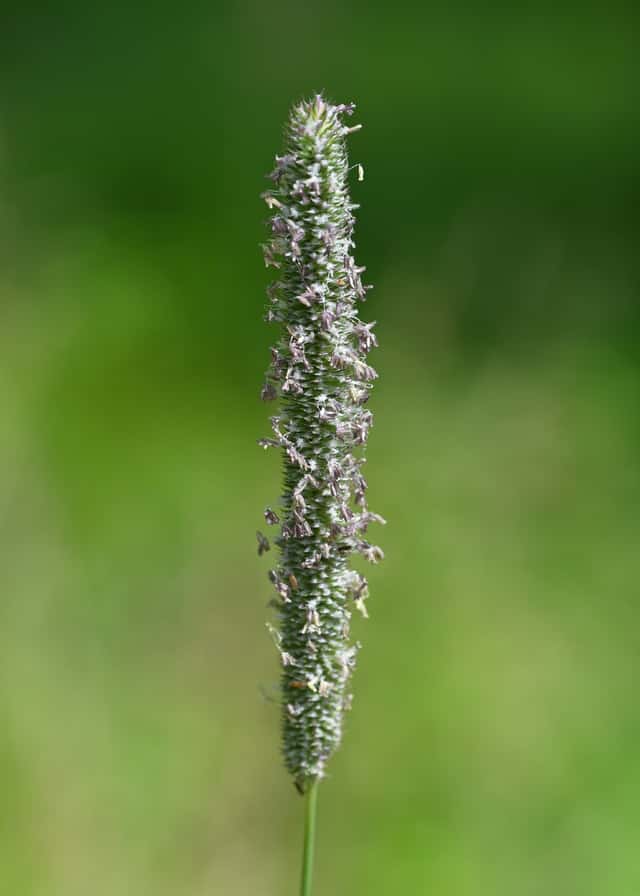
Phleum pratense, commonly known as Timothy-grass or Cat's Tail, is a perennial forage grass belonging to the Poaceae family, native to Europe and temperate Asia, and now naturalized in much of the temperate world. It forms erect clumps up to 100-115 cm tall, with linear leaves and a distinctive compact, cylindrical, greenish-purple inflorescence (a false spike). It is one of the most widely cultivated forage grasses in cool and mountainous regions for hay production and for grazing cattle, horses, sheep, and goats.
How Big Does Timothy-grass Grow?
TLDR: Timothy-grass can reach up to 1.1m tall with Medium growth rate.
Max height
1.1m
Spread
50cm
Growth rate
Medium
Foliage
Deciduous
Plant Uses
Ground Cover
Soil coverage
Medicinal Uses
- No documented traditional medicinal uses; some laboratory studies on extracts have reported preliminary anti-cancer activity, but it is not an established phytotherapeutic application.
Is your plant showing symptoms?
Click on the symptom to discover possible causes:
What Diseases Commonly Affect Timothy-grass?
TLDR: Timothy-grass is susceptible to 6 known diseases. Monitor regularly for early detection.
Rust
Rust is a common fungal disease caused by fungi in the order Pucciniales that affects a wide variety of plants. The disease gets its name from the characteristic orange, yellow, or reddish-brown pustules that appear on leaves, resembling metal rust. This obligate fungal parasite requires living plants to survive and can cause significant economic losses in agricultural crops.
Powdery Mildew
Powdery mildew is a common fungal disease caused by various fungi species including Erysiphe, Podosphaera, Oïdium, and Leveillula. It affects over 10,000 plant species worldwide. The disease thrives in warm, dry climates with high humidity and appears as a distinctive white powdery coating on plant surfaces.
Root Rot
Root rot is a serious fungal disease that affects the root system of plants, causing them to decay and die. It is primarily caused by overwatering, poor drainage, or soil-borne fungi such as Pythium, Phytophthora, Rhizoctonia, and Fusarium. The disease thrives in waterlogged conditions where roots are deprived of oxygen, making them susceptible to fungal infection.
Crown Rot
Crown rot is a serious fungal disease that attacks the crown (base) of the plant where the stem meets the soil. It is caused by various fungal pathogens including Phytophthora, Fusarium, and Rhizoctonia. The disease thrives in waterlogged conditions and can quickly spread to kill the entire plant if not addressed promptly.
Meaning & Symbolism
It has no significant cultural symbolism: it is an agricultural plant, valued primarily for its forage quality in mountain meadows and pastures, lacking documented ornamental or symbolic traditions.
Compare with similar plants
| Attribute | Difficulty | Light | Watering | Pet Safe |
|---|---|---|---|---|
| Field Maple | Easy | Bright indirect | 14d | ✓ |
| Muriel's Bamboo | Medium | Partial shade | 3d | ✓ |
| Silver Birch | Easy | Direct sun | 14d | ✓ |
| Common Blanketflower | Easy | Direct sun | 10d | ✓ |





