Hypericaceae
Aaron's Beard (Hypericum calycinum): Complete Care Guide
Hypericum calycinum
An undemanding, drought-tolerant groundcover once established. Thrives in full sun to fairly deep shade, in almost any well-drained soil. Allow soil to dry between waterings and avoid soggy conditions, which invite root rot. Shear or mow every 2-3 years in late winter to renew growth and keep it tidy.
Every 7 days
Bright indirect
° - °C
% - %
Categories
What is Aaron's Beard?
Aaron's Beard (Hypericum calycinum) is a easy-care plant from the Hypericaceae family. Aaron's Beard (Hypericum calycinum) is a low-growing, semi-evergreen shrub in the St. John's Wort family (Hypericaceae), native to southeastern Europe and Asia Minor. Valued as a tough, spreading groundcover, it forms dense mats 30-60 cm tall via underground stolons and bears large, cup-shaped golde...
Aaron's Beard grows up to 60cm, spread of 60cm, watering every 7 days. It is not suitable for indoor environments and not safe for pets.
Unlike many tropical plants, Aaron's Beard tolerates watering mistakes. Best for beginners. Without precautions, ingestion can cause irritation in pets. Keep out of reach of cats and dogs.
How to Care for Aaron's Beard?
TLDR: Aaron's Beard needs Bright indirect, watering every 7 days, and temperatures between 15-30°C with 40-70% humidity.
How Often Should You Water Aaron's Beard?
Water deeply but infrequently, letting the top of the soil dry out between waterings. Established plants are quite drought tolerant; reduce watering in winter to avoid waterlogged roots.
How Much Light Does Aaron's Beard Need?
Best flowering occurs in full sun, but Aaron's Beard tolerates partial to fairly deep shade better than most flowering shrubs, making it useful under trees.
What Is the Best Soil for Aaron's Beard?
Adapts to nearly any soil type as long as drainage is good; prefers a slightly acidic to neutral pH (5.5-7.0). Avoid waterlogged or heavy clay soils.
What Pot Should You Use for Aaron's Beard?
Primarily grown in the ground as a garden groundcover; if grown in a container, choose a wide, well-draining pot to accommodate its spreading stolons.
What Is Aaron's Beard and Where Does It Come From?
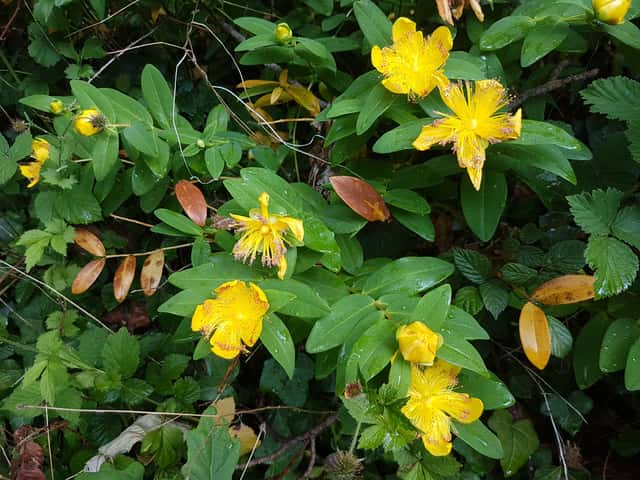
Aaron's Beard (Hypericum calycinum) is a low-growing, semi-evergreen shrub in the St. John's Wort family (Hypericaceae), native to southeastern Europe and Asia Minor. Valued as a tough, spreading groundcover, it forms dense mats 30-60 cm tall via underground stolons and bears large, cup-shaped golden-yellow flowers with prominent bushy stamens from early to late summer.
How to Propagate Aaron's Beard?
Softwood Stem Cuttings
Use clean, sharp tools and keep humidity high with a propagator lid or plastic bag until roots establish.
- 1 Take 8-10 cm softwood cuttings from non-flowering shoots in late summer
- 2 Remove the lower leaves and dip the cut end in rooting hormone
- 3 Insert into a well-draining cutting mix and keep consistently moist
- 4 Place in bright, indirect light until roots form, then pot on or plant out
Materials needed:
Clump Division
Division is the fastest and most reliable way to propagate Aaron's Beard, since it spreads naturally via stolons.
- 1 Dig up an established clump in autumn or early spring
- 2 Separate rooted sections with a spade or by hand, keeping roots and stolons intact
- 3 Replant divisions immediately at the same depth
- 4 Water well until new growth appears
Materials needed:
Seed Sowing
Germination can be slow and uneven; be patient and keep the mix consistently moist but not waterlogged.
- 1 Sow seeds on the surface of a seed-starting mix in spring
- 2 Press seeds lightly into the soil without covering, as they need light to germinate
- 3 Keep moist and at room temperature until germination
- 4 Transplant seedlings once they have several true leaves
Materials needed:
How Big Does Aaron's Beard Grow?
TLDR: Aaron's Beard can reach up to 60cm tall with Fast growth rate.
Max height
60cm
Spread
60cm
Growth rate
Fast
Foliage
Semi-evergreen
Warning: Toxic Plant
This plant can be toxic if ingested. Keep out of reach of:
Plant Uses
Ornamental
Great for decoration
Ground Cover
Soil coverage
Is your plant showing symptoms?
Click on the symptom to discover possible causes:
What Diseases Commonly Affect Aaron's Beard?
TLDR: Aaron's Beard is susceptible to 6 known diseases. Monitor regularly for early detection.
Rust
Rust is a common fungal disease caused by fungi in the order Pucciniales that affects a wide variety of plants. The disease gets its name from the characteristic orange, yellow, or reddish-brown pustules that appear on leaves, resembling metal rust. This obligate fungal parasite requires living plants to survive and can cause significant economic losses in agricultural crops.
Powdery Mildew
Powdery mildew is a common fungal disease caused by various fungi species including Erysiphe, Podosphaera, Oïdium, and Leveillula. It affects over 10,000 plant species worldwide. The disease thrives in warm, dry climates with high humidity and appears as a distinctive white powdery coating on plant surfaces.
Grey Mould
Root Rot
Root rot is a serious fungal disease that affects the root system of plants, causing them to decay and die. It is primarily caused by overwatering, poor drainage, or soil-borne fungi such as Pythium, Phytophthora, Rhizoctonia, and Fusarium. The disease thrives in waterlogged conditions where roots are deprived of oxygen, making them susceptible to fungal infection.
Meaning & Symbolism
Its golden, sun-shaped flowers have long linked St. John's Wort plants to the summer solstice and the feast of St. John, symbolizing light, protection, and the warding off of misfortune.
Fun Facts
Its cheerful, star-shaped yellow flowers give it another common name, Rose of Sharon, though it is unrelated to the shrub Hibiscus syriacus that shares the same nickname.
Aaron's Beard spreads so effectively via underground stolons that it is often used to stabilize slopes and prevent soil erosion.
The genus name Hypericum comes from the Greek 'hyper' (above) and 'eikon' (image), referring to the old custom of hanging the plant above religious icons to ward off evil spirits.
It tolerates deep shade better than almost any other flowering shrub, making it a go-to groundcover for difficult spots under trees.
Frequently asked questions
Is Aaron's Beard invasive?
Is Hypericum calycinum toxic to pets?
Does Aaron's Beard need full sun to flower?
How do I keep Aaron's Beard looking tidy?
Compare with similar plants
| Attribute | Difficulty | Light | Watering | Pet Safe |
|---|---|---|---|---|
| Field Maple | Easy | Bright indirect | 14d | ✓ |
| Silver Birch | Easy | Direct sun | 14d | ✓ |
| Common Blanketflower | Easy | Direct sun | 10d | ✓ |
| Cushion Bush | Easy | Direct sun | 14d | ✓ |
Choose & Compare
Sources & References
- Definitive guide on Hypericum calycinum: care, uses and curiosities
- Hypericum (St. Johnswort)-Rust | PNW Plant Disease Management Handbook
- Toxic and Non-toxic Plants: St. John's Wort | ASPCA
- Hypericum calycinum - Plant Finder | Missouri Botanical Garden
- Hypericum calycinum (Aaron's Beard) | NC State Extension Gardener Plant Toolbox
- Hypericum calycinum | Landscape Plants | Oregon State University





