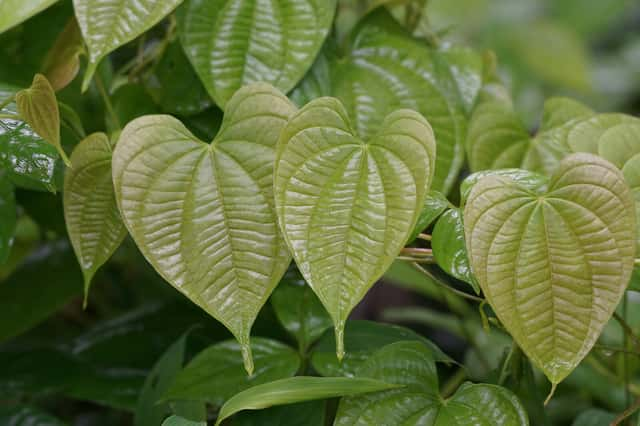
Dioscoreaceae
Air Potato (Dioscorea bulbifera)
Dioscorea bulbifera
A vigorous warm-climate vine: sun or part shade, rich moist soil and a sturdy support. The vines die back in winter and resprout from tubers and bulbils. Only eat bulbils from known edible varieties, always thoroughly cooked; wild forms are toxic.
Every 4 days
Bright indirect
10° - 35°C
50% - 90%
Categories
What is Air Potato?
Air Potato (Dioscorea bulbifera) is a easy-care plant from the Dioscoreaceae family. Air potato (Dioscorea bulbifera) is a perennial twining vine in the yam family, Dioscoreaceae, native to Africa, Asia and northern Australia. Its stems always twine counterclockwise, can top 10 m and may grow about 20 cm a day. The leaves are large and heart-shaped. Potato-like bulbils form in the l...
Air Potato grows up to 10.0m, spread of 50cm, watering every 4 days, 10°C – 35°C, 50–90% humidity. It is not suitable for indoor environments and safe for pets.
Unlike many tropical plants, Air Potato tolerates watering mistakes. Best for beginners. Unlike many popular species, Air Potato is safe to keep around pets.
How to Care for Air Potato?
TLDR: Air Potato needs Bright indirect, watering every 4 days, and temperatures between 10-35°C with 50-90% humidity.
How Often Should You Water Air Potato?
Water every 3–5 days while it is growing, keeping the soil moist but not soggy. Once the vine dies back in winter, water very little.
How Much Light Does Air Potato Need?
Full sun to part shade. More sun means more bulbils.
What Is the Best Soil for Air Potato?
Rich, loamy or sandy soil with plenty of organic matter and good drainage, pH 5.5–7.5.
What Pot Should You Use for Air Potato?
A large, deep pot (40 L or more) with drainage holes and a strong trellis; in the ground, plant beside a fence or arbor.
Care Schedule
Fertilize
Every 30 days
What Is Air Potato and Where Does It Come From?
Air potato (Dioscorea bulbifera) is a perennial twining vine in the yam family, Dioscoreaceae, native to Africa, Asia and northern Australia. Its stems always twine counterclockwise, can top 10 m and may grow about 20 cm a day. The leaves are large and heart-shaped. Potato-like bulbils form in the leaf axils, drop to the ground and sprout into new plants. Selected varieties are grown as food, but wild forms are bitter and toxic, and in places such as Florida it is a listed noxious weed that smothers native vegetation.
How to Propagate Air Potato?
Planting bulbils
Grow only edible varieties, and pick up every fallen bulbil so it does not spread through your yard.
- 1 Collect firm, mature bulbils when they drop from the vine in autumn
- 2 Store them somewhere dry and airy until spring
- 3 Plant 3–5 cm deep in rich soil
- 4 Give the young vine a stake or trellis right away
Materials needed:
Tuber division
Pieces from the top of the tuber sprout fastest.
- 1 Dig up the tuber in late winter
- 2 Cut it into pieces that include part of the crown
- 3 Let the cuts dry for a day
- 4 Plant in moist, well-drained soil
Materials needed:
How Big Does Air Potato Grow?
TLDR: Air Potato can reach up to 10.0m tall with Fast growth rate.
Max height
10.0m
Spread
50cm
Growth rate
Fast
Foliage
Deciduous
Warning: Toxic Plant
This plant can be toxic if ingested. Keep out of reach of:
Plant Uses
Edible
Can be consumed
Medicinal
Medicinal properties
Medicinal Uses
- Used in traditional Chinese and African medicine for goiter, wounds, boils and inflammation
- Contains diosbulbins, which can damage the liver and kidneys; do not use medicinally without professional advice
Culinary Uses
- Bulbils of edible varieties, peeled and thoroughly cooked: boiled, baked or fried like potatoes
- Never eat raw, and never eat bitter wild forms
Is your plant showing symptoms?
Click on the symptom to discover possible causes:
What Diseases Commonly Affect Air Potato?
TLDR: Air Potato is susceptible to 4 known diseases. Monitor regularly for early detection.
Anthracnose
Anthracnose is a fungal disease caused by fungi in the genus Colletotrichum that affects many plants, including vegetables, fruits, and trees. The disease thrives in cool, wet conditions, causing dark, sunken lesions on leaves, stems, flowers, and fruits.
Leaf Spot
Leaf spot is a common fungal disease caused by various pathogens including Alternaria, Ascochyta, Colletotrichum, Septoria, and Venturia. It primarily affects leaves, causing discolored spots that can lead to premature leaf drop if left untreated.
Root-Knot Nematodes
Root-knot nematodes (Meloidogyne species) are microscopic roundworms that parasitize plant roots, causing characteristic galls or knots. These soil-borne pests are among the most economically damaging plant pathogens worldwide, affecting a wide range of ornamental and edible plants. The nematodes inject enzymes into root cells, causing abnormal swelling and disrupting water and nutrient uptake.
Scale Insects
Scale insects are small sap-sucking pests that appear as brown, shell-like bumps on plant stems and leaves. There are over 25 species, divided into armored (hard) and unarmored (soft) scales. They feed by piercing plant tissue and extracting sap, which weakens the plant and can lead to yellowing, stunted growth, and even death if left untreated. They also excrete honeydew, which attracts ants and promotes sooty mold growth.
Fun Facts
It can grow about 20 cm in a single day
It always twines counterclockwise, unlike the winged yam (Dioscorea alata)
Florida released an Asian leaf beetle in 2012 to control invasive air potato
Frequently asked questions
Is air potato poisonous?
How do I plant air potato?
Why did my vine die in winter?
Is it invasive?
Compare with similar plants
| Attribute | Difficulty | Light | Watering | Pet Safe |
|---|---|---|---|---|
| Field Maple | Easy | Bright indirect | 14d | ✓ |
| Iberian Houseleek | Easy | Direct sun | 14d | ✓ |
| Silver Birch | Easy | Direct sun | 14d | ✓ |
| Common Blanketflower | Easy | Direct sun | 10d | ✓ |





