Pinaceae
Aleppo pine: Aromatic Plant
Pinus halepensis
The Aleppo pine requires very little maintenance once established. It needs a full sun location and perfectly drained soil, preferably sandy or limestone; it cannot tolerate standing water. Watering is only truly necessary during the first year while the tree takes root; after that, it relies on natural rainfall, even during dry summers. No severe pruning is required, only the removal of dead branches to maintain the tree's natural shape.
Every 14 days
Direct sun
-12° - 40°C
% - %
Categories
What is Aleppo pine?
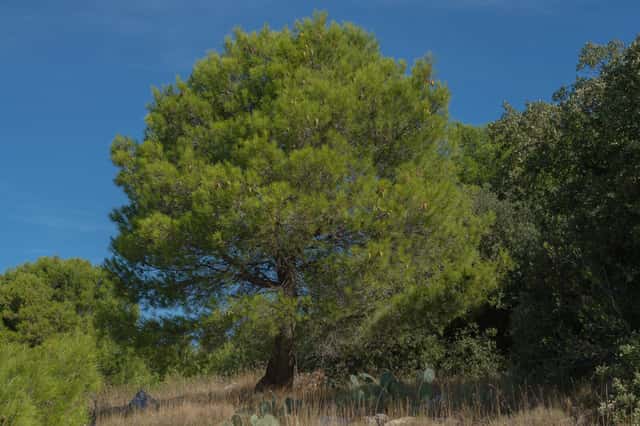
Aleppo pine (Pinus halepensis) is a easy-care plant from the Pinaceae family. The Aleppo pine is an evergreen Mediterranean conifer, recognizable by its often twisted and irregular habit, its fissured grayish bark, and its long, thin needles grouped in pairs of a pale, slightly bluish green. Native to the Mediterranean basin, it grows equally well on sandy coastal dunes as on...
Aleppo pine grows up to 20.0m, spread of 1000cm, watering every 14 days, -12°C – 40°C. It is not suitable for indoor environments and safe for pets.
Unlike many tropical plants, Aleppo pine tolerates watering mistakes. Best for beginners. Unlike many popular species, Aleppo pine is safe to keep around pets.
How to Care for Aleppo pine?
TLDR: Aleppo pine needs Direct sun, watering every 14 days, and temperatures between -12-40°C with 40-70% humidity.
How Often Should You Water Aleppo pine?
Water regularly, approximately every 15 days, only during the first year after planting to encourage root establishment. After this period, the Aleppo pine manages on its own thanks to its high drought tolerance: avoid any additional watering, as excess water is more dangerous for it than a lack of it.
How Much Light Does Aleppo pine Need?
Requires full sun exposure, with a minimum of 6 to 8 hours of direct light per day. It is one of the most light-demanding conifers: it tolerates neither shade nor prolonged partial shade, which weaken its growth.
What Is the Best Soil for Aleppo pine?
Prefers light, sandy to stony soils, including limestone and nutrient-poor soils, provided they are perfectly draining. The pH can range from slightly acidic to frankly alkaline. The main risk is root asphyxiation in heavy or waterlogged soil, which promotes root rot.
What Pot Should You Use for Aleppo pine?
In a pot (for young specimens or container cultivation), choose a wide and deep unglazed terracotta container to allow the roots to breathe, with large drainage holes and a layer of gravel at the bottom. The substrate must remain sandy and well-draining; ultimately, this species is best suited for planting in the ground.
Care Schedule
Fertilize
Every 365 days
What Is Aleppo pine and Where Does It Come From?
The Aleppo pine is an evergreen Mediterranean conifer, recognizable by its often twisted and irregular habit, its fissured grayish bark, and its long, thin needles grouped in pairs of a pale, slightly bluish green. Native to the Mediterranean basin, it grows equally well on sandy coastal dunes as on the most arid rocky and limestone slopes, where it can reach 15 to 25 meters in height. Extremely resistant to heat, wind, and drought once established, it plays a major ecological role in soil stabilization and Mediterranean reforestation.
How to Propagate Aleppo pine?
Seed sowing
- Never allow the substrate to become waterlogged: root suffocation is the primary cause of sowing failure.
- Choose the final location from the start if possible, as recovery after transplantation is delicate once the tree reaches a certain age.
- 1 Stratification
Place the seeds in the cold (stratification at about 4 degrees Celsius) for 6 weeks to break dormancy and improve germination.
- 2 Sowing
Sow each seed in an individual pot filled with a well-draining sandy substrate, under a cold frame, as soon as the seed is ripe or in late winter.
- 3 Early transplanting
Transplant young plants to their final location early, between 30 and 90 cm in height, because the Aleppo pine develops a taproot that does not tolerate late transplantation well.
Materials needed:
How Big Does Aleppo pine Grow?
TLDR: Aleppo pine can reach up to 20.0m tall with Medium growth rate.
Max height
20.0m
Spread
10.0m
Growth rate
Medium
Foliage
Evergreen
Plant Uses
Ornamental
Great for decoration
Aromatic
Pleasant fragrance
Medicinal
Medicinal properties
Edible
Can be consumed
Medicinal Uses
- Resin and turpentine with antiseptic, diuretic, and vermifuge properties
- Traditional external use against rheumatic and skin conditions
- Inhalation of resin to clear the respiratory tract
Culinary Uses
- Resin used as a chewing gum
- Flavoring agent for resinated wines (such as retsina)
Is your plant showing symptoms?
Click on the symptom to discover possible causes:
What Diseases Commonly Affect Aleppo pine?
TLDR: Aleppo pine is susceptible to 9 known diseases. Monitor regularly for early detection.
Root Rot
Root rot is a serious fungal disease that affects the root system of plants, causing them to decay and die. It is primarily caused by overwatering, poor drainage, or soil-borne fungi such as Pythium, Phytophthora, Rhizoctonia, and Fusarium. The disease thrives in waterlogged conditions where roots are deprived of oxygen, making them susceptible to fungal infection.
Canker
Canker is a disease caused by various fungi and bacteria that create necrotic, sunken areas on bark of branches, stems, and trunks. Pathogens enter through wounds and natural openings, especially when plants are stressed. Canker can gradually weaken or kill branches by disrupting water and nutrient flow.
Powdery Mildew
Powdery mildew is a common fungal disease caused by various fungi species including Erysiphe, Podosphaera, Oïdium, and Leveillula. It affects over 10,000 plant species worldwide. The disease thrives in warm, dry climates with high humidity and appears as a distinctive white powdery coating on plant surfaces.
Leaf Spot
Leaf spot is a common fungal disease caused by various pathogens including Alternaria, Ascochyta, Colletotrichum, Septoria, and Venturia. It primarily affects leaves, causing discolored spots that can lead to premature leaf drop if left untreated.
Meaning & Symbolism
The evergreen pine has been a symbol of longevity, quiet strength, and immortality since antiquity. Its ability to withstand wind, drought, and poor soils makes it an emblem of resilience and continuity in the face of adversity in the Mediterranean.
Compare with similar plants
| Attribute | Difficulty | Light | Watering | Pet Safe |
|---|---|---|---|---|
| Field Maple | Easy | Bright indirect | 14d | ✓ |
| Silver Birch | Easy | Direct sun | 14d | ✓ |
| Common Blanketflower | Easy | Direct sun | 10d | ✓ |
| Cushion Bush | Easy | Direct sun | 14d | ✓ |
Choose & Compare
Sources & References
- Pinus halepensis - PFAF Plant Database
- Aleppo Pine Tree Care - Gardening Know How
- Pin d Alep (Pinus halepensis) : taille, bouturage, entretien
- Pin d Alep ou pinus halepensis, fiche technique complete
- Aleppo Pine Plant Care & Growing Basics - PlantIn
- Aleppo pine (Pinus halepensis) Care Guide - Forward Plant





