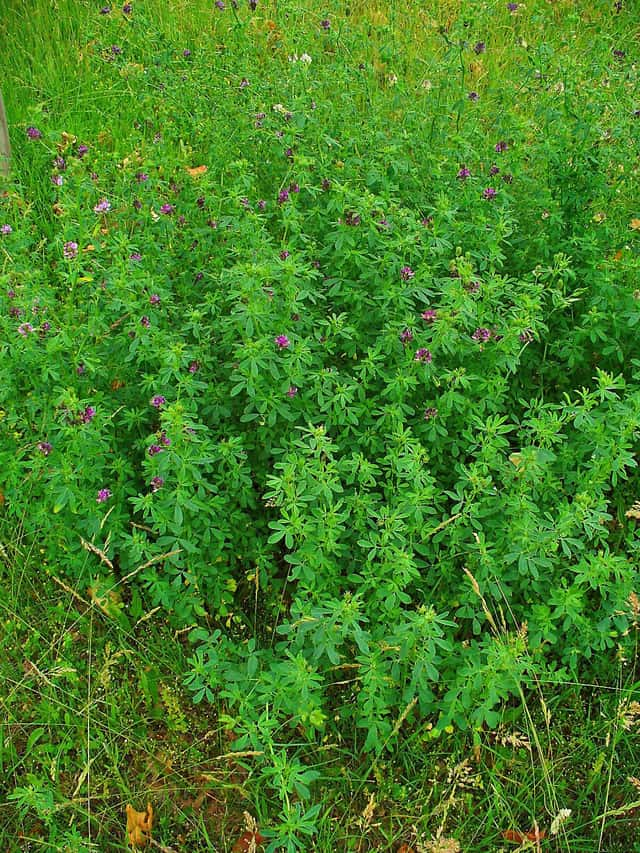
Fabaceae
Alfalfa: How to Grow and Care for Medicago sativa
Medicago sativa
Easy and low-maintenance: full sun, deep well-drained soil near neutral pH and moderate watering. Avoid wet, heavy or acidic ground. Cut it back when it starts to bloom and leave the cuttings as mulch or use them as feed.
Every 7 days
Direct sun
-40° - °C
% - %
Categories
What is Alfalfa?
Alfalfa (Medicago sativa) is a easy-care plant from the Fabaceae family. Alfalfa (Medicago sativa) is a perennial legume from south-central Asia, grown worldwide as hay and pasture for livestock and as a soil-building cover crop. It forms upright, bushy clumps 60-90 cm tall with three-part clover-like leaves, clusters of small purple flowers (sometimes blue, yellow or cr...
Alfalfa grows up to 90cm, spread of 100cm, watering every 7 days. It is not suitable for indoor environments and safe for pets.
Unlike many tropical plants, Alfalfa tolerates watering mistakes. Best for beginners. Unlike many popular species, Alfalfa is safe to keep around pets.
How to Care for Alfalfa?
TLDR: Alfalfa needs Direct sun, watering every 7 days, and temperatures between -40-30°C with 40-70% humidity.
How Often Should You Water Alfalfa?
Water deeply about once a week while it establishes, then only in long dry spells; mature plants are drought tolerant thanks to the deep taproot. Never let the soil stay soggy, and water at ground level so the leaves stay dry. No watering is needed while it is dormant in winter.
How Much Light Does Alfalfa Need?
Give it full sun, at least 6-8 hours a day. It also grows in light part shade, but with fewer stems and flowers.
What Is the Best Soil for Alfalfa?
Deep, well-drained loam with a pH of about 6.5-7.5. Lime acidic soil before sowing. It does not tolerate waterlogged soil or flooding.
What Pot Should You Use for Alfalfa?
Best grown in the ground. If you want it in a container, use a deep pot (at least 30 cm) with drainage holes to fit the long taproot.
What Is Alfalfa and Where Does It Come From?
Alfalfa (Medicago sativa) is a perennial legume from south-central Asia, grown worldwide as hay and pasture for livestock and as a soil-building cover crop. It forms upright, bushy clumps 60-90 cm tall with three-part clover-like leaves, clusters of small purple flowers (sometimes blue, yellow or cream) in summer and spiral seed pods. A deep taproot and nitrogen-fixing root nodules make it very drought tolerant and good for the soil.
How to Propagate Alfalfa?
Direct sowing
In warm climates, sow in late summer or autumn instead. Do not sow where alfalfa or another legume has just been grown.
- 1 Prepare a sunny bed after the last frost, removing weeds and loosening the soil.
- 2 Scatter the seed thinly over the surface.
- 3 Rake lightly to cover the seed with a thin layer of soil.
- 4 Keep the soil moist until seedlings appear, then water less often.
Materials needed:
How Big Does Alfalfa Grow?
TLDR: Alfalfa can reach up to 90cm tall with Fast growth rate.
Max height
90cm
Spread
1.0m
Growth rate
Fast
Foliage
Deciduous
Plant Uses
Edible
Can be consumed
Culinary Uses
- Sprouted seeds eaten raw in salads and sandwiches
- Young leaves and the purple flowers can be added to salads
Is your plant showing symptoms?
Click on the symptom to discover possible causes:
What Diseases Commonly Affect Alfalfa?
TLDR: Alfalfa is susceptible to 9 known diseases. Monitor regularly for early detection.
Aphids
Aphids are small, soft-bodied, pear-shaped insects (1/16 to 1/8 inch long) that feed by sucking nutrient-rich sap from plants. They reproduce rapidly and can quickly weaken plants, causing distorted growth and transmitting plant viruses. Aphids come in various colors including green, black, red, yellow, brown, and gray. They secrete honeydew, a sticky substance that attracts ants and encourages sooty mold growth.
Curculionidae
Curculionidae (weevils) are small beetles that feed on plants. Adults chew leaf margins, leaving crescent-shaped notches, primarily at night. The larvae live in the substrate and consume roots, causing decline, yellowing, and wilting even when the substrate is moist, and in severe cases, plant death. They frequently affect ornamentals and garden plants such as strawberries, citrus, roses, hydrangeas, azaleas, blueberries, begonias, and many potted plants.
Bacterial Wilt
Bacterial wilt is a fatal vascular disease caused by bacteria (Erwinia tracheiphila, Ralstonia solanacearum, Xanthomonas spp.) that infects the water-conducting tissue of plants. The bacteria multiply and block the flow of water and nutrients, causing rapid wilting and plant death within 1-2 weeks.
Verticillium Wilt
Verticillium wilt is a soil-borne fungal disease caused primarily by the fungi Verticillium dahliae and V. albo-atrum. These pathogens infect plant roots and grow within the vascular tissues, blocking water and nutrient transport, resulting in wilting and eventual plant death. The disease affects over 350 plant species including vegetables, fruits, ornamental flowers, and trees. The fungi can survive in soil for more than 10 years as resistant structures called microsclerotia.
Fun Facts
Its roots commonly reach 3-5 m deep, which is why it survives drought so well.
According to Pliny, alfalfa reached Greece around 490 BC with the Persian invasion.
The alfalfa leafcutter bee is managed specifically to pollinate alfalfa seed crops.
Frequently asked questions
How often should I water alfalfa?
When should I cut alfalfa?
Is alfalfa safe to eat?
Does alfalfa need fertilizer?
Compare with similar plants
| Attribute | Difficulty | Light | Watering | Pet Safe |
|---|---|---|---|---|
| Field Maple | Easy | Bright indirect | 14d | ✓ |
| Iberian Houseleek | Easy | Direct sun | 14d | ✓ |
| Silver Birch | Easy | Direct sun | 14d | ✓ |
| Common Blanketflower | Easy | Direct sun | 10d | ✓ |





