Droseraceae
Alice sundew (Drosera aliciae)
Drosera aliciae
Give it plenty of light, with shade from hot midday sun. Through the growing season, stand the pot in a saucer with about 1 cm of rainwater, distilled or reverse osmosis water. Never use tap water or fertiliser. In winter keep it just moist, out of standing water, and above 10 °C.
Every 3 days
Bright indirect
10° - 29°C
50% - 80%
Categories
What is Alice sundew?
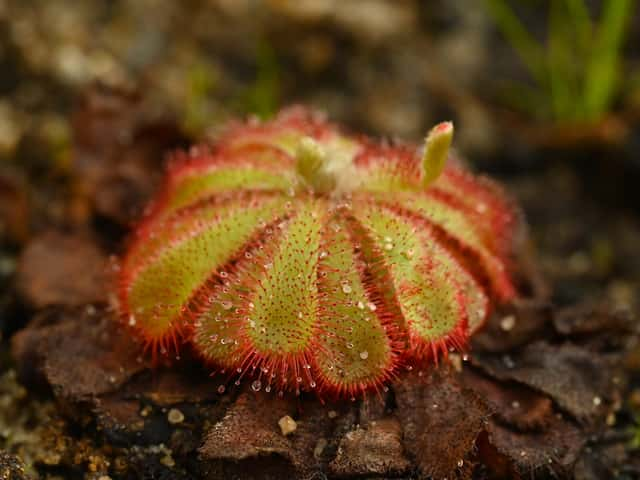
Alice sundew (Drosera aliciae) is a easy-care plant from the Droseraceae family. A small carnivorous plant from the Cape region of South Africa and one of the most widely grown sundews. It forms a low rosette about 5 cm across, with spoon-shaped leaves covered in red hairs, each tipped with a sticky drop. The drops trap gnats and other small insects, which the leaf then digests....
Alice sundew grows up to 4cm, spread of 5cm, watering every 3 days, 10°C – 29°C, 50–80% humidity. It is suitable for indoor environments and safe for pets.
Unlike many tropical plants, Alice sundew tolerates watering mistakes. Best for beginners. Unlike many popular species, Alice sundew is safe to keep around pets. Without adequate drainage, root rot can develop within 7 days.
How to Care for Alice sundew?
TLDR: Alice sundew needs Bright indirect, watering every 3 days, and temperatures between 10-29°C with 50-80% humidity.
How Often Should You Water Alice sundew?
Use only rainwater, distilled or reverse osmosis water. In the growing season, keep the pot in a saucer with about 1 cm of water and top it up when it dries. In winter, take it out of the saucer and keep the mix just moist.
How Much Light Does Alice sundew Need?
A very bright window or morning sun. If the plant is green with no dew, it needs more light. In summer, shield it from the hottest midday sun.
What Is the Best Soil for Alice sundew?
A lean, acidic half-and-half mix of peat or sphagnum moss with perlite or washed sand. No ordinary potting soil or fertilised compost.
What Pot Should You Use for Alice sundew?
A plastic pot with drainage holes standing in a saucer of water. Avoid terracotta, which builds up salts.
What Is Alice sundew and Where Does It Come From?
A small carnivorous plant from the Cape region of South Africa and one of the most widely grown sundews. It forms a low rosette about 5 cm across, with spoon-shaped leaves covered in red hairs, each tipped with a sticky drop. The drops trap gnats and other small insects, which the leaf then digests. The more light it gets, the redder it turns. In summer it sends up thin stalks 30 to 40 cm tall with pink flowers, held well away from the leaves so pollinators don't get caught.
How to Propagate Alice sundew?
Leaf cutting
Water only with rainwater or distilled water. Remove the cover gradually as the plantlets grow.
- 1 Cut off a whole healthy leaf during the growing season
- 2 Lay it flat on very damp sphagnum or peat
- 3 Cover the pot with clear plastic to keep humidity in
- 4 Keep it bright but out of direct sun until plantlets appear
Materials needed:
Seed
The seed is tiny: scatter it on the surface, don't bury it.
- 1 Sow as soon as the seed is ripe, because it loses viability quickly
- 2 Scatter it on damp peat without covering
- 3 Stand the pot in a saucer of pure water
- 4 Keep it bright and humid until it sprouts
Materials needed:
How Big Does Alice sundew Grow?
TLDR: Alice sundew can reach up to 4cm tall with Medium growth rate.
Max height
4cm
Spread
5cm
Foliage
Evergreen
Plant Uses
Ornamental
Great for decoration
Is your plant showing symptoms?
Click on the symptom to discover possible causes:
What Diseases Commonly Affect Alice sundew?
TLDR: Alice sundew is susceptible to 6 known diseases. Monitor regularly for early detection.
Aphids
Aphids are small, soft-bodied, pear-shaped insects (1/16 to 1/8 inch long) that feed by sucking nutrient-rich sap from plants. They reproduce rapidly and can quickly weaken plants, causing distorted growth and transmitting plant viruses. Aphids come in various colors including green, black, red, yellow, brown, and gray. They secrete honeydew, a sticky substance that attracts ants and encourages sooty mold growth.
Salt Buildup
Salt buildup (also called salt accumulation or fertilizer salt deposits) is an environmental condition where mineral salts accumulate in the soil over time, creating a toxic environment for plant roots. The most visible sign is a white or yellowish crusty layer on the soil surface or around pot edges.
Lack of Light
Lack of light, also known as etiolation, is an environmental condition that occurs when a plant does not receive adequate light for normal photosynthesis and growth. Without sufficient light, the plant cannot produce enough chlorophyll, leading to pale coloration, weakened tissues, and abnormal elongation as the plant stretches toward any available light source. Etiolation affects virtually all plant species, from sun-loving tropicals to shade-tolerant houseplants. While the condition is not contagious, it progressively weakens the plant over time, making it more susceptible to pests, disease, and physical damage. Prompt correction of lighting conditions is essential to reverse the effects and restore healthy growth.
Spider Mites
Spider mites are tiny arachnids (less than 1/20 inch long) related to spiders and ticks that feed on plant sap. They thrive in hot, dry conditions and can cause significant damage to ornamental and vegetable plants. During severe infestations, crop losses can reach 14% or higher as these pests disrupt vital plant processes including photosynthesis, carbon dioxide absorption, and transpiration.
Fun Facts
The flowers sit on stalks 30 to 40 cm tall, well away from the sticky leaves, so pollinating insects don't get trapped.
The red colour of the tentacles comes from pigments that deepen in strong light.
It is named after Dr Alice Rasse, who encouraged botanist Raymond Hamet to study sundews. He described the species in 1905.
Frequently asked questions
Can I water Drosera aliciae with tap water?
Do I need to feed it insects?
Why has it turned green with no sticky drops?
Should I fertilise it?
Compare with similar plants
| Attribute | Difficulty | Light | Watering | Pet Safe |
|---|---|---|---|---|
| Field Maple | Easy | Bright indirect | 14d | ✓ |
| Iberian Houseleek | Easy | Direct sun | 14d | ✓ |
| Silver Birch | Easy | Direct sun | 14d | ✓ |
| Common Blanketflower | Easy | Direct sun | 10d | ✓ |





